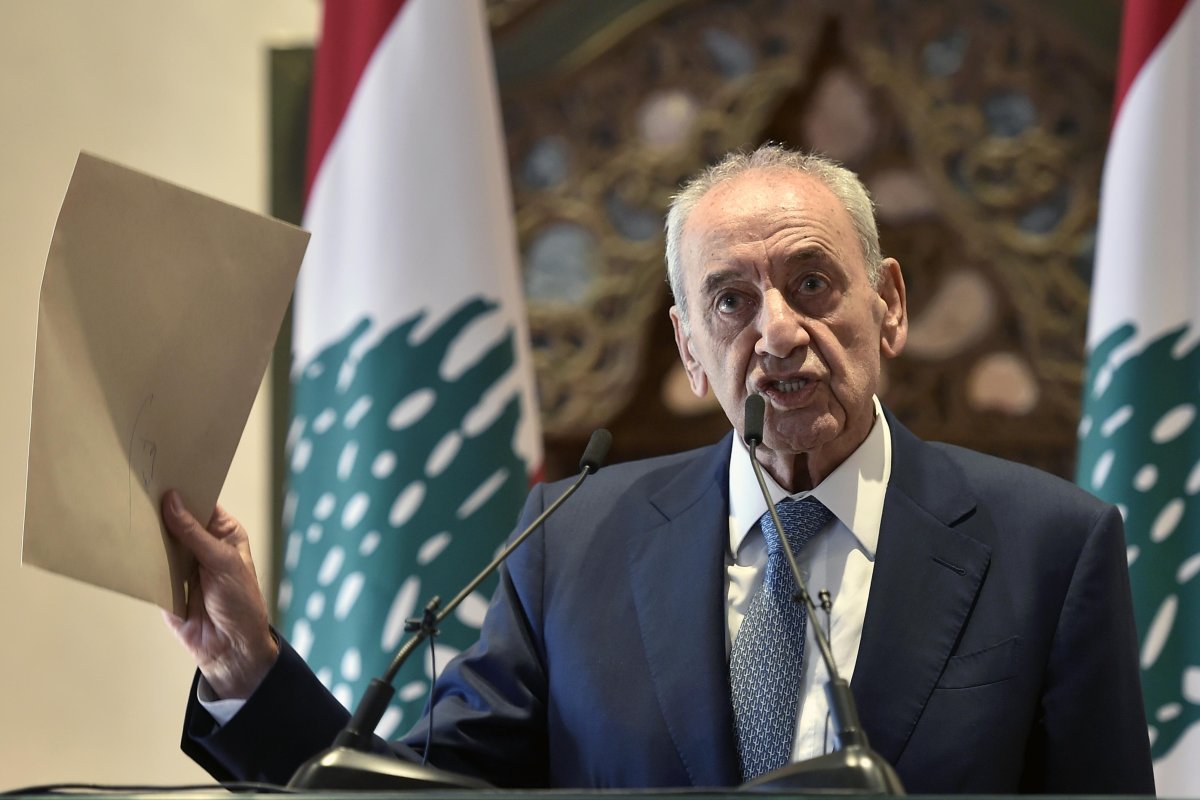
Lebanese Parliament Speaker Nabih Berri speaks during a news conference in Beirut, Lebanon, in 2020. He said Monday that Lebanon is facing “existential risks.” Photo by Wael Hamzeh/EPA-EFE
BEIRUT, Lebanon, Aug. 31 (UPI) — Lebanese Parliament Speaker Nabih Berri said on Monday that Lebanon is facing “existential risks,” arguing that Israel’s objective is not simply to disarm Hezbollah but to stir up sectarian strife in the country.
Berri, who heads the Shiite Amal Movement and is a close ally of Hezbollah, reiterated his rejection of direct talks with Israel initiated by Lebanese President Joseph Aoun, as well as the June 26 U.S.-brokered framework agreement aimed at ending the Israel-Hezbollah war.
He also rejected any Israeli security zone in southern Lebanon, “any secret annexes,” and any relinquishing of Lebanon’s right to pursue legal action against Israel.
“Believe me, what Israel is seeking is not Hezbollah, its weapons, the Amal Movement, or the Shiite community. What Israel is seeking is sectarian strife,” he said in a televised speech marking the 48th anniversary of the disappearance of Imam Musa al-Sadr, a Lebanese Shiite cleric and political leader.
Al-Sadr disappeared along with two companions in August 1978 while on an official visit to Libya. The circumstances surrounding his disappearance remain unresolved.
Berri argued that Israel is targeting Lebanon’s unity and civil peace because the country represents “the antithesis of Israel’s racism,” warning that Lebanon — and the South in particular — is currently facing “existential risks.”
In a reference to President Aoun, he said that the current circumstances “give no one the right to make decisions affecting Lebanon’s sovereignty under any pretext,” citing the framework agreement and “secret annexes,” or to undermine UN resolutions that safeguard Lebanon’s sovereign rights over its entire territory.
Aoun opted for direct talks with Israel as the only viable path to ending the war, despite Hezbollah’s staunch opposition, in an effort to bring the decades-long conflict to a definitive close.
At the core of the framework agreement was the complete disarmament of Hezbollah, a firm Israeli condition — strongly rejected by the Iran-backed militant group — for halting its attacks and withdrawing from parts of southern Lebanon it has occupied since the war began on October 8, 2023.
On that day, Hezbollah opened a support front for Gaza. It resumed limited attacks against Israel on March 2, 2026, in solidarity with Iran, after which Israel launched a much broader military campaign in Lebanon.
Israel’s intensive military campaign has killed 8,915 people and wounded 30,543 since October 8, 2023, including 4,352 killed and 12,318 wounded since last March, according to Lebanon’s Health Ministry. It has caused massive destruction to property and infrastructure, with some 70 border villages in southern Lebanon reduced to rubble and rendered uninhabitable.
Berri rejected turning southern Lebanon into a “buffer zone or security belt” for Israel, “regardless of the sacrifices,” stressing that residents of southern Lebanon have been victims of Israel’s aggression since its establishment in 1948.
He strongly rejected a clause in the framework agreement that would “suspend” Lebanon’s right to pursue legal action against Israel over what he described as “genocidal crimes” committed against residents of southern Lebanon and their properties.
He cited the complete destruction of villages and cities, historic and heritage sites, the alleged use of internationally prohibited weapons, as well as attacks on religious symbols and sites.
A member of the Lebanese negotiating team recently told UPI that Israel threatened during the talks to take legal action against Lebanon for “harboring a terrorist organization,” referring to Hezbollah, if Beirut refused to accept the inclusion of the clause.
Relinquishing this right, Berri said, would amount to relinquishing sovereignty. “It is a national sovereign right that no one has the authority to give up, whether during negotiations, through prescription, or with the passage of time.”
He renewed his warning about the dangers of engaging in direct talks with Israel, saying: “Seven rounds of negotiations … what was the result? The area under occupation expanded, the scale of destruction increased, the death toll rose, and Israel continues its war.”
He emphasized that civil peace, national unity, and the Lebanese Army are “red lines that must not be crossed,” dismissing calls for “federalism or partition” that threaten Lebanon’s existence and territorial unity.
“Nothing is more precious than Lebanon. Do not squander it in internal conflicts, divisions, or deadly political or security missteps,” Berri said.
About the Author