Canada is the second-largest country on earth by total area, yet somehow it manages to pack wildly different worlds into a single national border. You can stand beside a glacial lake in the Rockies in the morning and eat fresh Atlantic lobster by a harbour boardwalk a flight later. That contrast is part of what makes narrowing down the most beautiful cities so genuinely difficult.
Tourism in Canada generated $129.7 billion in revenues in 2024 and contributed $50.8 billion to the country’s GDP, making it one of the fastest-growing sectors that year. The cities driving much of that interest aren’t just convenient stops. They are destinations in their own right, consistently voted and revisited by travellers who know what they’re comparing them to. Here are the seven that keep rising to the top.
1. Quebec City, Quebec: The Most European Corner of North America
1. Quebec City, Quebec: The Most European Corner of North America (Image Credits: Unsplash)
There is a reason Quebec City has appeared on the same best-of lists year after year without wavering. It topped traveller rankings for the tenth consecutive time, with readers citing the French architecture, winding streets, food and shopping, the historic atmosphere of Vieux-Quebec, and the UNESCO World Heritage-listed old town as the core reasons for its enduring appeal.
Advertisement
Advertisement
A visit to Quebec City could be a genuine alternative to a trip to Europe. This charming destination on the St. Lawrence River draws visitors in with its centuries-old stone buildings that make up Old Quebec, a UNESCO World Heritage Site, while aromas of freshly baked bread and brewing espresso fill the cobblestone streets of the Quartier Petit-Champlain with the essence of Paris. Some travellers go in summer for the festival atmosphere. Others insist winter is the only way to truly see it.
2. Vancouver, British Columbia: Mountains, Ocean, and Everything Between
2. Vancouver, British Columbia: Mountains, Ocean, and Everything Between (a.canvas.of.light, Flickr, CC BY 2.0)
There is a reason Vancouver consistently tops global rankings. Its breathtaking setting between mountains and the Pacific Ocean earns it top scores across categories covering culture and environment alike. In Condé Nast Traveler’s 2024 Readers’ Choice Awards, Vancouver claimed the number-six spot among the best big cities in the world.
Vancouver was founded as “Gastown” by an Englishman with a penchant for beer and storytelling. Today, Gastown remains a historic section of the city, and its forests, grand parks, and impressive suspension bridge continue to beckon travellers alongside the city’s shops and museums. Stanley Park alone covers over 400 hectares of urban forest right beside the downtown skyline, which is a combination few cities on the planet can match.
3. Victoria, British Columbia: The World’s Best Small City, Three Years Running
3. Victoria, British Columbia: The World’s Best Small City, Three Years Running (Image Credits: Pixabay)
Victoria was voted the number one small city in the world by Condé Nast Traveler readers three years in a row, in 2023, 2024, and 2025. The city offers world-class museums, 125-year-old heritage buildings, and diverse marine wildlife along its coast. That kind of sustained recognition from global readers is rare and says something very specific about what Victoria delivers.
Advertisement
Advertisement
British Columbia’s capital is renowned for its natural beauty, oceanfront living, mild climate, and relaxed pace, reachable by a scenic 90-minute ferry ride from Vancouver. Named after Queen Victoria, the city pairs cosmopolitan sophistication with laid-back West Coast tranquility. The famous Butchart Gardens alone offer over 55 acres of meticulously landscaped grounds, designed to bloom throughout all seasons. The numbers back the hype, too: the city welcomed over one million cruise passengers during the 2025 season alone.
4. Montreal, Quebec: Culture, Food, and a Pulse That Never Quite Stops
4. Montreal, Quebec: Culture, Food, and a Pulse That Never Quite Stops (Image Credits: Unsplash)
In Condé Nast Traveler’s 2024 Readers’ Choice Awards, Montreal landed at number nine among the world’s best big cities, a significant jump after missing the list entirely the previous year. Montreal blends French and English cultures, offering vibrant festivals, incredible food, and European-style architecture in a way that feels organic rather than performed.
Quebec’s biggest and most cosmopolitan city is perhaps best known for its picturesque Old Montreal neighbourhood, with its quaint cobblestone streets and Gothic Revival cathedral. The city’s underground pedestrian network, the largest of its kind in the world, stretches for roughly 33 kilometres, connecting visitors to shops, restaurants, and galleries even in the depths of a Quebec winter. It’s an urban ecosystem that genuinely rewards slow exploration.
5. Banff, Alberta: Where the Landscape Does All the Talking
5. Banff, Alberta: Where the Landscape Does All the Talking (functoruser, Flickr, CC BY 2.0)
Canada’s oldest national park, Banff was established in 1885 and is famous for its impressive glaciers, deep blue lakes, and steaming hot springs. It is also, without question, one of the most photographed places on the entire planet. Technically a town rather than a city, Banff punches far above its weight class in the beauty stakes, and no list shaped by traveller rankings can ignore it.
Advertisement
Advertisement
Soaring mountains, jewel-colored lakes, and pristine wilderness await in Canada’s first National Park. The irresistible beauty of the landscape invites travellers to immerse themselves in the outdoors year-round, whether hiking through untouched forests and paddling turquoise lakes in summer, or skiing the slopes and soaking in steamy hot springs during winter. Travellers also enjoy the warm hospitality of Banff and Lake Louise, the region’s charming mountain townships. Tourism in Alberta saw 38.1 million visits generating $14.4 billion in revenue in 2024, and the number of domestic visits to the Alberta Rockies alone reached approximately 5.5 million that same year.
6. Halifax, Nova Scotia: Atlantic Canada’s Most Compelling Port City
6. Halifax, Nova Scotia: Atlantic Canada’s Most Compelling Port City (Image Credits: Unsplash)
Halifax owes its existence largely to its location on one of the largest and deepest ice-free natural harbours in the world, which over time made it one of the most important Canadian commercial ports on the Atlantic seaboard. That harbour is still its defining feature, shaping the skyline, the food culture, and the daily rhythm of life in ways that are immediately visible to any visitor.
Halifax is a historic port city, and the harbour still shapes daily life. The Halifax Waterfront boardwalk stretches nearly four kilometres along the water, ranking among the longest urban boardwalks in the world. The boardwalk is also home to the Maritime Museum of the Atlantic, which holds an extensive Titanic collection, since Halifax was the closest major port to the 1912 sinking and sent recovery ships to the scene. Nova Scotia received over 2 million visitors, generating approximately $3.5 billion in revenue in 2024, with a significant portion of that drawn to Halifax and its iconic waterfront.
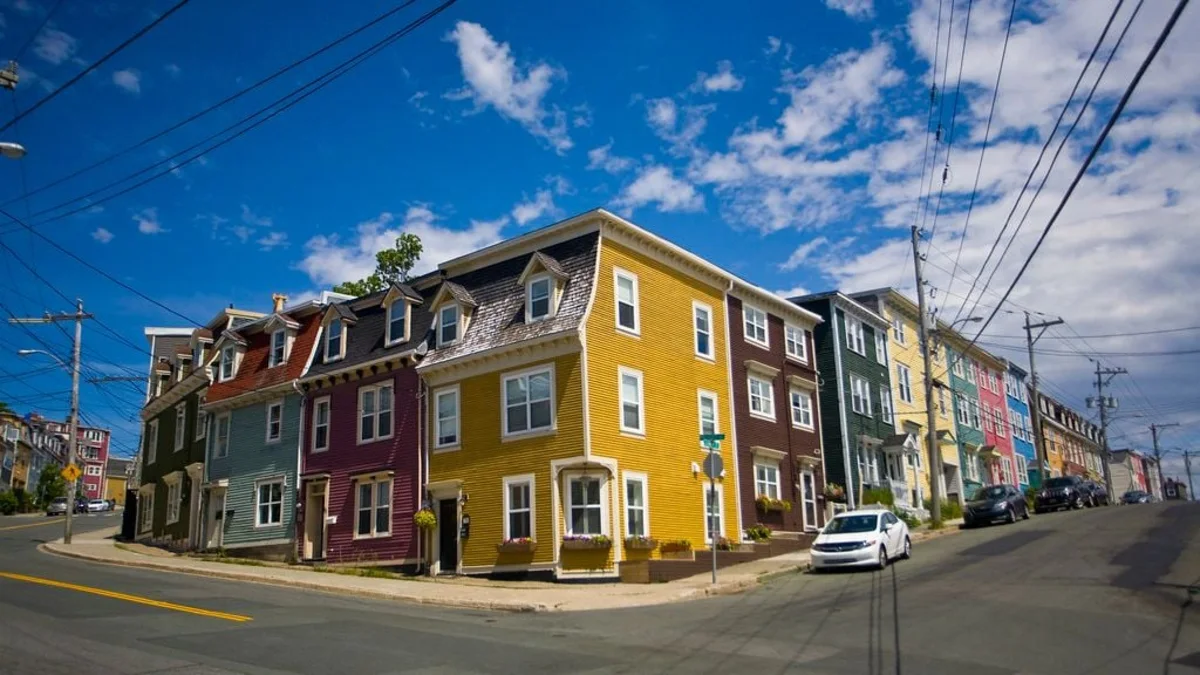
7. St. John’s, Newfoundland: The Most Colourful City in Canada
7. St. John’s, Newfoundland: The Most Colourful City in Canada (miketnorton, Flickr, CC BY 2.0)
St. John’s is Canada’s most easterly point and arguably its most visually striking city. Tucked on Canada’s eastern coast and surrounded by the untamed splendour of the Atlantic Ocean, St. John’s is distinguished by its vivid and varied architecture, with brightly painted row dwellings in a spectrum of hues adorning the city’s meandering little lanes. It looks like no other city in the country, and that’s precisely the point.
Advertisement
Advertisement
A picturesque neighbourhood in St. John’s known as The Battery features colourful row houses and stunning coastal views that have made it one of the most photographed streetscapes in Atlantic Canada. The city’s geography is dramatic by any measure, perched on a hill above a narrow harbour entrance where icebergs drift past in spring and humpback whales surface in summer. It’s the kind of place that stays with you long after you’ve left, not because it tries to impress, but because it simply is what it is.
About the Author