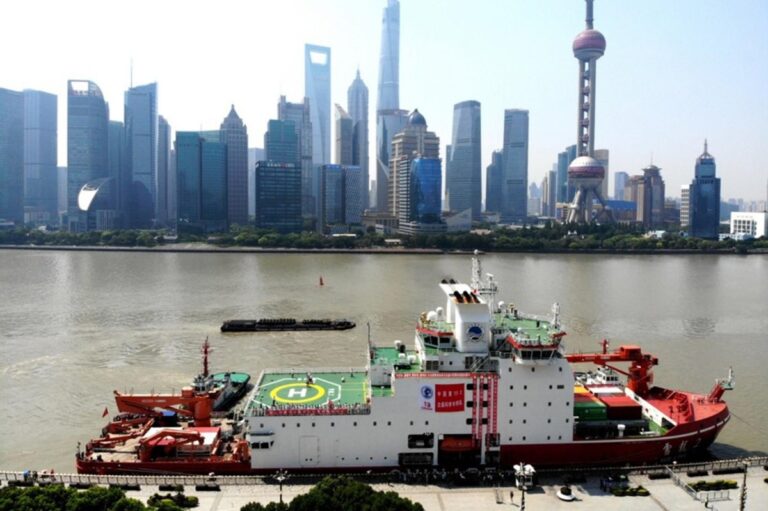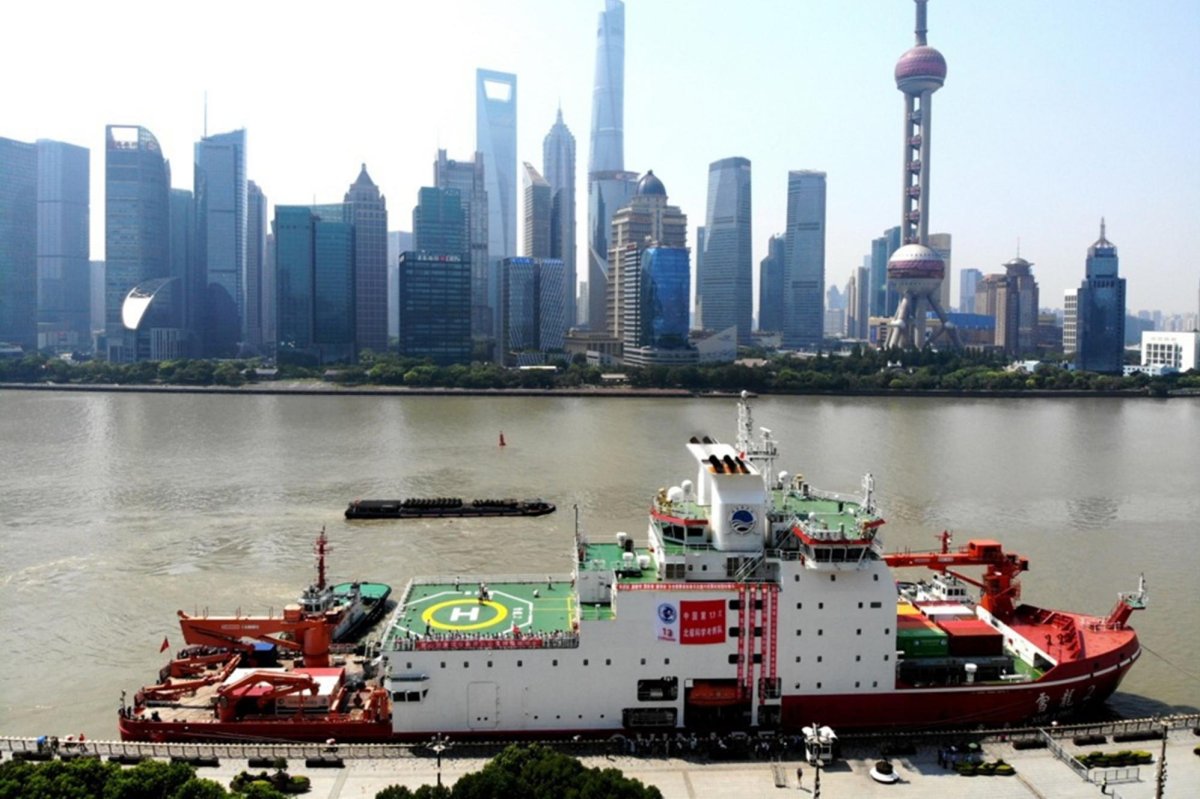
An aerial view of the Xuelong 2 docking at a port in east China’s Shanghai. Photo by Zhang Ansong// Xinhua/EPA
Aug. 13 (Asia Today) — China is moving to establish a regular Arctic container route to Europe as retreating sea ice and geopolitical tensions increase interest in shipping through waters north of Russia.
Chinese carrier Sea Legend is beginning a regular container service linking Ningbo in eastern China with Felixstowe in Britain through the Northern Sea Route.
The route has been branded the “Ice Silk Road.”
Depending on Arctic conditions, the voyage could reduce the normal roughly 40-day sailing time between the ports to about 20 days.
The Financial Times reported that the service underscores China’s growing commercial position in the Arctic as Beijing uses Russian icebreaking capacity and its enormous shipbuilding industry to develop new shipping options.
The Northern Sea Route can reduce sailing distance between Asia and Europe by about 30% to 40% compared with routes through the Suez Canal.
Sea Legend plans seasonal weekly sailings during the Arctic navigation window. Other reporting on the carrier’s schedule says eight voyages are planned during the 2026 season.
Northern Sea Route transits increased from 15 in 2024 to a record 23 during last year’s summer season, according to the report.
Summer ice retreat can allow some vessels to travel through parts of the route without their own icebreaking capability.
Russia nevertheless maintains extensive control over the passage along its northern coast.
The route is divided into multiple operating sectors based on ice conditions and shipping permits are administered under the Russian system associated with state nuclear company Rosatom.
Shipping companies seek alternatives to geopolitical chokepoints
Interest in Arctic shipping has also increased as maritime companies look for alternatives to established routes exposed to conflict.
The Red Sea and Bab el-Mandeb Strait have become particularly significant concerns following attacks on commercial shipping.
Shorter Arctic voyages could reduce time and fuel costs while avoiding some geopolitical chokepoints.
The trend has contributed to growing demand for ice-class vessels.
Figures cited by the Financial Times from Veson Nautical showed 167 ice-class ships were built last year, the highest level in more than a decade, with another 164 expected this year.
China uses shipbuilding dominance to expand Arctic position
Competition over Arctic shipping also intersects with a broader contest over shipbuilding and maritime power.
China’s share of global shipbuilding has increased from about 5% in 2000 to roughly 55% today, according to figures cited in the original report.
China has described itself as a “near-Arctic state” and has expanded cooperation with Russia on oil, natural gas and maritime transportation.
Russia operates a large fleet of icebreakers, giving Beijing access to capabilities that are difficult for other countries to reproduce quickly.
The United States, meanwhile, is considering legislation intended to rebuild domestic shipyards and expand its merchant fleet.
Washington has also pursued cooperation with Finland on icebreaker construction.
The United States, Canada and countries in Europe and Asia are expanding Arctic seabed mapping and surveys of northern routes while examining access to undeveloped resources including rare earth minerals and natural gas.
Melting ice opens routes but increases risks
The expansion of Arctic shipping is closely tied to declining sea ice.
Researchers at Britain’s University of Southampton found Arctic maximum winter sea ice fell 5.8% between 2024 and 2025, the largest decline on record, according to the Asia Today report.
Maximum ice coverage recovered slightly this year but remained the second lowest recorded.
The same environmental changes that make shipping easier also create serious risks.
Maersk and other European shipping companies have remained cautious about the Northern Sea Route, citing environmental concerns and relations with Russia.
Navigation is also difficult.
Satellite navigation can be less reliable at high latitudes and crews require specialized experience operating around sea ice.
Ships must comply with the International Maritime Organization’s Polar Code, which imposes safety and environmental standards for polar waters.
More than 500 maritime incidents were reported in the Arctic during the past decade and nearly half involved machinery damage or failure, according to an Allianz analysis cited in the original story.
Search-and-rescue capabilities are also limited across much of the Arctic.
An accident involving fuel or hazardous cargo could therefore become difficult to contain.
Still, advocates say shorter routes can reduce fuel use and carbon dioxide emissions per voyage.
China’s new regular service will test whether the Arctic can evolve from a specialized seasonal route into a commercially significant link between Asia and Europe.
— Reported by Asia Today; translated by UPI
© Asia Today. Unauthorized reproduction or redistribution prohibited.
About the Author