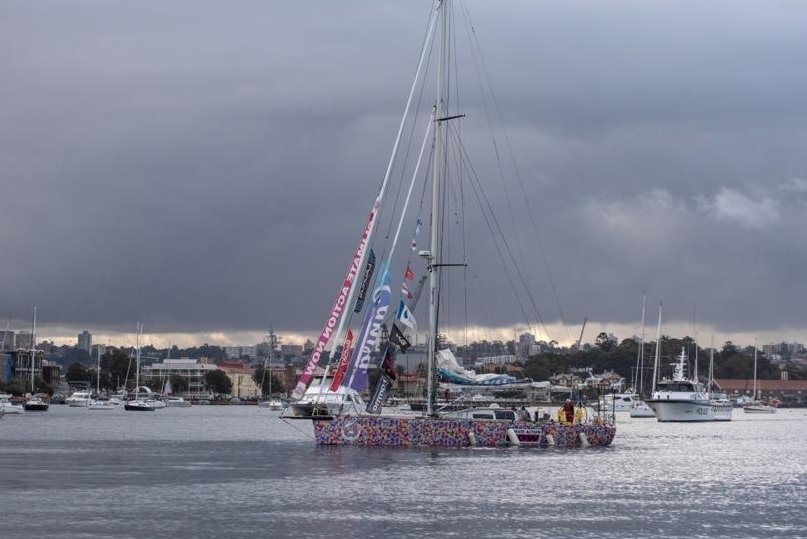
The prospect of an undersea cable connecting Chile and Antarctica faces major technical challenges because of Antarctica’s extreme environmental conditions .File Photo by Flavio Branca;eone/EPA
SANTIAGO, Chile, Nov. 10 (UPI) — Chile’s Undersecretariat of Telecommunications has confirmed that building an undersea fiber-optic cable stretching up to 2,548 miles to connect Chile with Antarctica is technically feasible.
The project, aimed at improving communications and scientific research, could cost up to $621 million and begin operating in 2034, Chilean authorities said Monday in a statement.
The findings were initially presented in Madrid during the Ibero-American Summit of Heads of State and Government on Wednesday and Thursday, when officials unveiled the results of a feasibility study for the Antarctic Cable project.
The initiative would lay a fiber-optic cable along the seabed to transmit large volumes of data between mainland Chile and scientific research stations in Antarctica.
Chile is leading the project with support from CAF, the Development Bank of Latin America and the Caribbean, to overcome the limitations of existing satellite connections. The cable would enable real-time climate monitoring, facilitate data sharing among researchers from different countries and allow scientific equipment to be operated remotely.
“The study confirms that the Antarctic Cable is feasible. It is an initiative that our country must lead and that will transform Chile into a technology hub for science, connectivity and international cooperation,” said Romina Garrido, Chile’s undersecretary of telecommunications.
Garrido said one of the options under consideration would connect 28 scientific facilities and include research programs from the United States, the United Kingdom, Brazil and Poland, in addition to Chile, Germany and South Korea, which are already included in the basic configuration.
The proposed financing model would combine resources from multilateral development banks, contributions from participating countries and long-term fiber-optic usage rights agreements, without direct funding from Chile’s national budget.
The connectivity project is part of a broader scientific cooperation agenda that CAF plans to advance through the international “Antarctic Pearl” expedition, which will bring together representatives from 15 countries and international partners from Feb. 10 to 14.
The initiative aims to establish partnerships among governments, scientific institutions and international organizations to strengthen research and improve access to climate change data.
“This milestone will mark the beginning of sustained work that we want to translate into three concrete outcomes. First, an Ibero-American agenda for science, climate observation, digital infrastructure and financial cooperation. Second, a network of national focal points to maintain coordination. And finally, an Ibero-American Antarctic Cooperation Charter, open to voluntary participation,” said Sergio Díaz-Granados, CAF’s executive president.
The expedition seeks to promote research into ice, ocean and atmospheric conditions, with findings that have direct implications for Latin America and the Caribbean.
Glacier measurements help improve projections of sea-level rise, while meteorological data contribute to more accurate weather forecasts.
However, the 55 research facilities operated by 21 countries in Antarctica face connectivity restrictions.
According to Chile’s telecommunications authority, demand for data transmission could exceed 59 terabits per second by 2058, underscoring the need for higher-capacity communications infrastructure.
Existing satellite systems serving Antarctica are saturated and provide speeds comparable to those available 15 years ago, limiting their ability to support scientific operations.
Luciano Ahumada, director of the School of Computer Science and Telecommunications at Diego Portales University in Chile, said installing the cable would represent a significant advance for scientific research and strengthen Chile’s international position.
“An undersea cable would transform Antarctica into a scientific laboratory permanently connected to the world. Unlike satellite connections, it would offer greater transmission capacity, lower latency and more stable service to transport large volumes of climate, oceanographic and geophysical data, operate instruments remotely and conduct collaborative research in real time,” Ahumada told UPI.
He added that the project would consolidate Chile’s position as a digital gateway to Antarctica, a role with geopolitical significance.
“Profitability must be assessed by considering international strategic and scientific benefits, not just commercial revenue. That is why financing is being evaluated through various multilateral arrangements,” he said.
However, Ahumada cautioned that advances in satellite technology also raise questions about whether an investment of this magnitude is necessary.
“Low-Earth-orbit satellites have dramatically improved connectivity and will continue to do so. That is why a $621 million cable cannot be justified simply to provide Internet access to Antarctic research stations,” he said.
The project also faces major technical challenges because of Antarctica’s extreme environmental conditions.
“The cable must cross the Drake Passage, contend with ice, extreme seabed conditions and very limited windows for installation or repairs. However, the Subtel study confirms that there are no insurmountable technical obstacles,” Ahumada said.
He warned, though, that the project could face geopolitical scrutiny, given previous international tensions surrounding submarine cable projects linked to China.
“Geopolitically, the risk does not necessarily lie in the cable itself, but in who finances, builds and manages it and who controls its data. Questions could arise from the United States or other powers if they perceive security risks, technological dependence or strategic influence,” he said.
Ahumada said establishing a shared governance model among participating countries, with transparent rules consistent with the Antarctic Treaty, would be essential.
“The participation of different countries, including the United States, could significantly reduce those tensions or concerns,” he said.
About the Author