June 19 (UPI) — Ecuadorian President Daniel Noboa signed a decree authorizing the deployment of foreign military personnel in the country to assist in operations against organized crime, granting them immunity under existing international agreements and reaffirming the existence of an “internal armed conflict” against criminal groups.
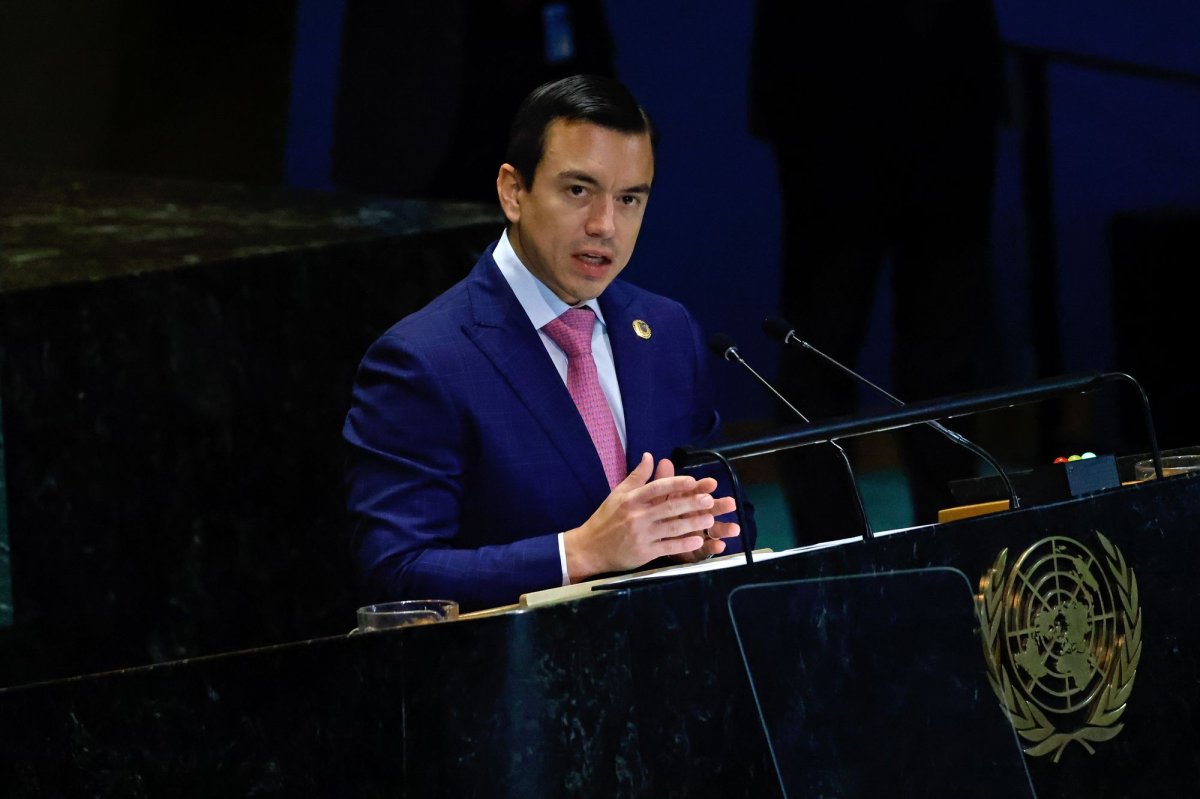
The measure was announced by Noboa in a video released by the Presidency, in which he said troops from allied countries would be able to work alongside Ecuadorian security forces in the provinces most affected by violence.
“Today I signed a decree that strengthens the fight against narco-terrorism in Ecuador. As a result of this decision, military personnel from allied countries will be able to deploy to the provinces hardest hit by violence and work alongside our security bloc,” the president said.
“This measure is the result of months of work, especially during our most recent meeting at the Pentagon. From today on, narco-terrorists will face a stronger, better-prepared Ecuador that is no longer fighting alone,” he added.
The announcement came after Noboa traveled to Washington this week to meet with U.S. Defense Secretary Pete Hegseth, with whom he discussed security cooperation.
“You have been an exemplary partner for us in the fight against these networks that threaten your homeland, threaten ours and threaten the security of our shared hemisphere,” Hegseth told the Ecuadorian president, according to a transcript released by the Pentagon.
Executive Decree 424 states that Ecuador is facing an internal armed conflict caused by criminal organizations whose activities pose a threat to national sovereignty, state security, public order and the protection of the population.
The declaration revisits a measure adopted by Noboa in January 2024, when he recognized the existence of an internal armed conflict and designated 22 organized crime groups as terrorist organizations and non-state belligerent actors, according to Executive Decree 111 and reports by Ecuadorian newspaper El Universo.
One of the central provisions of the new decree is that it allows foreign military personnel to participate in operations related to that conflict.
The text states that troops sent by cooperating countries will enjoy immunity in accordance with international agreements signed by Ecuador.
Among the agreements cited in the decree is the Status of Forces Agreement signed between Ecuador and the United States in October 2023 and ratified in February 2024.
According to El Universo, the agreement regulates the temporary presence of U.S. military and civilian personnel in Ecuadorian territory and also covers civilian employees of the U.S. Department of Defense and contractors associated with those activities.
The agreement includes ship visits, military and security exercises, training and capacity-building programs, as well as humanitarian operations to respond to natural and man-made disasters.
It also provides for cooperation against shared threats such as drug trafficking, illicit trafficking and international terrorism, along with other activities that may later be agreed upon by both governments.
Although the decree does not specify which countries will participate or when deployments could begin, the agreement with the United States is the only bilateral framework explicitly cited in the document.
An analysis published by Lexis noted that between 2025 and 2026 Ecuador signed security cooperation agreements and instruments with France, the United Kingdom, Uruguay, Argentina, the European Union and Peru.
However, none of those documents included commitments to deploy troops or military personnel on Ecuadorian territory.
Ecuador already receives international support, particularly from the United States, through intelligence sharing, training and technical assistance, but until now no deployment of foreign military personnel to participate in domestic security operations had been announced.
The decree also urges the National Assembly to grant amnesty to those acting “in defense of the State” during operations linked to the internal armed conflict.
The decision comes as Ecuador faces one of the worst security crises in its recent history. The country has become a key route for international cocaine trafficking and has experienced a sharp rise in homicides, extortion, kidnappings and clashes between criminal organizations in recent years.
About the Author