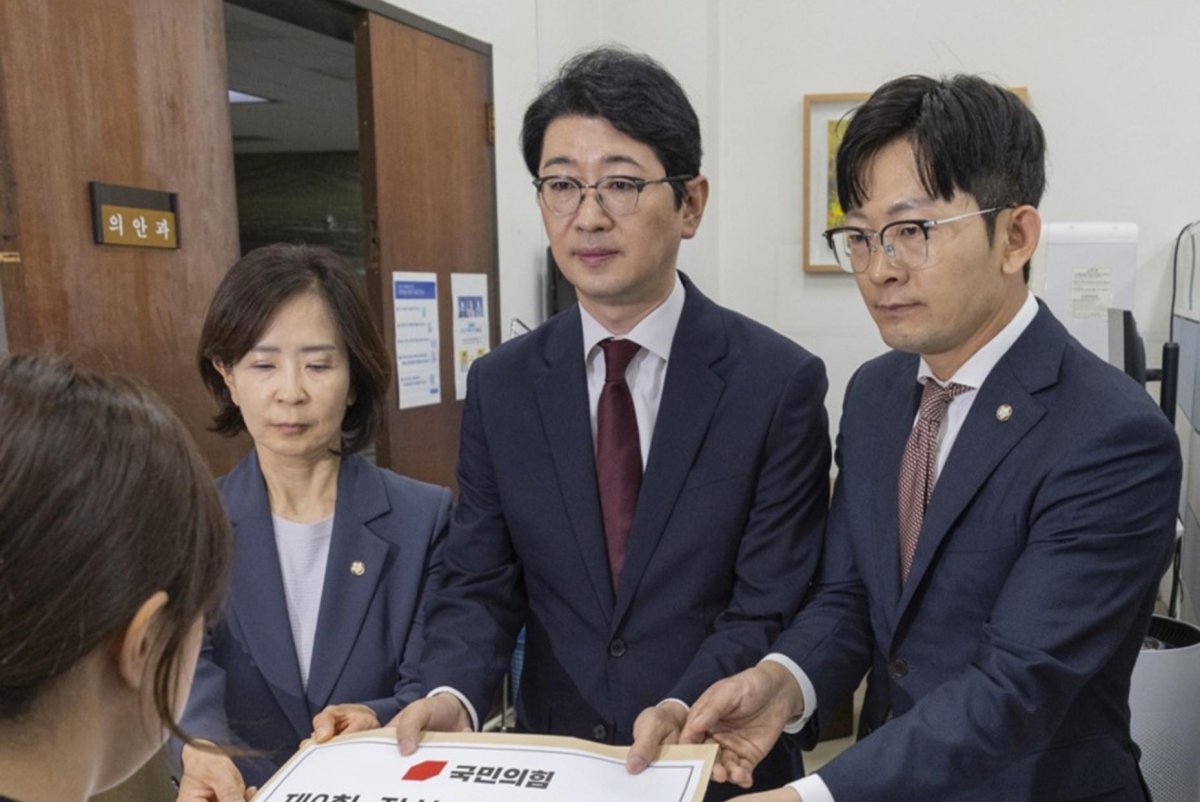
Lawmakers of the main opposition People Power Party, (from L to R) Choi Soo-jin, Joo Jin-woo, and Park Choong-kwon, submit a bill to an office of the National Assembly in Seoul, South Korea, 09 June 2026, to seek an independent counsel probe into an unprecedented shortage of ballot papers that disrupted voting in the June 3 local elections at some polling stations and, critics say, infringed upon voters’ rights. Photo by YONHAP / EPA
July 5 (Asia Today) — South Korea’s ruling and opposition parties clashed Sunday over a revised online information law set to take effect Tuesday, with the ruling Democratic Party calling it a safeguard against fake news and the main opposition People Power Party denouncing it as a threat to free speech.
The revised Information and Communications Network Act allows punitive damages of up to five times the actual damage when false or manipulated information is distributed online and causes harm. Repeat distribution can also trigger administrative fines of up to 1 billion won, or about $655,000.
The People Power Party called the measure an online “gag law” and said the standard for determining what counts as false or manipulated information is too vague.
Choi Soo-jin, the party’s chief floor spokesperson, said posts criticizing the government or raising reasonable suspicions could become targets of disputes.
“To avoid large damages and fines, platforms will have no choice but to preemptively delete posts even before illegality is clearly determined,” Choi said. “Excessive deletion and de facto prior censorship are structurally inevitable.”
People Power Party lawmaker Joo Jin-woo said he plans to file a constitutional challenge after the law takes effect.
“The law is rushed legislation that does not even have a body to determine false or manipulated information,” Joo wrote on social media. He said the measure violates constitutional protections against prior censorship as well as principles of proportionality and freedom of speech and the press.
The Democratic Party rejected the criticism and said the law is being misrepresented.
Jeon Su-mi, a party spokesperson, said the measure is not designed to silence ordinary citizens but to prevent malicious false information and so-called “cyber wreckers,” a Korean term for online personalities who profit from sensational or defamatory content.
“Not a single citizen who shares daily life, expresses legitimate political opinions or sharply criticizes power will be subject to punishment under this law,” Jeon said.
She accused the People Power Party of defending false information and online harassment by portraying basic social filtering as censorship.
The Democratic Party also criticized opposition proposals to limit regulation to already illegal information, saying such an approach would leave manipulated falsehoods unaddressed.
The dispute comes as South Korea continues to debate how to regulate online misinformation without chilling political speech. Supporters say the revised law is needed to hold malicious content creators accountable when false claims cause real harm. Critics say vague definitions could pressure platforms to over-remove content and discourage citizens from criticizing public officials.
The revised law was passed by the National Assembly in December under Democratic Party leadership.
— Reported by Asia Today; translated by UPI
© Asia Today. Unauthorized reproduction or redistribution prohibited.
About the Author