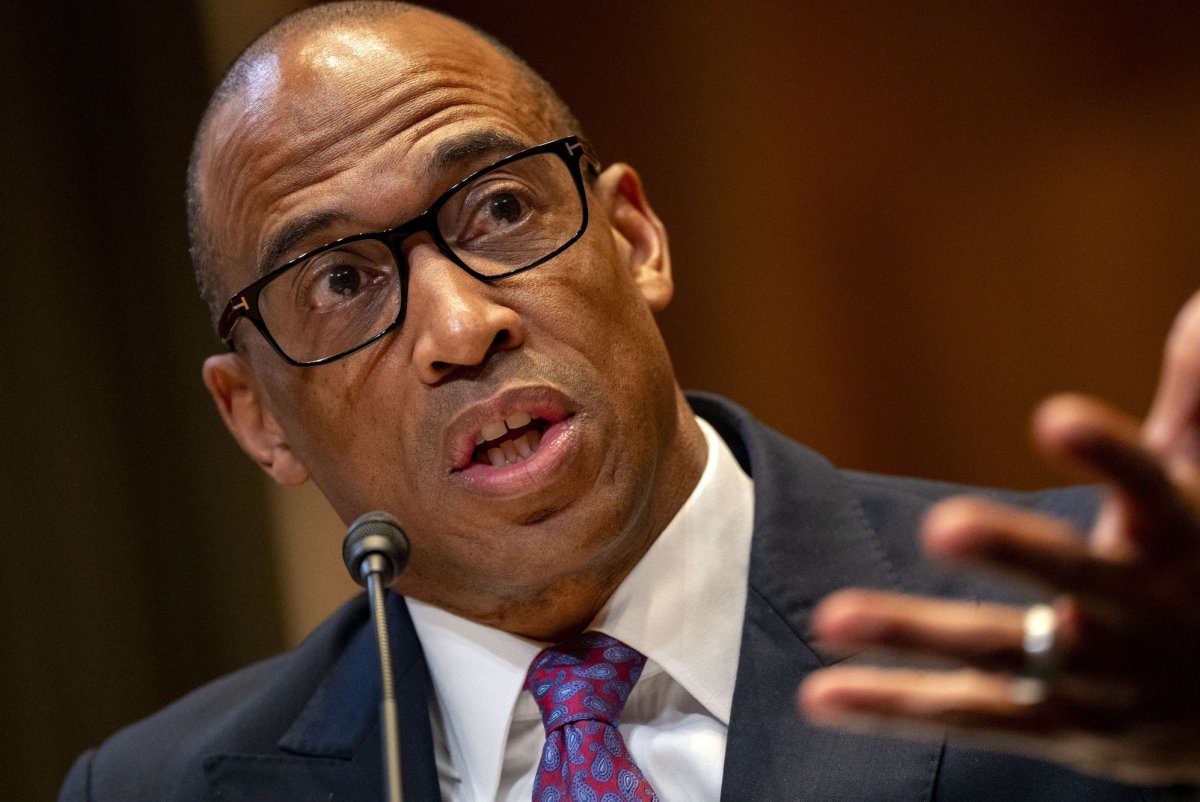
WASHINGTON, May 14 (UPI) — Bipartisan members of the House and Senate Appropriations subcommittees warned this week that President Donald Trump’s proposed $10.7 billion in cuts to the Department of Housing and Urban Development’s fiscal 2027 budget would significantly worsen the homelessness crisis.
During subcommittee hearings Tuesday and Thursday, Republican and Democratic members of Congress grilled HUD Secretary Scott Turner about the immediate impact of the proposed budget’s sweeping cuts.
Democrats criticized proposed reductions to programs that support long-term housing solutions, which activists estimated could force up to 170,000 people onto the street. Republicans decried hundreds of millions of dollars worth of proposed cuts to Native American housing programs.
The bipartisan pushback showed the opposition in Congress to the president’s housing proposals, after legislators rejected even deeper cuts a year earlier.
One of the week’s most intense exchanges between Turner and lawmakers came on Thursday when Sen. Kirsten Gillibrand, D-N.Y., questioned him about the delay in HUD’s point-in-time count and housing inventory count report. The report, typically issued annually, compiles the number of people around the country who were experiencing homelessness on a given night in January.
When asked about the delay, Turner blamed it on the government shutdown and criticized the Biden administration for the 770,000 people who were counted as experiencing homelessness at the time of HUD’s 2024 report.
“A government shutdown helps us not be able to work, it’s a government shutdown. The point-in-time report would be out right now if we did not have a government shutdown. Irregardless of all of that, during the Biden administration, there was record funding,” Turner said before being cut off.
“Oh my god, it’s like two children saying ‘I didn’t do it, my brother did it.’ Stop with excuses, just explain your record,” Gillibrand said.
Throughout both hearings, Turner countered criticisms by arguing that the proposed cuts would represent better stewardship of taxpayer money and “promote pathways to self-sufficiency.”
But Senate and House subcommittee members, such as Sen. Patty Murray, D-Wash., criticized the proposed budget for eliminating billions in funding to programs that promote permanent supportive housing, a community-based approach intended to offer stable housing for those with chronic disabilities or a history of homelessness.
Murray echoed housing activists’ estimates that up to 170,000 people would be at risk of losing their housing again. Last year’s proposal included regulatory changes to the continuum of care program and an even deeper HUD funding reduction of some $45.6 billion. A federal court halted the regulatory changes and program cuts in March.
Among this year’s proposed cuts would be a $393 million reduction in Homeless Assistance Grants, which fund housing and services for people experiencing homelessness.
That would include elimination of the continuum of care program, a HUD initiative that funds local governments and nonprofits to take a community-based approach to eliminate homelessness by creating long-term stabilized housing.
“I am really concerned because your department has ignored the law,” she told Turner. “HUD is required to provide proven strategies including permanent supportive housing and rapid rehousing. But last year, you limited our local governments’ use of those federal grants. At least, until a federal judge and Congress stopped you.”
Turner responded by saying the continuum of care program funds for last year were distributed in accordance with the Congress’ 2026 budget.
He defended the renewed attempt to cut the continuum of care program by criticizing the “housing-first” approach to homelessness, which prioritizes housing individuals before providing supportive services.
“The housing-first model has failed,” he told Murray. “I believe part of the housing-first model, to house people, is important, but we can’t stop there. We have to get to the root of homelessness and that is mental addiction, drug addiction, domestic violence and things of this nature. I believe we have to treat people and get them back out there into a life of self-sustainability.”
Trump’s fiscal 2027 budget request would represent roughly a 13% decrease in HUD funding compared to the FY2026 budget.
Anna Bailey, a senior policy analyst for the Center on Budget and Policy Priorities, expressed concern about the long-term effects of eliminating the continuum of care program. She called it “the ultimate solution” to the homelessness crisis and warned that Murray’s estimate of 170,000 could be low for the number of people at risk of losing their housing.
“By ending the continuum of care program and moving some of that money to the emergency solutions grant, HUD would basically be eliminating permanent housing funding for about probably over 200,000 people who used to be unhoused and currently have stable housing because of the program,” she said in an interview Wednesday with Medill News Service.
The House eventually rejected last year’s proposed cuts and increased the HUD’s 2026 budget from the year prior, passing the Consolidated Appropriations Act 2026 in January by a 341-88 vote. However, some housing advocates warned that this year’s proposed HUD budget attempted to revive the same policies that had been rejected.
Jennifer Kye, director of federal housing advocacy for Justice in Aging, an advocacy group, said that despite the Trump administration’s unsuccessful bid to push last year’s housing assistance budget cuts through Congress, the new proposed budget repeated the effort.
“As a whole, HUD is again trying to shift funding away from permanent supportive housing in various ways, for example, changes in funding criteria within the Continuum of Change program,” she said.
“They’re trying to just also reduce homeless assistance overall and they want to try to eliminate the [continuum of care] program altogether. So I don’t anticipate that HUD will stop trying to pursue these changes.”
In another criticism of the proposed budget, some Republican subcommittee members vowed to combat HUD’s proposed $467 million cut to Native American housing programs.
“I just want this committee to understand, as we work through this process, one way or the other, we’re not going to have cuts of the order of magnitude we’re talking about in the Tribal Home Program,” Rep. Tom Cole, R-Okla., told Turner during the hearing.
“I think if more Americans went to places like Pine Ridge [Indian Reservation] and saw the housing conditions, they wouldn’t believe it. They would think they were in a third-world country,” Cole said.
About the Author