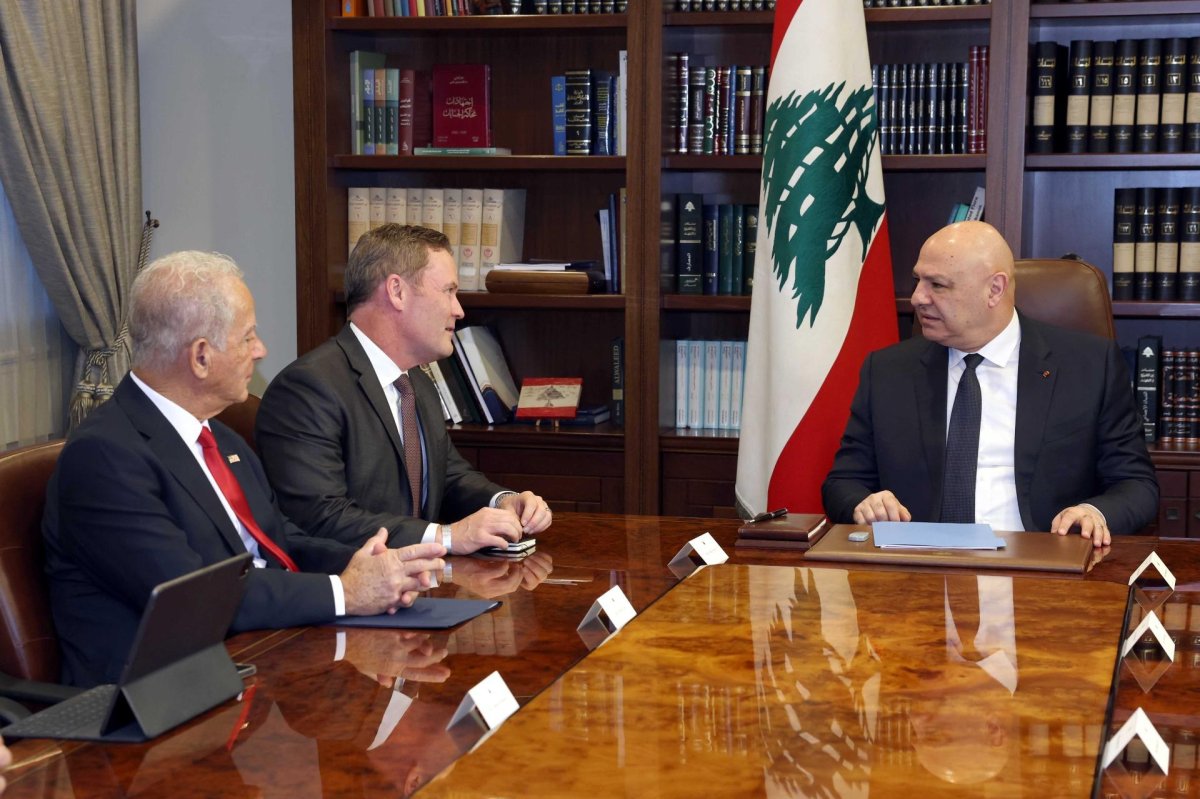
Lebanese President Joseph Aoun (R) meets Monday with U.S. Ambassador to the United Nations Mike Waltz (C) and U.S. Ambassador to Lebanon Michel Issa to discuss post-UNIFIL arrangements in southern Lebanon. Photo by Lebanese Presidency
BEIRUT, Lebanon, Nov. 16 (UPI) — U.S. Ambassador to the United Nations Mike Waltz said Monday negotiations are underway to agree on an alternative to the U.N. Interim Force in Lebanon, or UNIFIL, and secure a Security Council consensus before its mandate expires next month.
Waltz, who met with Lebanese President Joseph Aoun, House Speaker Nabih Berri and Prime Minister Nawaf Salam, also called on Iran-backed Hezbollah to disarm “voluntarily.”
Lebanese officials have been warning of security vacuum in southern Lebanon if no agreement is reached on a new international force to replace UNIFIL, whose mission is set to end on Dec. 31.
Without an U.N.-mandated international presence, Lebanon risks losing an important source of protection and leverage and could find itself increasingly at the mercy of Israel and the United States — the two countries that have pushed hardest to terminate the U.N. peacekeeping mission.
While Israel has repeatedly criticized UNIFIL for failing to fulfill its mandate, accusing the force of allowing Hezbollah to expand its military presence in southern Lebanon since the 2006 war, ending the mission also aligned with U.S. President Donald Trump’s broader efforts to sideline the U.N. and diminish its role in addressing global crises.
UNIFIL — originally established following Israel’s 1978 invasion of southern Lebanon to confirm the withdrawal of Israeli forces and assist the Lebanese government in restoring its authority in the area — is to begin its gradual withdrawal in January, as Lebanon once again negotiates an Israeli withdrawal and future security arrangements in the south, this time through U.S.-mediated direct talks with Israel.
Waltz said U.N. Security Council Resolution 1701, which was adopted unanimously in 2006 to end hostilities between Israel and Hezbollah and authorized an increase in UNIFIL’s strength to up to 15,000 troops, served as the basis and mandate for the force in its current form.
“We expect [Resolution 1701] to continue with some modifications, of course, and some updating,” he said after holding talks with House Speaker Nabih Berri, Hezbollah’s main allay.
Waltz noted, however, that the peacekeeping force composed of between 8,000 and 11,000 troops costs half a billion dollars a year, adding, “We think that needs to change and be updated.”
Several potential post-UNIFIL arrangements have been floated in recent months.
These have reportedly included a European-led force of up to 3,500 personnel focused on border monitoring, a proposal that was quickly dropped; a small, U.S.-backed verification mission comprising around 100 personnel; and a more recent U.S. suggestion to establish a mechanism similar to the Multinational Force and Observers stationed in Egypt to monitor the June 26 trilateral agreement between Lebanon and Israel.
However, no specific proposal was discussed during Waltz’s talks with Lebanese officials, which instead focused on building consensus on the post-UNIFIL arrangements.
France is expected to draft a U.N. Security Council resolution aimed at securing consensus among member states.
Waltz said Washington would work closely with France, which is the “penholder on this resolution,” to “incorporate elements of the trilateral dialogue” into the draft.
He said negotiations would continue over the coming month, ahead of the expiration of UNIFIL’s mandate, adding: “We have to reach consensus as a U.N. Security Council, but this is certainly our intent. I believe this is France’s intent, as well.”
The U.S.-mediated trilateral framework agreement, signed by Lebanon, Israel and the United States on June 26, despite strong opposition from Hezbollah, was meant to end the war that broke out when the militant group opened a support front for Gaza on Oct. 8, 2023.
The accord outlines a phased and reciprocal process that links the Lebanese Army’s deployment and the disarmament of non-state armed groups to Israel’s gradual withdrawal from Lebanese territory.
It also provides for a third-party verification mechanism and the establishment of a U.S.-supported military coordination group to oversee implementation and facilitate coordination between the parties.
“I think the message should be loud and clear: Lebanese sovereignty must be fully restored, and the mechanism to achieve that should be the Lebanese Armed Forces,” Waltz said. “This is a unique opportunity. … I hope and pray that Hezbollah will disarm. They should do so voluntarily. … There cannot be two armies” in the country.
Prime Minister Nawaf Salam reiterated the need for “a continued international presence” in southern Lebanon under a mandate from the U.N Security Council, stressing the importance of maintaining Resolution 1701 as a key reference point for international arrangements in southern Lebanon.
Salam also called for establishing a credible verification mechanism to verify that Lebanon and Israel are fulfilling their commitments.
About the Author