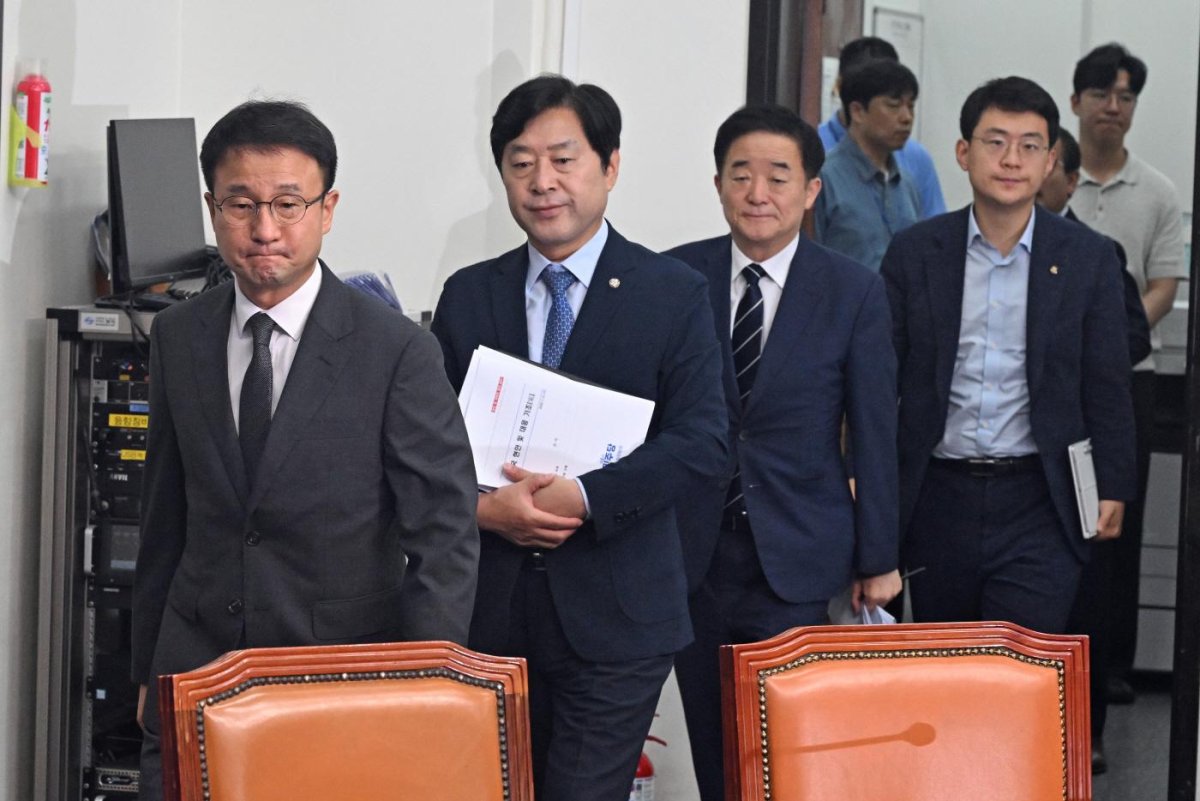
1 of 2 | Han Byung-do, left, acting leader and floor leader of South Korea’s ruling Democratic Party, attends a party leadership meeting Wednesday at the National Assembly in Seoul with Supreme Council members Hwang Myung-sun, Kang Deuk-gu and Park Jie-won. Photo by Asia Today
July 15 (Asia Today) — South Korea’s main opposition People Power Party launched a campaign Wednesday to preserve prosecutors’ supplementary investigative authority, taking advantage of emerging divisions within the ruling Democratic Party over plans to eliminate the power.
The opposition party introduced three bills under the banner of protecting crime victims and highlighted several prominent criminal cases to build public support for its position.
All People Power Party lawmakers jointly sponsored amendments to the Criminal Procedure Act and legislation governing the planned Prosecution Service and Serious Crimes Investigation Agency.
The bills would preserve prosecutors’ authority to conduct additional investigations and expand the types of cases police must refer to prosecutors.
They would also allow prosecutors to become involved during the early stages of police investigations into serious crimes, including cases similar to the recent Jang Yun-gi murder case.
The legislation would delay implementation of laws establishing the Prosecution Service and Serious Crimes Investigation Agency by one year. The new investigative agency is scheduled to begin operating in October.
The People Power Party portrayed prosecutors’ supplementary investigative authority as a minimum safeguard for crime victims rather than merely an effort to preserve prosecutorial power.
The strategy appears intended to challenge the Democratic Party’s justification for its prosecution reform legislation by shifting the debate toward public safety and the protection of vulnerable people.
“It is difficult to understand an attempt to eliminate, for political purposes, a minimum safeguard intended to protect the public from violent crime,” said Kim Seung-su, the People Power Party’s senior deputy floor leader for parliamentary operations.
The opposition party has invoked both the Jang case and the 1987 torture death of student activist Park Jong-chul as examples of cases in which a second investigative authority could help uncover facts overlooked or concealed during an initial investigation.
People Power Party floor leader Jeong Jeom-sig said Monday that the truth surrounding Park’s death might never have emerged if the prosecution system proposed by the Democratic Party had existed in 1987.
“If the Democratic Party’s dismantling of the prosecution and abolition of supplementary investigative authority had taken place in 1987, Park Jong-chul’s official cause of death would have been an unexplained heart attack,” Jeong said.
Park died after being tortured by police during questioning. Authorities initially attempted to conceal the circumstances of his death, but the case helped intensify South Korea’s pro-democracy movement.
Kim Jin-ju, the survivor of the widely publicized “Busan roundhouse kick” attack, also voiced support for retaining an independent review of police investigations.
Kim said her case was initially treated as bodily injury and was referred to prosecutors as aggravated injury only after she submitted medical documentation showing the extent of her injuries.
“Each institution examines a case from a different position and therefore finds different errors,” Kim said during a forum.
“Having another institution review decisions made during an investigation should be an obligation, not an option,” she said.
The growing focus on victims has increased political pressure on the Democratic Party.
The ruling party must complete legislation before the Serious Crimes Investigation Agency launches in October, but critics say pushing the measures through without sufficient safeguards could result in a poorly prepared overhaul of the criminal justice system.
Women’s organizations and groups supporting crime victims have also raised concerns about completely eliminating prosecutors’ supplementary investigative authority.
The Democratic Party plans to hold a policy meeting with experts next week to consider the issue further.
Several Democratic Party lawmakers have introduced an amendment that would allow prosecutors to conduct supplementary investigations in a limited range of cases involving vulnerable victims, including sexual violence and child abuse.
A senior People Power Party lawmaker said the opposition cannot block the legislation through parliamentary votes alone because of the Democratic Party’s majority, but could influence the outcome by winning public support.
“What people experience directly are crimes that affect their everyday lives,” the lawmaker said.
“It will not be easy for the Democratic Party to push the legislation through solely in the name of prosecution reform while ignoring victims’ protection and public anxiety,” the lawmaker said.
— Reported by Asia Today; translated by UPI
© Asia Today. Unauthorized reproduction or redistribution prohibited.
About the Author