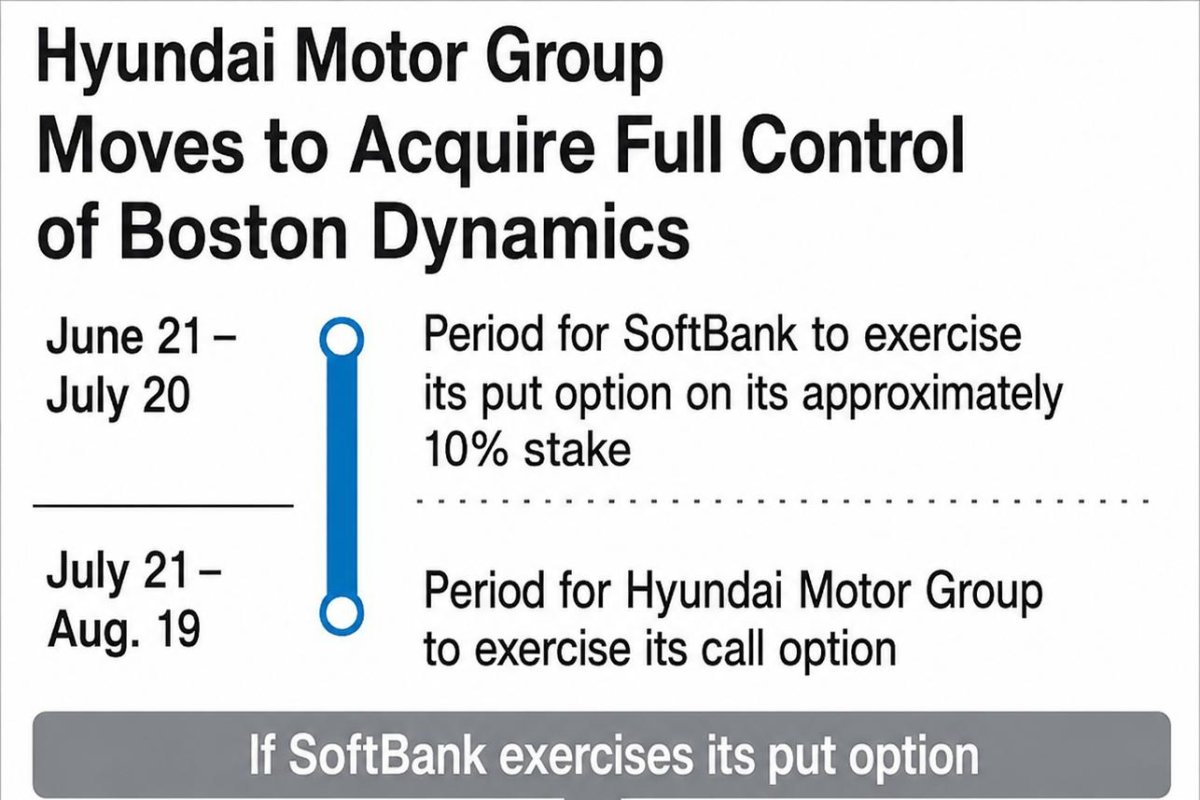
An infographic outlines the periods for SoftBank and Hyundai Motor Group to exercise options involving SoftBank’s remaining stake in Boston Dynamics. Information shared by Hyundai Motor Group, Hyundai Glovis and Financial Supervisory Service. Infographic by Asia Today and translated by UPI
June 23 (Asia Today) — Hyundai Motor Group is preparing to acquire SoftBank Group’s remaining stake in Boston Dynamics, a move that could give the South Korean automotive group full control of the U.S. robotics company.
Hyundai Motor Group is reviewing plans to purchase SoftBank’s remaining stake of about 10% if the Japanese investment company exercises a put option allowing it to sell the shares, industry sources said Tuesday.
The group could also exercise a call option to acquire the shares if SoftBank does not invoke its right to sell them.
Boards at Hyundai Motor Group affiliates are expected to review the proposed transaction. Market attention has focused particularly on Hyundai Glovis, which holds about 11% of Boston Dynamics.
Kia reportedly held a board meeting Monday to discuss the possible acquisition of additional shares. Hyundai Motor, Kia, Hyundai Mobis and Hyundai Glovis jointly invested in Boston Dynamics, meaning each company may need to complete its own approval procedures.
Hyundai Motor Group acquired an 80% controlling stake in Boston Dynamics from SoftBank in 2021 in a transaction that valued the robotics company at $1.1 billion. SoftBank retained a 20% stake at the time.
Subsequent capital increases reduced SoftBank’s ownership to about 10%, according to industry reports.
Acquiring the remaining shares would bring Boston Dynamics under the full control of Hyundai Motor Group and could accelerate the integration of robotics with the group’s mobility, logistics and manufacturing businesses.
Hyundai Glovis has been introducing autonomous logistics robots and artificial intelligence technology at its facilities to improve warehouse efficiency and transportation services.
The logistics company is also developing indoor robot delivery services and AI-based software tailored to different working environments.
Boston Dynamics’ mobile robotics technology could support those efforts by automating the movement and handling of goods inside warehouses and distribution centers.
The potential transaction is also viewed as part of Hyundai Motor Group’s broader physical AI strategy.
Physical AI refers to artificial intelligence incorporated into robots, vehicles and other machines that can perceive their surroundings and perform tasks in the real world.
Hyundai Motor Group has said it plans to connect robotics, autonomous driving, software-defined vehicles and smart factories within a single technology ecosystem.
The group’s affiliates could combine Boston Dynamics’ robotics research with their manufacturing, automotive parts and logistics capabilities to develop and commercialize new products more quickly.
Hyundai Motor Group outlined an AI robotics strategy at the CES technology show in January that calls for Boston Dynamics to work with Hyundai Motor, Kia, Hyundai Mobis and Hyundai Glovis across an end-to-end robotics value chain.
The group plans to use its factories as testing and training environments for robots before expanding their use into logistics and other industries.
Market participants are also watching whether full control of Boston Dynamics could affect the valuations of Hyundai Motor Group affiliates.
Some estimates have placed Boston Dynamics’ potential value at more than 30 trillion won, or about $19.2 billion. The figure remains speculative because the company has not reached full-scale commercialization and its eventual value will depend on revenue growth and the market adoption of its robots.
A Hyundai Motor Group official told Asia Today that a decision on the remaining stake could be made around July 20, which the official identified as the deadline for SoftBank to exercise its put option.
“If necessary, Hyundai Motor Group could exercise its call option to acquire 100% of Boston Dynamics,” the official said.
— Reported by Asia Today; translated by UPI
© Asia Today. Unauthorized reproduction or redistribution prohibited.
About the Author