
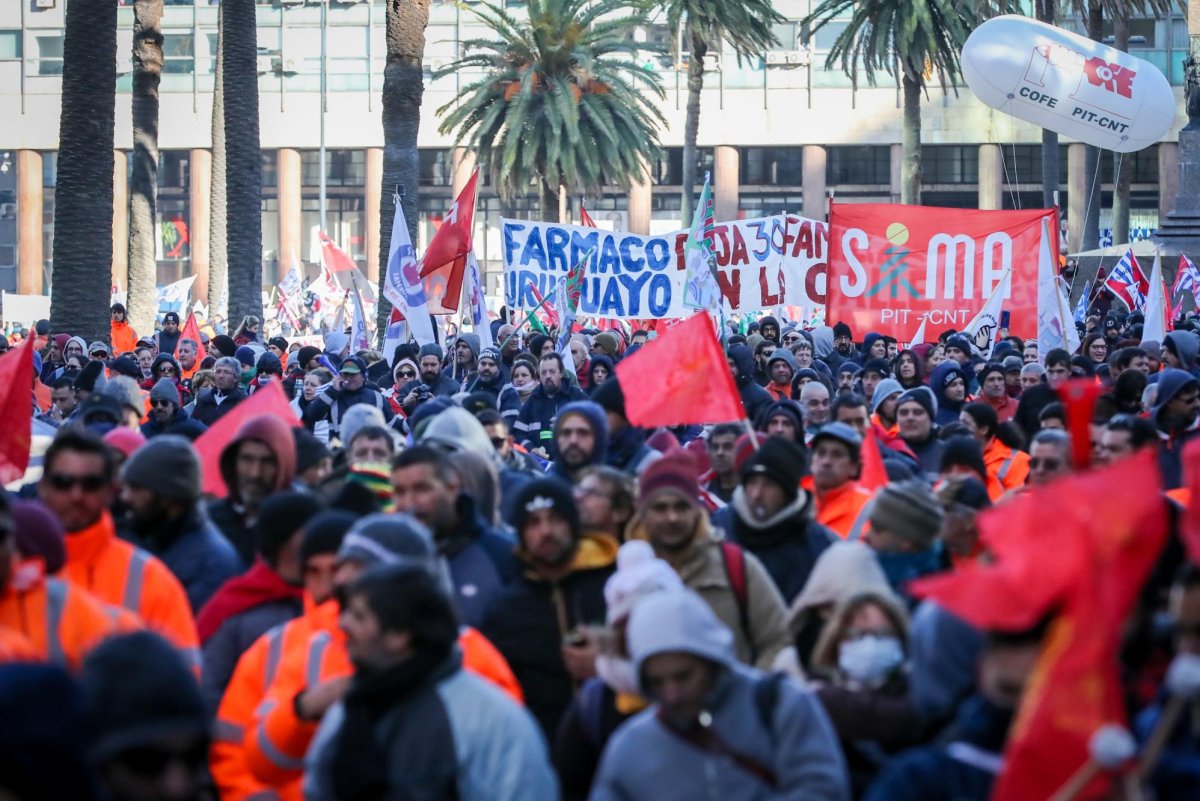
People protest against an economic model “associated with the development of inequality” in Montevideo, Uruguay, in 2022. File Photo by Raul Martinez/EPA
Aug. 18 (UPI) — The recent Ruptures and Opportunities report from the U.N. Economic Commission for Latin America and the Caribbean describes a world entering a period of profound reconfiguration and portrays the region as caught in three mutually reinforcing traps: weak economic growth, persistent inequality that erodes social cohesion and insufficient institutional capacity to sustain long-term development.
Other forces aggravate the picture, from population aging to organized crime. But behind many of these challenges lies a deeper problem: unequal access to opportunity is deeply entrenched.
Inequality is usually presented as a statistic or a photograph of society at a particular moment. But it can also be understood as a force that creates pressure and eventually produces movement.
We see that movement across Latin America.
Millions of Venezuelans have left their country in one of the largest population movements in the region’s modern history.
Elsewhere, frustration over inequality, inadequate public services and limited social mobility has contributed to political upheaval and public protest.
These phenomena have different causes and should not be reduced to a single explanation. But they share an important characteristic: people react when the distance between their expectations and their lived reality becomes too great.
This is where what I call the Gradient Principle can offer a useful way of looking at our region.
In mathematics and physics, a gradient describes the direction and intensity of change. Differences in pressure help produce wind. Differences in elevation cause water to flow. The steeper the gradient, the greater the potential movement.
Human societies, of course, do not obey the laws of physics. People possess culture, values, aspirations and freedom of choice. But the gradient provides a useful metaphor for understanding what happens when differences in wealth, opportunity and access to basic services become extreme.
A pronounced social gradient creates tension. The greater the distance between good schools and bad ones, between accessible healthcare and none, or between visible opportunity and its absence, the greater the pressure on the social fabric.
This idea also connects with the work of Chilean thinkers Humberto Maturana and Francisco Varela.
Their concept of autopoiesis described living organisms as systems that continually reproduce themselves through networks of relationships while interacting with their environment. Its elements are interdependent, and the condition of one part affects the functioning of the whole.
The concept was developed to understand biological systems, not to establish a law of social behavior. Yet its underlying insight is valuable for thinking about society.
No community is merely a collection of independent individuals. We live within networks of relationships, institutions and expectations. When serious imbalances persist within those networks, the consequences eventually spread beyond the people who suffer most directly from them. Migration illustrates this particularly well.
It is tempting to view migration primarily as a border problem, where people arrive and political arguments begin over who should be admitted. But borders are often where deeper problems become visible, not where they originate.
People move for many reasons, including political repression, insecurity, family considerations and economic opportunity. When individuals conclude that the place where they were born offers little chance of a dignified future, the gradient between where they are and where they hope to be becomes an incentive to move.
A border may regulate that movement. It cannot by itself eliminate the forces producing it.
The same principle can help us understand social protest. Governments can restore public order after demonstrations, but restoring order does not necessarily resolve the conditions that generated the anger. If citizens continue to believe that institutions are unresponsive, opportunities are inaccessible, or the rules are fundamentally unfair, the pressure remains.
This does not mean inequality automatically produces migration or rebellion, or that every difference within society is harmful. Differences in income, achievement and circumstance are part of every functioning society.
The problem arises when the gradient becomes so steep that large numbers of people lose confidence that effort can improve their condition. The appropriate objective, therefore, is not to eliminate differences but to prevent them from becoming so extreme that they fracture social cohesion.
That requires what I would call a common floor: a minimum threshold of socioeconomic well-being beneath which no person should be allowed to fall because of birthplace or social position.
This idea is closely related to Amartya Sen’s conception of human development. Development cannot be measured solely by national income. It must also concern the real capabilities people possess to make meaningful choices about their lives.
A common floor begins with access to quality education, healthcare, decent work and basic security, sustained by institutions capable of maintaining these conditions over time. The purpose is not to guarantee identical outcomes but to ensure dignity and opportunity do not depend on geography or inherited circumstance.
Borders and police can contain movement and unrest for a time, but lasting stability requires something more difficult: reducing the gradient itself and preventing social differences from becoming chasms.
That task cannot fall to government alone. The private sector, civil society and citizens all share responsibility for building a common floor of dignity and opportunity beneath every citizen.
Carlos Cantero is a Chilean academic at the International University of La Rioja in Spain and the author of Digital Society: Reason and Emotion. An international lecturer, adviser, and consultant, he focuses on adaptability in the digital society, ethics, social innovation, and human development. The views and opinions expressed in this commentary are solely those of the author.
About the Author