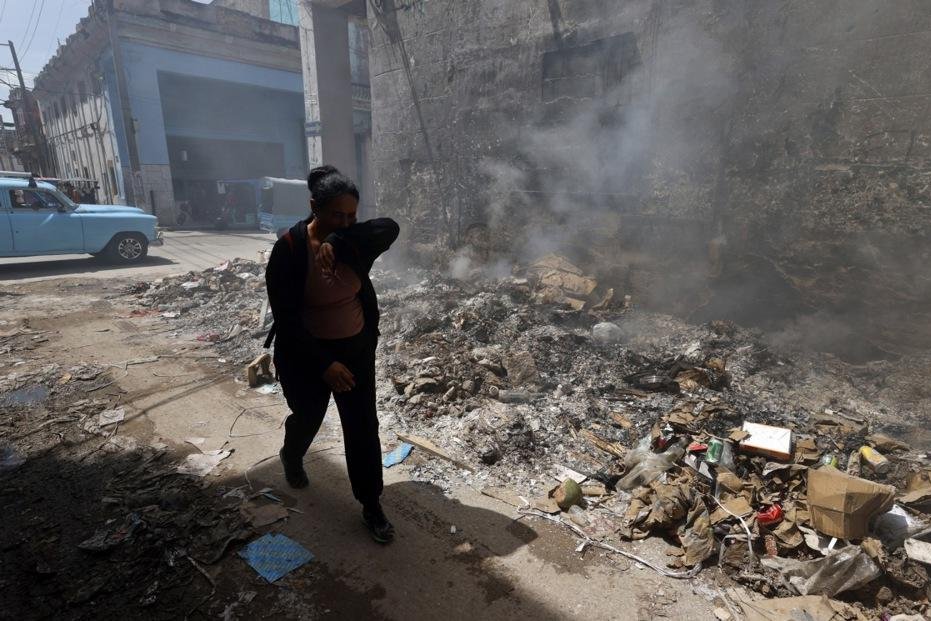
A man shields himself from smoke rising out of a trash fire in Havana in late May. Photo by Ernesto Mastrascusa/EPA
June 11 (UPI) — Cuba reached a record 1,281 political prisoners at the end of May, according to a report released Thursday by human rights organization Prisoners Defenders.
The group said the figure reflects an intensifying crackdown by the government of President Miguel Díaz-Canel amid growing public frustration over the island’s severe economic crisis, food scarcity and persistent power outages driven by severe fuel shortages.
Prisoners Defenders documented 28 new political prisoners during May, most of them ordinary citizens jailed after peacefully protesting shortages of water, food and other essential services.
The report said arbitrary detentions, short-term enforced disappearances, threats against family members, torture during interrogations and the routine use of pretrial detention as punishment have become common practices.
According to the report, only seven people were removed from the organization’s political prisoner registry in May. Three completed their sentences, while two others were released after accepting forced exile.
Civil society organizations, however, argue that the releases primarily benefited common inmates and did little to ease the persecution of political dissidents.
The most recent individual removed from the political prisoner list was Ernesto Brieva Sempé, who died in state custody after allegedly being denied adequate medical care.
According to Prisoners Defenders, Brieva Sempé suffered from chronic kidney disease and severe malnutrition. The hemodialysis treatments he required were not provided with the necessary frequency, accelerating his physical deterioration.
His death brings to six the number of political prisoners who have died since 2023 while in custody or under the direct responsibility of the Cuban state.
The organization warned that its registry represents only “the tip of the iceberg” because of strict government controls on information and fears among relatives of possible reprisals, making it difficult to document the full scope of political imprisonment on the island.
The report said the visible number of political prisoners is only one manifestation of a broader crisis marked by extensive social control mechanisms, including thousands of de facto house arrests, police harassment, censorship and widespread public dissatisfaction over economic collapse and deteriorating public services.
Separately, the Cuban Observatory for Human Rights reported more than 330 additional acts of repression during May, including house arrests, selective communications disruptions and the surveillance of activists’ homes.
Prisoners Defenders also highlighted what it described as increasing repression against women.
Among the cases cited was Sordey Ballester, a dermatologist from the province of Matanzas who was detained in mid-May while waiting for transportation to a hospital in the city of Cárdenas.
According to relatives, she was arrested after photographing a sign bearing the phrase “Down with the dictatorship.” Family members said police told her she had been “in the wrong place at the wrong time.”
Political prisoner Yunaiky Linares was returned to prison after being detained alongside her stepfather during neighborhood protests in Havana sparked by more than four days without running water and prolonged electricity outages.
According to family testimony, Linares was not leading the demonstration, but rather intervened to defend a minor who was allegedly being beaten by police. After her detention, authorities revoked the release benefit she had received on Feb. 27, 2025, under an agreement between the Catholic Church and the Cuban government.
Linares had previously been convicted of sedition in connection with the nationwide protests of July 11, 2021. Prisoners Defenders noted that the United Nations and its Committee Against Torture have criticized the use of sedition charges against peaceful demonstrators.
Linares was initially sentenced to 14 years in prison, a term later reduced to eight years by Cuba’s Supreme People’s Court.
About the Author