
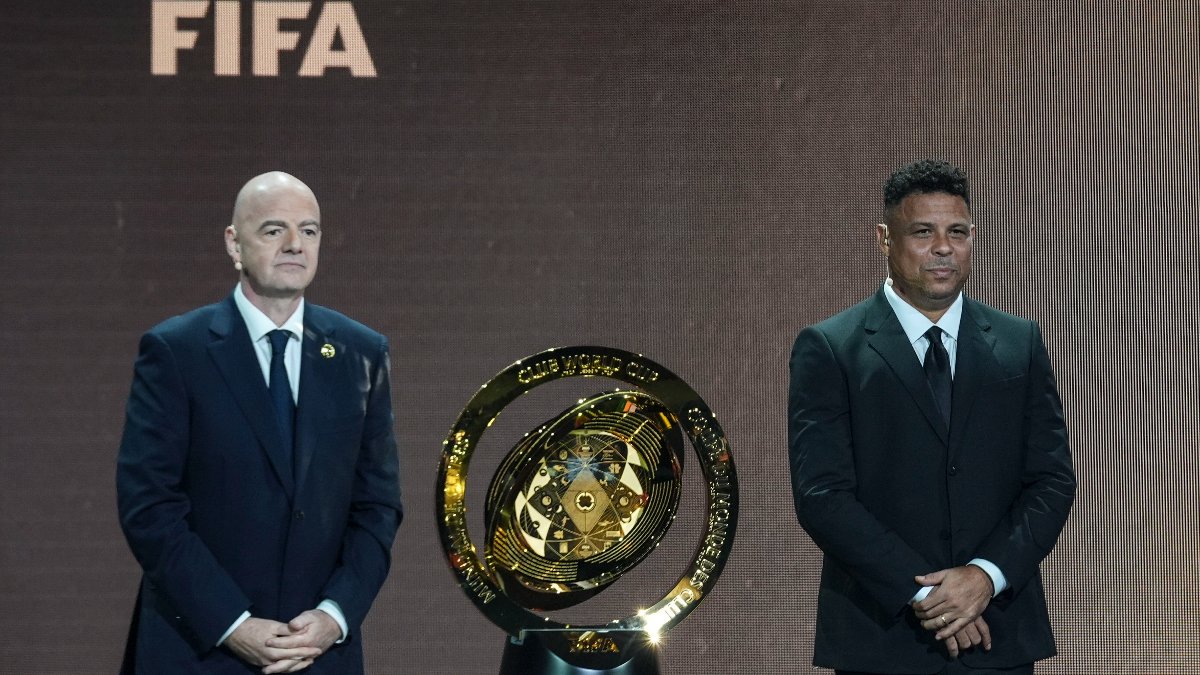
With 30 Days left for the upcoming FIFA World Cup 2026 scheduled to take place in the USA, Mexico, and Canada, as many as 3 billion people are left in a state of dilemma as to whether they can watch the biggest football fiesta on their TVs. The stalemate has reached such a boiling point that FIFA still does not have a broadcast deal in place for China and India, as all the prospective bidders are playing a tug-of-war with the broadcasting rights.
The problem has forced the FIFA delegation, comprising Mattias Gradstrom and the director of media rights, Jean-Christophe Petit, to try and woo authorities in Beijing to buy the ‘overpriced’ broadcasting rights.
Why Is FIFA Not Able To Tap In Asian Market With WC Fiesta?
Broadcasting rights have not been such a major problem for FIFA in Asian markets, where there is a sizeable population following and watching football. But what changed this year? The answer lies in the ‘Price’ of these broadcasting rights. According to a report by the South China Morning Post (SCMP), the original demand put forth by FIFA had been USD $ 300 million. This was way higher than the USD $ 80 million that the China Central Television (CCTV) was willing to shell out.
The last amount that the CCTV was willing to go ahead with was somewhere between USD $ 120 million and USD $ 150 million. However, the deal could not be reached at that point in time between the two sides. The South China Morning Post (SCMP) had speculated that FIFA was willing to cut its asking price by over 50%. It also noted that a deal is expected to be finalised and officially announced by the end of May in China.
“Both sides were said to be optimistic about reaching a deal and an announcement was expected to be made in the second half of May, with FIFA willing to make the ‘significant concessions’ for the tournament,” the SCMP wrote. But according to the CCTV, there was a deliberate attempt by FIFA to package two WC- 2026 and 2030 and sell them, which was creating the price hike.
The FIFA World Cup in 2030 is expected to take place in six different countries- Morocco, Portugal, Spain, Argentina, Uruguay and Paraguay. Coming to broadcasting in India, the Reliance-Disney joint venture had earlier quoted $ 20 million. According to Reuters, it was only a fraction of the entire sum asked by FIFA, and the deal was thrown out of the window.
Problem Of ‘Timings’
The odd viewing hours in Asia are one of the major problems that are bringing a recurring question to the forefront- What are our stakes in this? For instance, the timings in China will be 3 am when the matches are going on in America. In India, the time will be in the range of 4:30 am to 6 am.
Consequently, the broadcasters are asking why they should shell out so much money for such odd timings.
The problem has not been limited to China and India. Things have not been very smooth in Thailand as well, and there was a growing raucous among the football fans of the country. However, the Thai Prime Minister stepped in and assured the football-frenzied fans of the country that the government would not miss out. The outrage last month, as no deal was forthcoming, PM Anutin Charnvirakul had to step in.
“Previous governments ensured free access to the World Cup, and my administration should not be an exception,” he was quoted as saying by Thailand Enquirer.
What Will Happen If FIFA WC Is Not Shown?
According to James Walton, sports business leader at Deloitte Asia Pacific, quoted by the Enquirer, the population can become mad once the tournament blackout starts to sink in the country. “One way or another, a deal will be reached. Realistically, fans in all these countries will definitely get to watch as their governments will realise the potential for unrest,” Walton was quoted as saying.
While a sense of nostalgia and mild amusement is settling in, according to unverified reports on social media, there is a possibility that the state broadcasting ministry will spearhead Doordarshan to secure the rights of the upcoming FIFA World Cup. However, the broader question that remains is how long FIFA can continue to overlook the Asian markets to satiate its financial thirst.
Story first published: Tuesday, May 12, 2026, 13:08 [IST]
About the Author