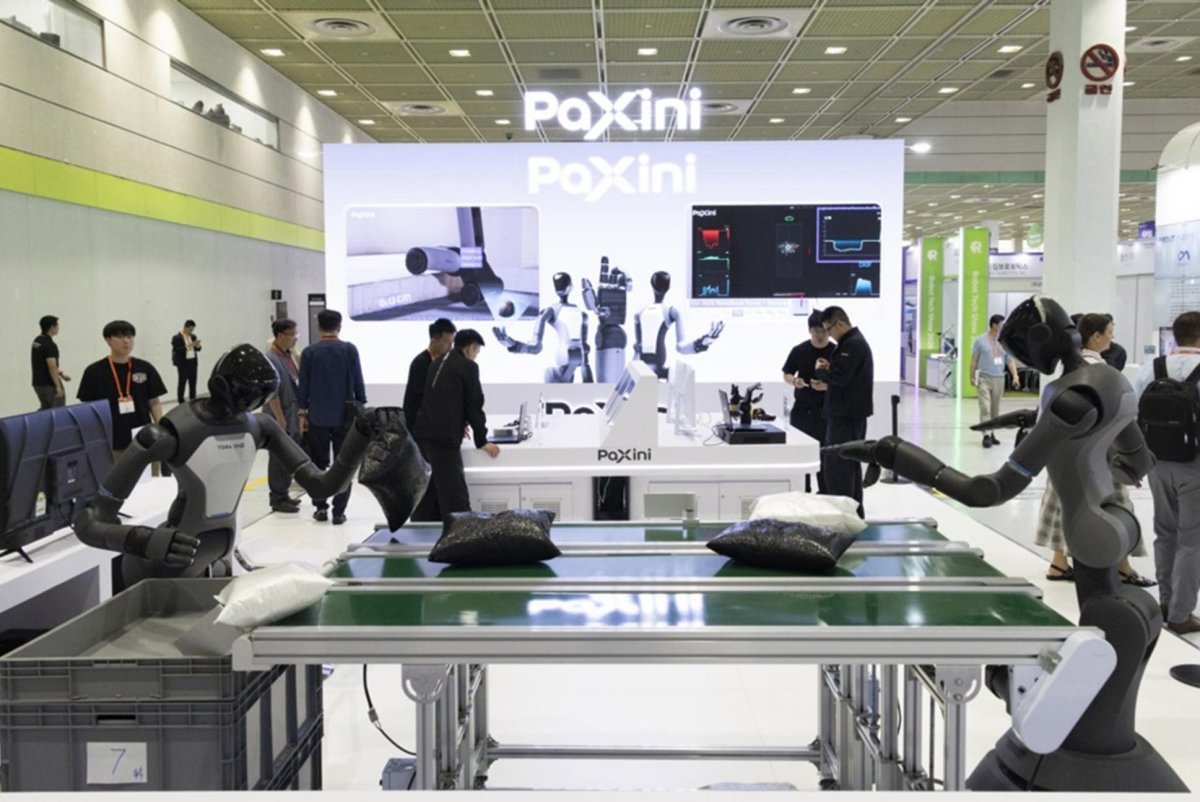
People visit the Robot tech show 2026 at the COEX exhibition center in Seoul, South Korea, 10 June 2026. The event showcases the latest advancements in robotics technology. Photo by JEON HEON-KYUN / EPA
June 28 (Asia Today) — Artificial intelligence and automated robots are helping HD Hyundai Electric’s newest South Korean factory achieve an on-time delivery rate approaching 100% as global demand for power distribution equipment surges.
The company’s Cheongju Power Distribution Campus, which began operations in February, uses AI-based production planning and automated logistics to coordinate manufacturing from the arrival of materials through final shipment.
When a customer order enters the system, materials are automatically retrieved and divided into containers at a 26-foot-high warehouse. Autonomous mobile robots then calculate the most efficient routes and transport the materials to production lines.
The 21-acre campus is designed as a flexible smart factory capable of manufacturing about 50,000 product configurations on shared production lines.
Its products range from air circuit breakers and vacuum circuit breakers used at power plants and industrial facilities to molded-case circuit breakers commonly installed in homes and commercial buildings.
The factory has an annual production capacity of 8.5 million units.
Its flexible production system allows multiple models to be assembled on a single line, reducing the time required to change products and improving assembly efficiency.
The factory’s central production system, called Single Plan, uses AI demand forecasts to connect sales projections with production schedules and supplier orders.
“AI allows sales forecasts to move through the sales and operations planning process and become precise production plans,” said Kim Se-yong, who oversees low- and medium-voltage product design and production.
“Our suppliers can also prepare the necessary parts in advance based on those plans,” Kim said.
The system manages production data for about 50,000 product variations, helping the company reduce unused materials and prevent bottlenecks while meeting customer delivery schedules.
Robots carry out the plans established by the AI system.
Depalletizing robots separate materials into containers at the automated warehouse. Autonomous mobile robots then deliver the parts to production lines two or three days before they are needed.
The campus operates 12 autonomous mobile robots, 10 automated case-handling robots and 20 logistics shuttles.
Automation has reached 95% on production lines for low-voltage equipment, including molded-case circuit breakers. Machine-vision systems also inspect product surfaces, reducing defects even in an environment characterized by small production runs and frequent model changes.
The company said the automated campus will help it compete for growing global demand driven by the construction of AI data centers and investment in electric grids.
Delivery times have become increasingly important as customers seek to secure power equipment through long-term supply agreements and reduce supply-chain risks.
HD Hyundai Electric has raised overall equipment effectiveness, a measure of factory productivity, from 58% to about 75%.
The company aims to increase that figure to 90% by 2030 and expand annual low- and medium-voltage circuit-breaker production capacity to 13 million units.
It also plans to gradually transfer production equipment for switchboards and distribution transformers from its Ulsan factory to Cheongju, bringing major parts of its power distribution supply chain together at one campus.
“Customers are increasingly trying to secure supplies in advance through long-term contracts to reduce supply-chain risks,” said Lee Chang-ho, executive vice president and head of the company’s power distribution business.
“The Cheongju campus’ on-time delivery rate for projects is currently approaching 100%,” Lee said.
Lee said the facility was named the Cheongju Power Distribution Campus rather than simply a circuit-breaker factory because the company ultimately plans to manufacture a wider range of power distribution products at the site.
“With new demand coming from data centers, we expect the power distribution business to become one of the company’s growth engines and play a central role in improving the stability of its earnings,” he said.
— Reported by Asia Today; translated by UPI
© Asia Today. Unauthorized reproduction or redistribution prohibited.
About the Author