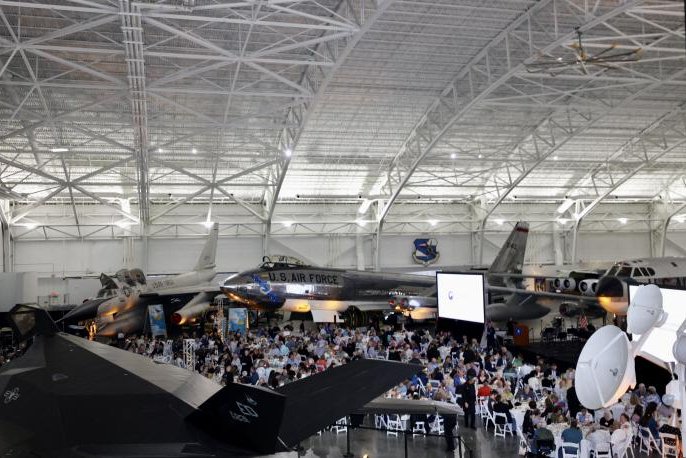
1 of 5 | South Korea’s Ministry of Patriots and Veterans Affairs hosts a dinner Friday for Korean War and Cold War POW/MIA families at the Strategic Air Command & Aerospace Museum in Omaha, Neb. Photo by Asia Today
Aug. 8 (Asia Today) — Rick Downes and Donna Knox have spent more than seven decades waiting for answers about their father, U.S. Air Force 2nd Lt. Harold W. Downes Jr., who disappeared during a nighttime mission over North Korea during the Korean War.
Rick, who was 3 when his father went missing, said Friday that his father lives more in his heart than in his memories.
Donna, who was born about six weeks after her father disappeared, said the uncertainty left the family with “a wound that never really heals.”
Their story was shared in Omaha as South Korea and the United States renewed efforts to recover and identify service members still missing from the Korean War and support the families who have waited decades for answers.
South Korea’s Ministry of Patriots and Veterans Affairs and the U.S. Defense POW/MIA Accounting Agency signed a memorandum of understanding Friday on international cooperation in recovering remains and supporting families of prisoners of war and those missing in action.
The ministry also announced plans for a campaign honoring the 7,359 U.S. service members from the Korean War who remain unaccounted for.
Siblings grew up knowing their father through their mother
Rick was only 3 when his father disappeared.
He said his own memories of his father are faint and that he came to know him largely through stories, photographs and letters preserved by his mother.
His parents had been deeply in love, Rick said, and his mother continually told her children about their father, keeping him “alive in our memories.”
Downes was 26 at the time and his wife was 25.
After briefly serving during World War II, Downes graduated from the University of Michigan and reported for his first civilian job. On his first day, however, he received notice that he had been recalled to military service from the reserves.
Rick recalled a family story that his father responded to the news by saying he had not even had time to sharpen his pencil.
After additional training, Downes was sent to Korea.
Donna never had a chance to remember her father herself.
“I was born about a month and a half after he went missing,” she said.
She learned about him through the stories her mother told.
Because Downes was classified as missing rather than killed in action, his family held onto the possibility for years that he might someday walk through the front door.
“We kept hoping and waiting, but as time went on, that hope faded,” Donna said. “We missed him and didn’t know what had happened. Because we never had closure, there is really a wound inside us that never heals.”
Rick said the burden was especially difficult for their mother, who had to rebuild her life while raising two young children after her husband disappeared.
Downes was aboard a B-26C Invader bomber on a nighttime mission over North Korea when the aircraft was lost.
Donna said the pilot and navigator survived and were taken prisoner, remaining in captivity until the end of the war. The Downes family, however, never learned conclusively what happened to her father.
The family was initially told that the survivors had said Downes was dead.
Years later, when Rick and Donna were old enough to locate and speak directly with the survivors, they were told something different.
The men said they had never made such a statement and did not know whether Downes had survived.
Search for their father eventually took siblings to North Korea
Their father’s disappearance tied Rick and Donna to Korea for more than 70 years.
“Korea is a big part of our family,” Rick said.
He said he has often wondered why his father had to make such a sacrifice there. But when he looks at the freedom, prosperity and lives South Koreans enjoy today, he said he believes “something good came out of it.”
Still, the personal question remains unanswered.
“Personally, like everybody here tonight, I’m still looking for answers,” Rick said. “Unfortunately, most of our answers are inside North Korea.”
The siblings have even traveled to North Korea in search of a greater connection to their father’s final mission.
“We’ve both been to North Korea,” Donna said.
Being close to the place where their father disappeared gave them a sense of connection to him, she said.
Rick said he hopes dialogue among the United States, South Korea and North Korea will eventually make it possible to resume searches for missing personnel inside North Korea.
If investigators could locate the crash site of his father’s aircraft, he said, they might also be able to find local residents with knowledge of what happened that night.
Donna said the best outcome would have been for her father to have returned alive.
“But now we just want some kind of answer about what happened,” she said.
Finding his remains, she said, could provide clues about his final moments and finally answer questions the family has carried for generations.
South Korea hosts dinner for about 500 POW/MIA family members
The Ministry of Patriots and Veterans Affairs hosted about 500 families of prisoners of war and missing service members Friday at the Strategic Air Command & Aerospace Museum in Omaha following the signing of the bilateral agreement.
The setting reflected the history that brought the families together.
Tables for the guests were arranged among large military aircraft. Exhibits included material on Korean War veterans, signs pointing toward Seoul and Incheon and a display on the World War II bombing of Tokyo.
The Seocho Philharmoniker performed arrangements combining U.S. and South Korean military songs as well as Korean traditional music and classical works. A musician wearing traditional Korean clothing also performed a gayageum solo.
Kang Yun-jin, South Korea’s vice minister of patriots and veterans affairs, said the Korean delegation traveled from Seoul to Omaha to personally convey the gratitude of the South Korean people to families of missing U.S. service members.
Kang recalled President Lee Jae Myung’s remarks at a June 5 ceremony for the reciprocal repatriation of Korean and U.S. war remains.
Lee said returning heroes who had been unable to come home for decades to the embrace of their countries was “our historic responsibility as those who survived.”
Kang said the new agreement reflects a commitment by both countries to search not only for their own service members but also for those of their ally and return them to their families.
South Korea also plans to begin inviting families of missing and captured service members to visit the country and tour former battlefields and other places connected to their loved ones.
Although 76 years have passed since the Korean War began, Kang said 7,359 American service members who sacrificed themselves for South Korea’s freedom and peace still have not been accounted for.
The ministry said it will continue a campaign built around the principle “No Hero Left Behind.”
At the annual Korea and Cold War government briefings in Omaha, Kang said the agreement represents three promises: that the two countries will not forget those who went missing or became prisoners of war, that they will continue to support their families and that they will search for the missing until they can be returned home.
He said South Korea and the United States would continue those efforts based on their alliance and the trust built between the two countries.
According to the South Korean ministry, about 1.789 million U.S. service members served in the Korean War and 36,574 were killed.
The agency currently lists 7,359 U.S. personnel from the Korean War as unaccounted for.
South Korea expands flag campaign to 7,359 missing Americans
The South Korean ministry’s new “7,359 Stars and Stripes That Must Be Brought Home” campaign expands an initiative launched in 2020 for missing South Korean troops.
That earlier campaign, known as “122609 Taegeukgi That Must Be Brought Home,” honors South Korean service members whose remains had not been recovered.
Its Taegeukgi badge was modeled after the South Korean flag draped over the wooden boxes used to carry recovered remains.
The new version will use the Stars and Stripes for missing U.S. troops.
The ministry plans to produce 7,359 individually numbered badges and discuss with U.S. officials how they could be distributed to families and members of the American public.
U.S. agency puts 20 DMZ cases on investigation list
Efforts are also moving forward to prepare for possible recovery work inside the Demilitarized Zone separating North and South Korea.
During a panel discussion on DMZ strategy at the annual briefings, Dawn Berry, the agency’s Indo-Pacific chief of research for Korea, the Cold War and China, described the DMZ as a high-priority area.
Berry said the agency had recently added 20 cases involving bodies not recovered from the DMZ to its master investigation list for the first time.
The agency examines individual ground and aircraft losses as well as missing personnel from larger battles.
Berry said working south of the Military Demarcation Line is currently easier, but researchers are also examining cases involving areas that cross the line or lie inside North Korea.
“We want to be as prepared as possible when we are able to get into North Korea,” she said.
The agency is considering investigating within roughly the next two years the loss of a single-seat U.S. Marine Corps aircraft near White Horse Hill, where South Korean recovery teams are already conducting operations.
Gabe Zinni, the agency’s Indo-Pacific senior planner for Korea, the Cold War and China, described a recovery mission in the DMZ as one of the most complex operations the agency has planned in the past 25 years.
The area contains both active and historic minefields as well as unexploded ordnance, meaning the agency could not conduct such a mission alone.
Any operation would require cooperation with the South Korean military, South Korea’s remains-recovery agency, the United Nations Command and the South Korea-U.S. Combined Forces Command.
U.S. Marine Corps Lt. Col. Jeremy Smith, the agency’s Indo-Pacific deputy director, said agency personnel visited recovery sites in the DMZ in May and that another visit by officials involved in operations was being coordinated.
The agency said its May mission included observation of South Korean recovery operations at White Horse Hill and a joint visit near Hill 111.
For Rick Downes, all of that preparation ultimately points toward the same place where his family’s seven-decade search has led.
“Our answers are inside North Korea,” he said.
— Reported by Asia Today; translated by UPI
© Asia Today. Unauthorized reproduction or redistribution prohibited.
About the Author