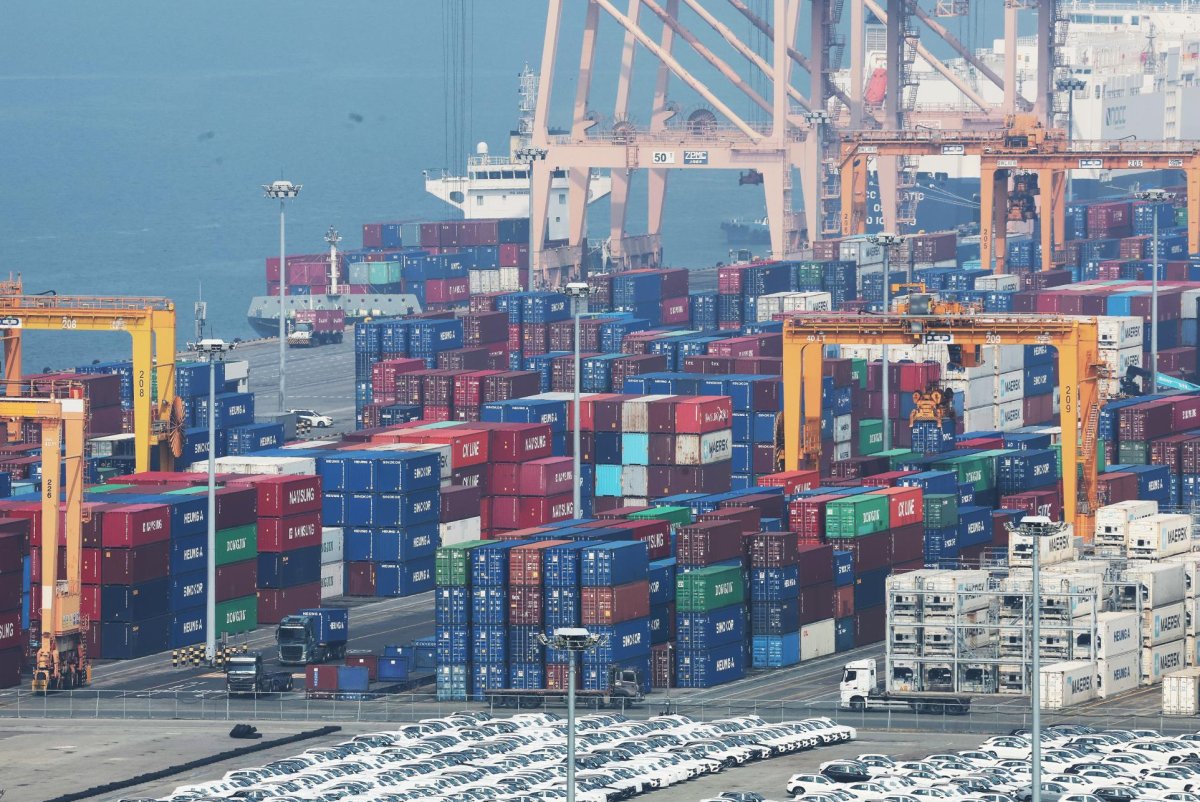
South Korea’s economy grew at its fastest pace in nearly six years in the first quarter, central bank data showed Thursday, driven by strong chip exports. In this April 1 photo, containers are stacked at a port in Pyeongtaek. Photo by Yonhap
SEOUL, April 23 (UPI) — South Korea’s economy grew at its fastest pace in nearly six years in the first quarter, central bank data showed Thursday, beating expectations as surging semiconductor exports powered the expansion.
Gross domestic product rose 1.7% from the previous quarter in the January-March period, the Bank of Korea said in preliminary data, marking the strongest growth since a 2.2% expansion in the third quarter of 2020. The figure nearly doubled the bank’s forecast of 0.9%.
On an annual basis, the economy expanded 3.6%, the fastest since the fourth quarter of 2021.
Exports climbed 5.1% on-quarter, driven by strong global demand for semiconductors and other IT products, while facility investment rose 4.8% and construction investment increased 2.8%.
“The semiconductor manufacturing sector accounted for a little more than half of overall growth,” Lee Dong-won, director general of the BOK’s economic statistics department, said at a press briefing, estimating the contribution at around 55%.
Lee said the strength of the chip sector had exceeded expectations, pointing to earnings at major South Korean semiconductor firms that approached or surpassed their full-year results from last year.
Consumer spending, which rose 0.5% on-quarter, also helped underpin the expansion.
“Private consumption, which accounts for about half of our economy, provided the basic foundation,” Lee said, adding that a contraction in spending would have made it difficult for overall growth to increase.
Real gross domestic income surged 7.5% from the previous quarter — the fastest pace since 1988 — driven by improved terms of trade as export prices, particularly for semiconductors and IT goods, rose sharply.
Lee said the conflict in the Middle East had a limited impact on first-quarter growth, as shipments passing through the Strait of Hormuz continued to arrive through late March, but warned the effects are likely to emerge from April.
“Uncertainty remains very high,” Lee said, noting that second-quarter growth will hinge on the balance between downside risks such as higher oil prices and supply disruptions and positive drivers including strong chip exports and policy support.
Analysts at ING described the first-quarter performance as “remarkable” and raised their 2026 growth forecast for South Korea to 2.8% from 2.0%.
However, the bank cautioned that prolonged supply disruptions could weigh on chip production and investment in artificial intelligence, posing outsized risks for an economy heavily reliant on semiconductors.
“We expect strong chip momentum to continue, but also a slowdown in 2Q26 growth as energy disruptions affect activity across petrochemicals and other manufacturing sectors,” ING said in a note.
About the Author