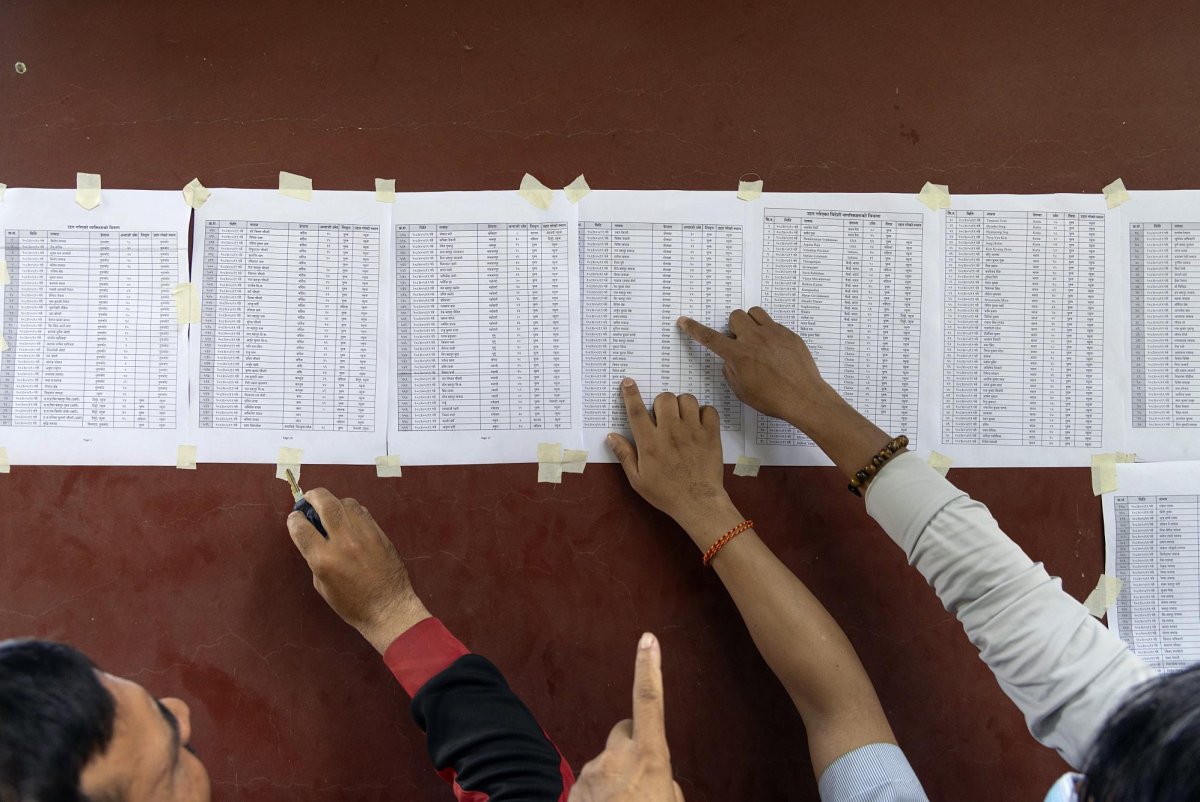
People search the names of their relatives on lists of missing people outside the army operations center in the aftermath of flash floods, in Nuwakot district, Nepal, Friday. More than 500 people have died and hundreds remain missing across northern Nepal after a suspected glacial collapse and avalanche triggered flash floods and mudslides along the Bhotekoshi and Trishuli river valleys near the Nepal-Tibet border. Photo by Narendra Shrestha/EPA
Aug. 28 (UPI) — Lists of identified survivors line the exterior walls of a building at a Nepal army base as people search the names of their loved ones after a devastating flash flood killed at least 579 people with more than 1,900 still missing.
Another building showed photos of unidentified bodies that authorities had found. People perused them to find missing family members.
The flash flood, triggered by a collapsed glacier, hit north-central Nepal on Wednesday morning, leaving people stranded, missing or dead, with entire towns buried in mud.
More than 3,700 people have been rescued so far, Nepali officials have said, including some who had been trapped in a tunnel that was part of a hydroelectric project under construction. Footage shows rescuers pulling people across a river of mud, and others trudging through deep mud with survivors on their backs.
There are still 90 Americans missing, 977 Nepalese people missing and about 658 Chinese citizens missing, The Guardian reported. Others missing include: Malaysia, 51; Ukraine, 55; Australia, 39; Great Britain, 33; Canada, 25; South Korea, 9; Singapore, 8, Germany, 8; Russia, 8; South Africa, 6; and others from Latvia, Japan, New Zealand, France, Belgium, Spain, Italy, Kazakhstan, Portugal, Ireland and the Netherlands. There is one each missing from Belarus, Finland, Hungary, Israel, Lithuania, Philippines, Bulgaria, Switzerland, Serbia and Sweden.
Chinese authorities have said that five people have been confirmed dead in Tibet.
As Nepal and Tibet work to rescue survivors and unearth bodies, they are trying to take care of people injured or waiting for news.
David Fisher, head of delegation for the Red Cross in Nepal, told reporters in Kathmandu that about 93,000 people need support, The New York Times reported. He added that it was a preliminary estimate because some places are only accessible by helicopter and hadn’t yet been reached.
“We’re of course very concerned about the secondary flood,” Fisher said, adding that Red Cross trucks with relief supplies were blocked by a flood-created lake that had breached its banks.
One flood-created lake that threatened to breach is now in much less danger of doing so. China Central Television, a state broadcaster, said the lake level had dropped by more than 30 feet since the day before, The Times reported.
But the flood threat lingers. The Chinese water resources ministry said rain was forecast over the next three days and could double the volume of water in the lake.
One city, Bharatpur, has become the main collection area for bodies. But morgues and hospitals in the area can’t hold the amount of bodies arriving, The Times reported. The Nepal government turned a government building into a mortuary for about 150 bodies and they were trying to get dry ice to keep the bodies cool.
“It has no chilling facilities,” said Rameshwor Poudel, the district’s police chief. “It only has air-conditioners.”
He added that many of the remains had washed up in pieces, making it more difficult to identify them. Police clean the bodies and take pictures of the ones that are recognizable and post them for people to identify.
About the Author