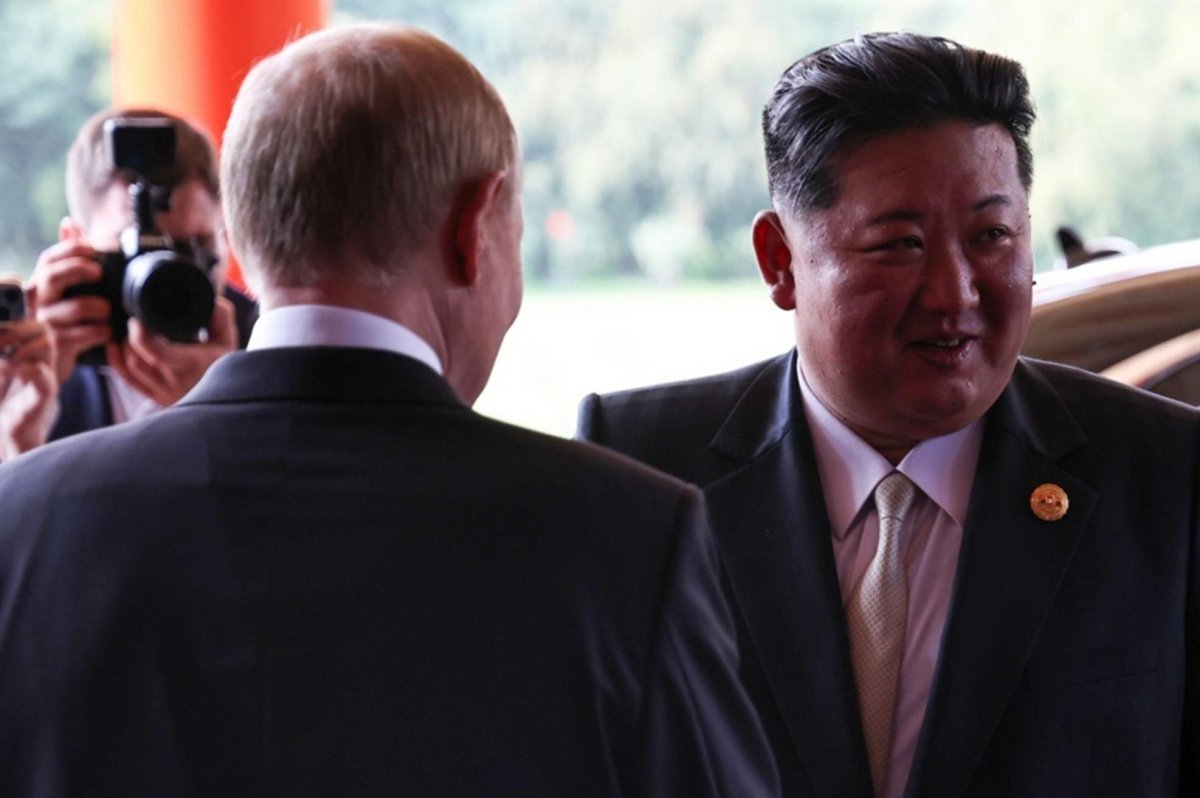
Russian President Vladimir Putin (L) bids farewell to North Korean leader Kim Jong Un following their meeting at the Diaoyutai State Guesthouse, on the occasion of the 80th anniversary of victory in the Chinese People’s War of Resistance against Japanese Aggression and the end of World War Two, in Beijing, China. Photo by ALEXANDER KAZAKOV / EPA
July 26 (Asia Today) — North Korean leader Kim Jong Un has ordered the country’s main intelligence agency to significantly strengthen its military reconnaissance and foreign intelligence capabilities, raising concerns about deeper information cooperation among North Korea, Russia and China.
North Korean state media said Kim issued the order during a meeting this month, calling for the country to improve its ability to collect essential intelligence and respond to threats from potential adversaries.
North Korea expanded and renamed its Reconnaissance General Bureau as the General Reconnaissance and Information Bureau in September 2025.
The agency oversees conventional espionage, overseas covert operations, cyberattacks and military satellite reconnaissance.
The restructuring appears intended to give the organization a broader role in collecting and analyzing foreign intelligence as Pyongyang deepens its military relations with Moscow and political ties with Beijing.
North Korea seeks to address intelligence limitations
North Korea has conducted major overseas operations despite having a relatively limited global intelligence network.
The country has been blamed for the 2014 cyberattack against Sony Pictures Entertainment, the theft of South Korean and U.S. military plans in 2016 and the 2017 assassination of Kim’s half brother Kim Jong Nam in Malaysia.
North Korea has denied responsibility for the Sony attack and involvement in Kim Jong Nam’s death.
Pyongyang maintained diplomatic missions in about 43 countries as of 2024, giving its intelligence officers and overseas operatives a significantly smaller diplomatic network than major powers.
North Korean diplomats and trade representatives have previously been accused of supporting weapons transactions, sanctions evasion and intelligence operations.
The country also has only one military reconnaissance satellite known to have reached orbit successfully.
The Malligyong-1 satellite was launched in November 2023. Outside analysts have questioned the quality and operational value of the images it can produce.
Kim has ordered the development of additional reconnaissance satellites, but subsequent launches have failed or experienced delays.
Russian technology could improve satellite program
South Korean intelligence officials have said Russia may be providing North Korea with technical assistance related to satellites and space launches in return for Pyongyang’s support for Moscow’s war against Ukraine.
Kim visited Russia’s Vostochny Cosmodrome during his September 2023 summit with Russian President Vladimir Putin.
Security analysts said the location of the meeting highlighted North Korea’s interest in acquiring Russian knowledge related to launch vehicles, satellite operations and advanced military technology.
Russian assistance could help North Korea build a group of reconnaissance satellites capable of monitoring South Korea, Japan and U.S. military facilities more frequently.
A single satellite provides only limited coverage because it passes over a target area periodically. Multiple satellites operating together would allow North Korea to collect images more often and track military movements more effectively.
North Korean and Russian cyber operators may also benefit from sharing malware, infrastructure and technical expertise.
North Korean hackers have been accused of stealing billions of dollars in cryptocurrency and other digital assets to finance state programs restricted by international sanctions.
United Nations investigators said they examined dozens of suspected North Korean cyberattacks against cryptocurrency companies between 2017 and 2023.
Intelligence cooperation with Russia and China
North Korea, Russia and China have not announced a formal trilateral intelligence-sharing alliance.
Joseph Bermudez Jr., a North Korea specialist at the Center for Strategic and International Studies, said the three countries could nevertheless develop a division of labor in which cyber and intelligence units focus on different regions and share selected information.
Such cooperation would not necessarily resemble the institutionalized Five Eyes partnership among the United States, Britain, Canada, Australia and New Zealand.
It could instead involve informal exchanges of satellite images, intercepted communications, cyberattack techniques and intelligence gathered through overseas diplomatic missions.
Russia could provide satellite and military expertise while China could offer access to communications infrastructure, technology and a broader overseas presence. North Korea could contribute cyber personnel, weapons data and information gathered through its networks.
The extent of any current intelligence exchange among the three countries remains unclear.
Overseas expansion could increase cyber risks
North Korea has sought to strengthen relations with governments aligned with Russia as it expands its overseas presence.
Kim held his first summit with Belarusian President Alexander Lukashenko in March. Belarus plans to open its first embassy in Pyongyang in August.
Former South Korean Special Warfare Commander Chun In-bum said an expanded diplomatic network could give North Korea more opportunities to monitor foreign communications and support overseas cyber operations.
North Korean hackers have previously operated from or used infrastructure connected to countries with diplomatic relations with Pyongyang.
Analysts warned that closer cooperation with Russia and China could help North Korea overcome weaknesses in human intelligence, satellite surveillance and international access.
It could also increase risks for South Korean government agencies, defense companies, financial institutions and overseas diplomatic missions.
— Reported by Asia Today; translated by UPI
© Asia Today. Unauthorized reproduction or redistribution prohibited.
About the Author