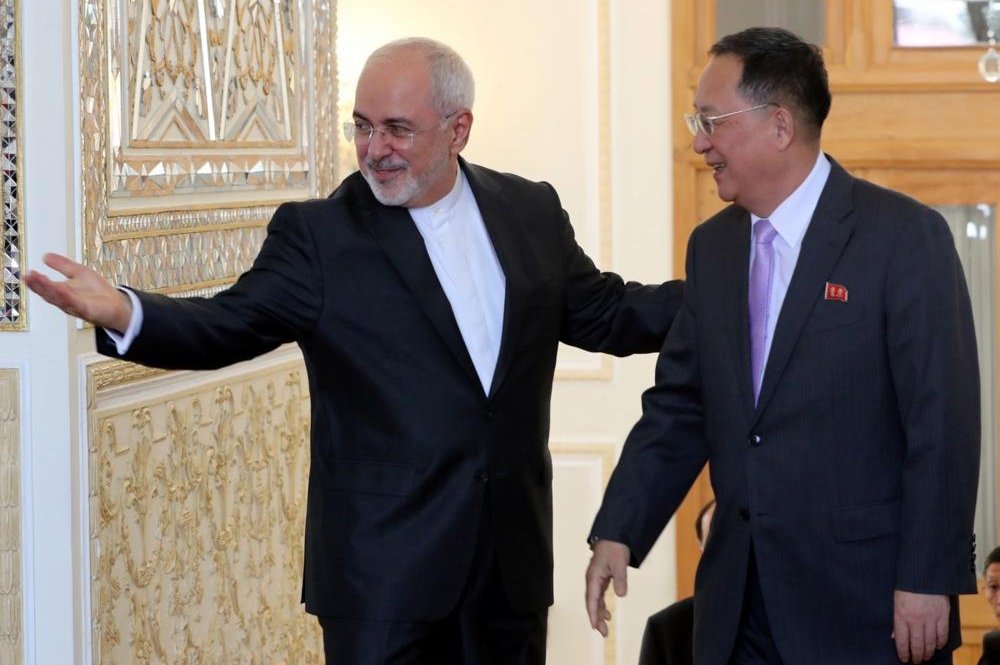
The relationship between Iran and North Korea goes back decades. Here, then Iranian foreign minister Mohammad Javad Zarif (L) welcomes his then North Korean counterpart, Ro Yong-ho, in Tehran in 2018. File Photo by Abedin Taherkenareh/EPA
May 11 (UPI) — The author prefers to use the lowercase “n” in north Korea to challenge the Kim family regime’s legitimacy.
History is not made only by what happens. It is also shaped by what we allow to survive. That is the question we should ask about Iran today.
When Israeli, American and allied planners assess Iranian missile attacks, hardened underground facilities, drone swarms and long-range strike capabilities, they usually begin with Tehran. But the trail does not end there. It runs east to Pyongyang.
The Pyongyang-Tehran axis
Much of what Iran wields today was not built in isolation. It was transferred, adapted, refined and sustained through decades of strategic cooperation with north Korea.
Bruce E. Bechtol Jr. and Anthony N. Celso document this in Rogue Allies: The Strategic Partnership between Iran and North Korea. Their work makes a hard point: North Korea and Iran are not parallel rogue states. They operate as interdependent partners in proliferation, sanctions evasion, missile development and regime survival.
That fact changes the question. We should not only ask what Iran is doing now. We should ask what Iran could do if north Korea had not helped build the arsenal, infrastructure and doctrine that now give Tehran coercive reach.
The arsenal Iran did not build alone
Iran’s missile force did not emerge from Persian soil alone. The Shahab line drew heavily from north Korean missile technology. Iran’s hardened underground infrastructure reflects lessons Pyongyang spent decades perfecting. Its logic of concealment, dispersal, survivability and deception carries north Korean fingerprints.
This was not charity. It was commerce and strategy. north Korea needed money, oil,and relevance. Iran needed capability. Both regimes needed time.
Together, they built a military ecosystem. The West too often treated Iran as a Middle East problem and north Korea as a peninsula problem. That was the error. Their collusion was always a strategic problem that was connected.
First lost moment: 1994
The first great hinge was 1994. Had the north Korean nuclear issue been solved then, either through effective diplomacy or decisive force, the strategic landscape would look different today.
A fully dismantled and verified nuclear program — including its future highly enriched uranium program — would have denied Pyongyang the leverage, money and prestige that came from becoming a nuclear proliferator. A forceful solution, though dangerous, might also have ended the regime’s ability to develop and export strategic weapons. Either way, Iran would have faced a much harder road.
The Agreed Framework froze part of the problem. It did not solve the regime problem. That distinction mattered. The issue was never only one reactor at Yongbyon. It was the future architecture of proliferation.
Neustadt and May warned in Thinking in Time that policymakers fail when they isolate today’s decision from yesterday’s pattern and tomorrow’s consequence. In 1994, the United States and its allies managed a crisis. They did not close the strategic pipeline that later helped Iran.
Second lost moment: 1997
The second hinge came in 1997. The Kim regime was weak. Famine had ravaged the north. The economy was broken. The system was brittle. Then came Kim Dae-jung’s Sunshine Policy. Its intent was reconciliation. Its effect was preservation. It gave the Kim family time, resources and political space.
Had the regime collapsed in the late 1990s, the “Korea question” (Paragraph 60 of the Armistice Agreement) might have been solved. A free and unified Korea, or United Republic of Korea, could have emerged under Seoul’s leadership.
That would have transformed Northeast Asia. It also would have transformed the Middle East. Iran would have lost one of its most useful military partners. There would have been no north Korean missile engineers to assist Tehran, no tunnel specialists, no conventional weapons pipelines, no sanctions evasion architecture and no model of nuclear blackmail to study and adapt.
The U-ROK counterfactual
Iran would still be hostile. It would still back proxies. It would still seek influence across the region. But hostility is not the same as capability. Ambition is not the same as reach. Without north Korea, Iran’s missile force would likely be smaller, less reliable, less survivable and slower to mature. Its escalation ladder would be shorter. Its confidence would be lower.
This is why the counterfactual matters. A U-ROK in the 1990s would not have solved every global security problem. It would not have ended Iranian ideology, Russian revanchism, Chinese coercion or jihadist violence. But it would have removed one of the world’s most dangerous engines of strategic proliferation. That alone would have changed the balance.
Why we overlook North Korea
So why do we overlook north Korea’s role?
Because bureaucracies love compartments. Middle East experts study Iran. Korea experts study Pyongyang. Russia experts study Moscow. Counterterrorism experts study proxies. But adversaries do not respect our wiring diagrams. They cooperate across regions. They exchange technology. They share lessons. They exploit seams.
north Korea is not a regional nuisance. It is a global malign actor. It has armed counties and malign actors conflict zones, strengthened dictatorships, assisted terrorist sponsors. It has supported Putin’s war against Ukraine and built a business model around strategic disorder. Pyongyang exports instability because instability keeps the Kim family regime in power.
The Russia parallel
The Russia example proves the point. Where would Vladimir Putin’s war be without Kim Jong Un’s support? Russia would still be dangerous. It would still have manpower, industry, and nuclear weapons. But without north Korean artillery, rockets, missiles and military support, the war in Ukraine would be harder, slower and even more costly for Moscow. north Korea has become an arsenal for embattled revisionists.
Iran is one case. Russia is another. Others will follow.
The strategic lesson
The lesson is plain. The Korea question was never only Korean. Every year the Kim family regime survives, it exports danger. It sells weapons. It teaches evasion. It models coercion. It strengthens anti-status quo powers. It helps America’s enemies endure.
A free and unified Korea is not a romantic aspiration. It is a strategic necessity. It would end the division of the peninsula, liberate the Korean people in the north, remove a nuclear-armed criminal regime and weaken the global network of rogue actors that profit from Pyongyang’s survival.
Question for policymakers
The question, then, is not whether north Korea is a global malign actor. The evidence is settled. The question is why policy still treats it as something less.
How many future wars are being armed today by problems we still call regional? If regime survival in Pyongyang strengthens Iran, Russia and other revisionist actors, is the Korea question merely unfinished history, or is it one of the central strategic problems of our time?
And if unification is the only permanent solution, what are we waiting for?
David Maxwell, executive director of the Korea Regional Review, is a retired U.S. Army Special Forces colonel who has spent more than 30 years in the Asia-Indo-Pacific region. He specializes in Northeast Asian security affairs and irregular, unconventional and political warfare. He is vice president of the Center for Asia Pacific Strategy and a senior fellow at the Global Peace Foundation, where he works on a free and unified Korea. After he retired, he became associate director of the Security Studies Program at Georgetown University. He is on the board of directors of the Committee for Human Rights in North Korea and the OSS Society and is the editor at large for the Small Wars Journal.
About the Author