
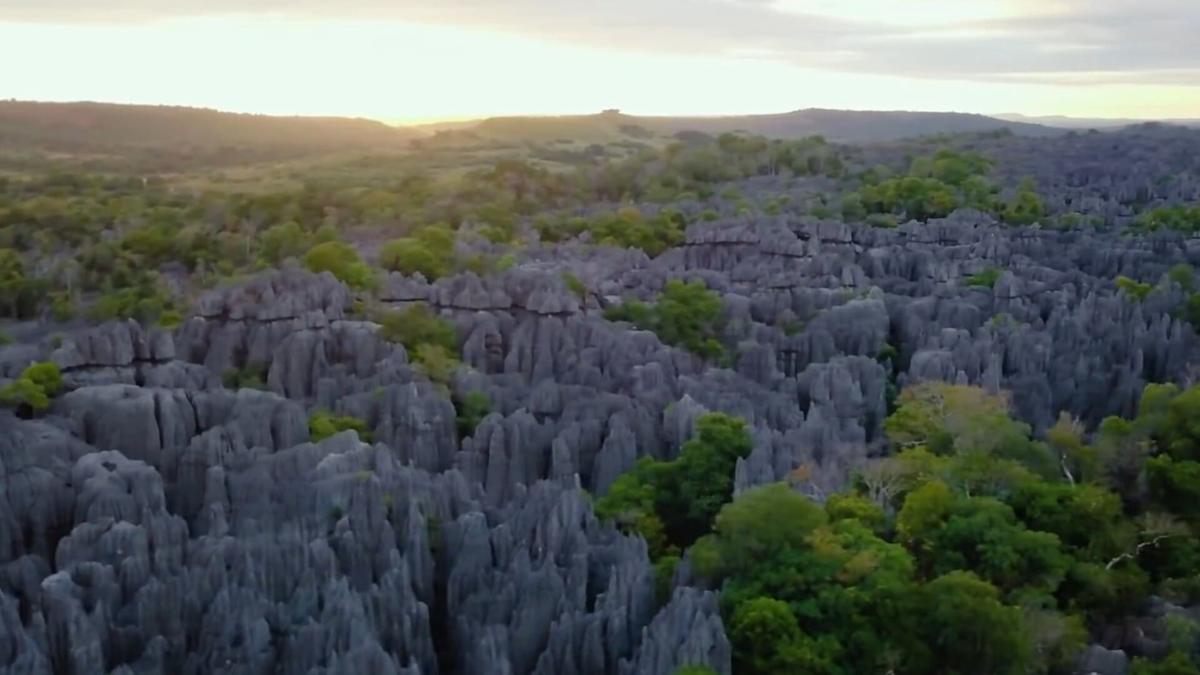
Deep within Madagascar lies one of the most unusual natural formations on Earth, a place where a forest does not grow from soil but rises in sharp stone. The Tsingy de Bemaraha National Park is often described as a ‘stone forest’ because of its towering limestone formations that stretch dramatically across the landscape. At first glance, the terrain appears almost unreal, with jagged spikes forming a dense and seemingly impenetrable maze. These formations were not always part of the land. Millions of years ago, the region was submerged under a shallow sea, where layers of limestone gradually formed. Over time, geological uplift brought the rock above sea level, and tropical rainfall began shaping it into its current form. The softer stone eroded away while the harder limestone remained, leaving behind razor sharp ridges and deep crevices. Today, the formations can rise more than two hundred feet above the ground, creating a striking natural skyline unlike any traditional forest. The name Tsingy comes from the Malagasy language and refers to a place where walking barefoot is impossible, a fitting description for such a sharp and unforgiving environment. Despite its harsh appearance, the area is recognised as a protected national park and a UNESCO World Heritage Site due to its unique geological and ecological significance.
While the stone forest may seem inhospitable, it is home to a surprising variety of life that has adapted to its challenging conditions. The intricate network of rock formations creates microhabitats that support diverse species, including several types of lemurs found only in Madagascar. Bird populations also thrive in the region, taking advantage of the vertical landscape for nesting and shelter. Vegetation grows in pockets where soil has collected, allowing plants to survive in an otherwise rocky environment. The combination of isolation and extreme terrain has helped preserve many species that might not survive elsewhere. Visitors who explore the park must navigate carefully through narrow pathways, suspended bridges, and steep climbs, making the journey both physically demanding and rewarding. The experience offers a rare opportunity to witness the intersection of geology and biology in a place that feels untouched by time. The Tsingy de Bemaraha stands as a powerful reminder of the Earth’s ability to transform landscapes over millions of years while still supporting life in the most unexpected forms. It continues to attract researchers and travellers who seek to understand and experience one of the planet’s most remarkable natural wonders.
About the Author