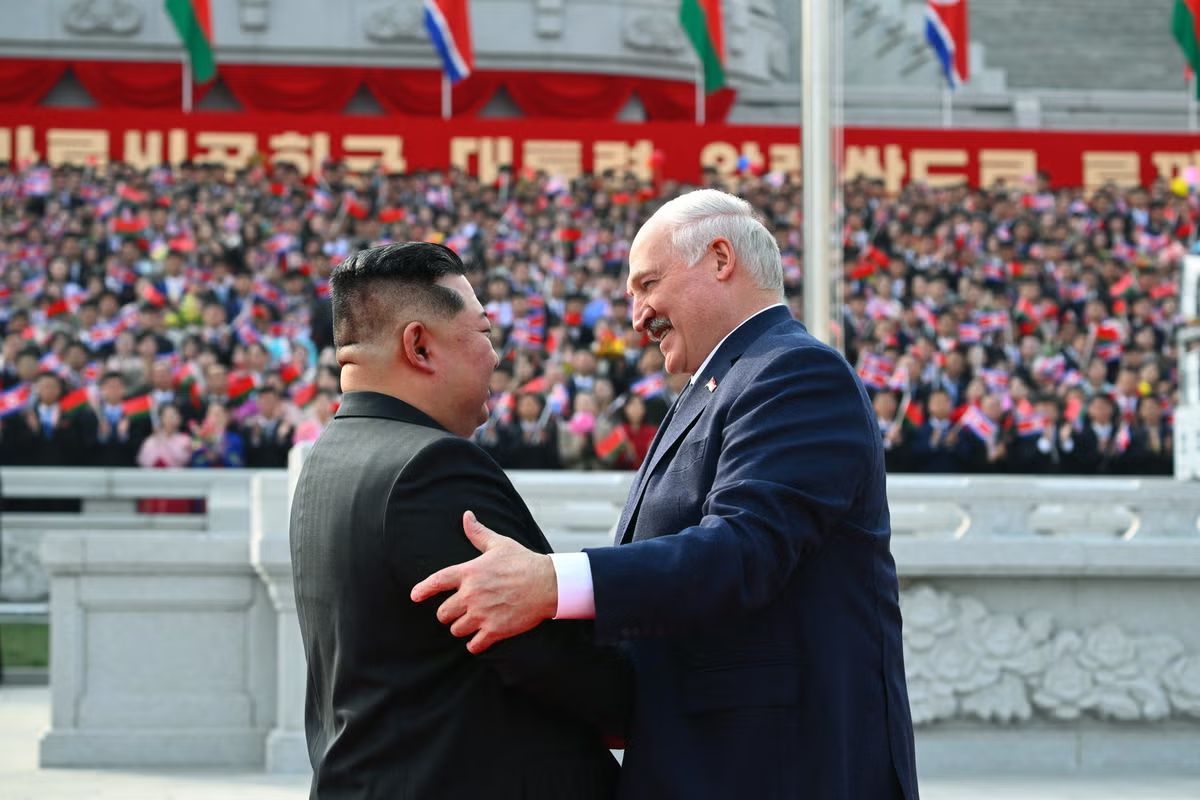
North Korean leader Kim Jong Un and Belarusian president Alexander Lukashenko signed a new treaty on friendship and cooperation in Pyongyang, marking what Minsk described as a shift to a “fundamentally new stage” in relations.
The agreement was concluded during Mr Lukashenko’s first visit to North Korea. The two-day trip began on Wednesday with a state ceremony at Kim Il Sung Square, according to North Korean and Belarusian state media.
The visit deepens North Korea’s alignment with Belarus and Russia amid the war in Ukraine.
Pyongyang is accused by South Korea and its Western allies of sending thousands of troops, along with artillery shells, missiles and rocket systems, to aid the Russian war effort in Ukraine. In return, it’s getting financial aid, military technology, and food and energy supplies, helping reduce reliance on China, its longstanding backer.
Belarus, a strategic ally of Moscow, hosts Russian forces, missiles and, reportedly, drones for use against Ukraine.
South Korea’s unification ministry says it expects the talks to focus on economic cooperation but also views the trip as part of a broader effort to reinforce Pyongyang’s coordination with Belarus and Russia.
Both Pyongyang and Minsk are subject to extensive Western sanctions. While North Korea faces restrictions linked to its nuclear weapons and missile programmes and its support for the Russian war effort, Belarus is under sanction for its role in the Ukraine conflict and its alleged crackdown on dissent following the disputed 2020 election.
North Korea and Belarus established relations in 1992 and, three years later, set up a joint trade and economic cooperation committee that was reactivated last year. North Korea maintains an embassy in Belarus, although Minsk doesn’t have one in Pyongyang.
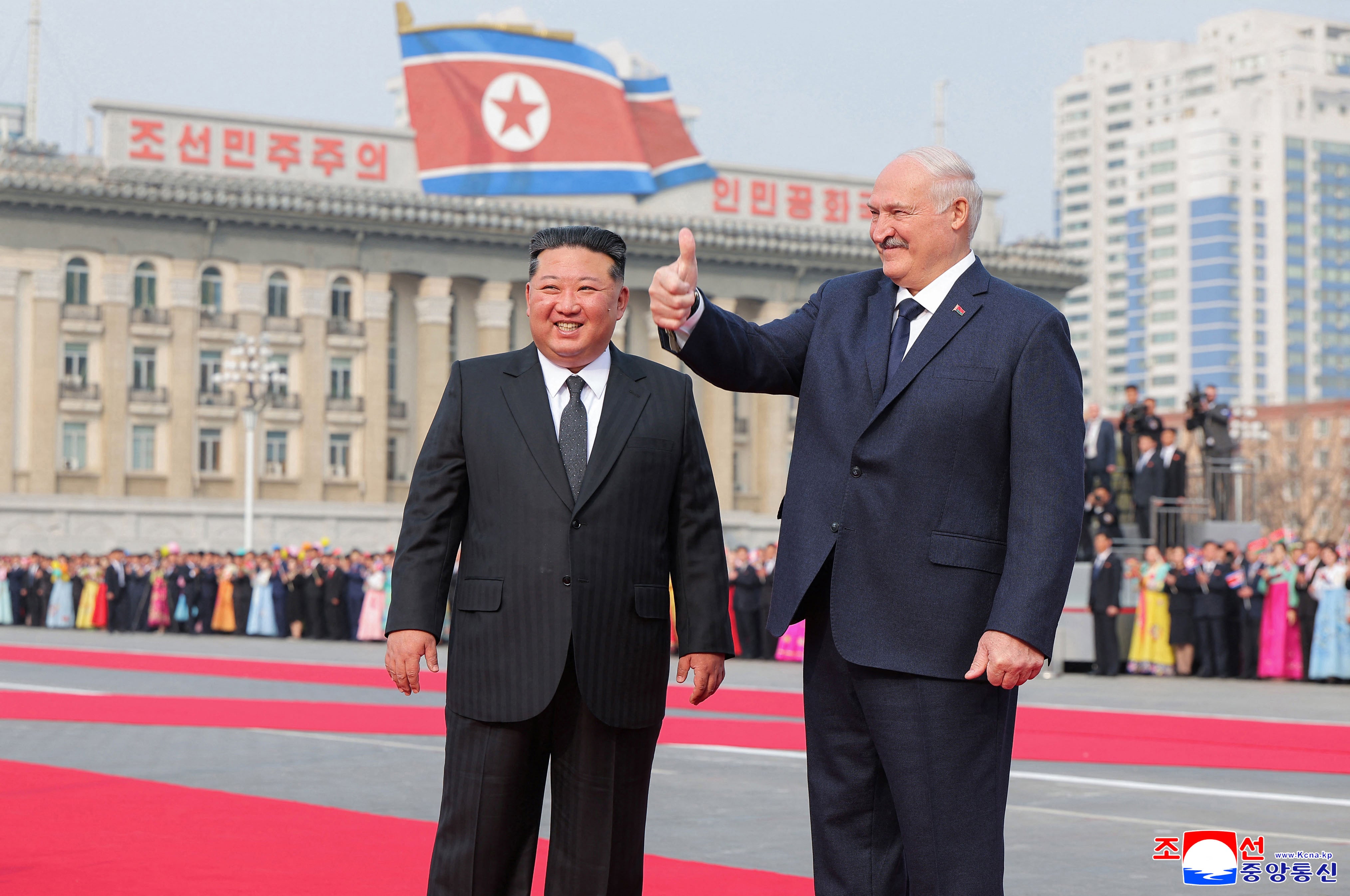
“The friendly relations between our states, which originated back in the days of the Soviet Union, have never been interrupted. Today, as a result of comprehensive progressive development, we’re transitioning to a fundamentally new stage,” Mr Lukashenko told Mr Kim, according to Belarusian state news agency Belta. “Belatedly, but nevertheless, we are transitioning to a new stage.”
Mr Kim described the newly signed agreement as a foundation for future ties, Yonhap reported. “The new interstate treaty will serve as a legal foundation that will further guarantee the stable development of bilateral relations,” he said.
Mr Lukashenko characterised the document as “fundamental”, adding that it “clearly and openly sets forth the goals and principles of interaction between the two countries, and defines the institutional framework for future mutually beneficial processes”.
The visit, Belarusian media noted, was meant to “identify key areas of mutual interest and the most promising projects for implementation”. It was expected to produce about 10 additional agreements spanning sectors including education, culture and sport, the Belarusian president said, according to the Korea Herald.
Ceremonial events dominated the first day of the trip.
According to the news agency KCNA, Mr Kim “gladly” met Mr Lukashenko and “warmly” welcomed him with a 21-gun salute, military honours, and crowds of citizens waving national flags.
The Belarusian leader reviewed an honour guard by the army and watched a goose-stepping parade by soldiers alongside his host.

Mr Lukashenko was accompanied by a delegation that included ministers for foreign affairs, public health, education, and industry as well as deputy prime minister Yuri Shuleiko.
The Belarusian leader visited the Kumsusan Palace of the Sun, where the embalmed bodies of North Korea’s former leaders Kim Il Sung and Kim Jong Il lie in state, and laid a floral tribute and a bouquet sent by Russian president Vladimir Putin.
He later joined Mr Kim at Liberation Tower, where they observed a moment of silence “in memory of the fallen fighters of the Soviet army who dedicated their precious lives to the sacred war for Korea’s liberation”, referring to the end of Japanese colonial rule in 1945.
Mr Kim met Mr Lukashenko in Beijing last September and extended the invitation for a visit. In a letter sent earlier this month, KCNA reported, the North Korean leader told the European leader that he was “willing to expand and develop the traditional relations of friendship and cooperation to a new, higher stage in line with the demands of the new era”.
Mr Lukashenko responded that “Minsk affirms it has an interest in actively expanding political and economic ties with Pyongyang at all levels”.
About the Author