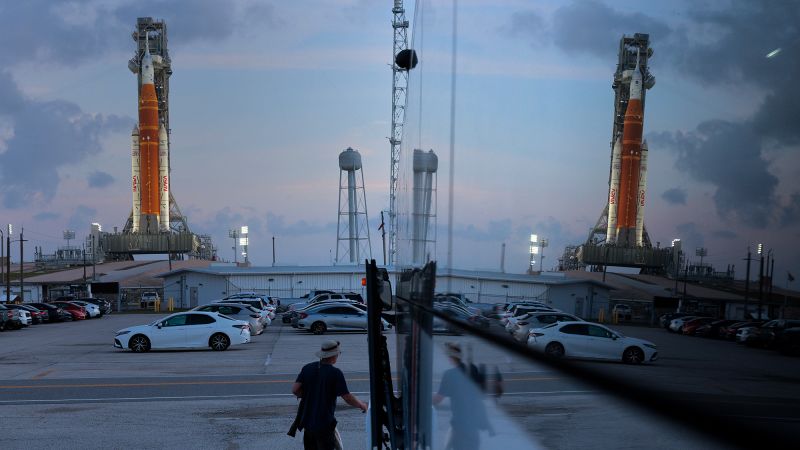
The countdown clocks is officially rolling at Kennedy Space Center in Florida, where four astronauts are preparing to take off on the mission of a lifetime — circumnavigating the moon and returning humans to deep space for the first time in five decades.
After nearly two months of tests and troubleshooting, NASA appears to be on the cusp of firing its 322-foot-tall (98-meter) Space Launch System rocket to orbit. The current target for takeoff is a two-hour launch window that opens at 6:24 p.m. ET on Wednesday.
Rockets launch fairly frequently from the United States’ Space Coast, as the area surrounding NASA’s KSC facilities is called, but this mission is an obvious standout. NASA’s Reid Wiseman, Victor Glover, and Christina Koch along with Canadian Space Agency astronaut Jeremy Hansen will climb aboard the Orion spacecraft — which sits atop the Space Launch System rocket — and blast toward space, going from zero to 500 miles per hour (about 805 kilometers per hour) in just two seconds.
Within three and a half hours after liftoff, the Orion capsule will be fully separated from the rocket, and the astronauts will get a chance to manually pilot the spacecraft.
Rocket launches are complex, hours-long affairs, but here are a few key moments to watch for and things to know.
Tracking Ts and Ls
One important note for those planning to follow along as NASA prepares for liftoff: The countdown clock isn’t always intuitive.
It shows the “T minus” time, where the “T” stands for “terminal count.” Occasionally, the clock will stop rolling — and that’s intentional. The launch team has a series of pre-planned holds, including one at the 40-minute mark and the 10-minute mark.
So, you can’t always get a great idea of takeoff time just by glancing at NASA’s countdown.
Just know that NASA is currently working toward a liftoff time of 6:24 p.m. ET — the first minute of the two-hour launch window. And that’s referred to as the “L minus” time, which is the real-time target for launch.
At some point on Wednesday, NASA may run into a technical issue that requires troubleshooting. It’s also possible that a wayward boat will wander into the flight path — it’s happened many times before. In that case, NASA will issue a new “L minus” time.
The rocket can takeoff on Wednesday anytime after 6:24 p.m. ET and anytime before 8:24 p.m. ET.

There are, however, no guarantees that the astronauts will take flight on Wednesday. Weather or technical issue can always arise.
And the rocket powering this mission, the Space Launch System or SLS, is notoriously finicky. The gargantuan orange vehicle has had numerous issues with hydrogen, the fuel used to power it. Millions of gallons of super-chilled liquified hydrogen must be loaded onto the SLS if launch teams give the “go” for fueling — which happens about 10 hours and 20 minutes before liftoff.
As that fueling begins, launch controllers will be keeping an eagle eye out for leaks. Hydrogen is the lightest molecule in the universe, and tends to seep out of any container in which it’s contained. Its volatility already thwarted launch attempts in February.
On Wednesday, launch controllers aren’t expecting to avoid leaks entirely. But as long as the rate stays below 16%, NASA should be able to get the rocket filled up and steer clear of any dangerous scenarios, according to NASA launch director Charlie Blackwell-Thompson.
Another unexpected issue NASA previously troubleshot involved the flow of helium into the upper stage of the rocket. Helium is used to clean out fuel lines and pressurize tanks, and in late February, it abruptly stopped flowing. NASA says it fixed that problem by removing a specialized seal, but launch controllers will be monitoring every piece of the vehicle to ensure no additional curveballs arise.

A lot of focus will be on the SLS rocket until about four hours and 40 minutes before launch, when the four astronauts emerge from their quarters, called the Neil Armstrong Operations & Checkout (O&C) Building.
Their families will be waiting nearby, waving and offering their well wishes and goodbyes.
Glover, the pilot for the Artemis II mission, reflected on that moment during a recent news briefing: “Our families are outside the building when we walk out. And that is the moment that I’m going to get to tell them I love them,” Glover said.
“Instead of sending a text message or a phone call, I get to tell them I love them,” he added.
In a 2024 interview with CNN, Jeremy Hansen’s wife, Catherine, said her husband serves as the family’s emotional anchor.
“Jeremy has always been and is always our grounding rod,” she said. “He is the person who really calms us in situations that are stressful and he won’t be there to do that. So that is going to be very, very hard not to have him there to do that for us.”
Clad in their bright orange spacesuits, the astronauts will then board futuristic “astrovans” and head to the launchpad. After this milestone, NASA will likely share frequent clips of the crew as they board their capsule, test their communications links, and are sealed inside the spacecraft ahead of takeoff.

As the countdown clock ticks down, NASA will work through a long series of vehicle checks and keep a close eye on the fueling process. As the minutes dwindle on the countdown clock, there are some critical moments.
At T – 16 minutes, launch controllers will conduct one last “go/no-go” poll, during which they will vote on whether to move forward with the takeoff attempt.
At the 10-minute mark, the clock will start rolling for “terminal count” — when “Ground Launch Sequencer” software will evaluate the rocket’s health and ensure all the criteria for liftoff is met.
If issues arise, NASA may be able to stop the process, roll the clock back and attempt to troubleshoot the problem and make another liftoff attempt the same day. It’ll take about 75 minutes to do such a reset, according to test director Jeff Spaulding. So, as long as there’s at least that amount of time left in the launch window, and the clock hasn’t ticked below about 33 seconds — a second takeoff attempt will be possible.
If a problem comes up after that mark, however, NASA will likely have to scrub the launch for the day. The space agency may then attempt another takeoff attempt as soon as April 2.
But if all goes according to plan, the Orion spacecraft will lift off across the evening sky over Florida’s space coast atop the SLS rocket, carrying four astronauts on a journey around the moon.

Once Orion reaches space and enters a stable low-Earth orbit, the crew is looking forward to one of the first milestones of the mission: taking the spacecraft for a manual test drive.
The test, called the Proximity Operations Demonstration, will enable the crew to safely practice docking Orion and piloting the capsule in manual mode, a step that will be necessary during future missions. Their docking target will be the ICPS, or the interim cryogenic propulsion stage, the upper segment of the rocket that propelled Orion on its journey in space.
The ICPS will separate from Orion about three and a half hours after launch and serve as a stand-in for any spacecraft Orion may dock to during future missions.
“Orion we developed for autonomous capability all the way to docking, so the crew does not need to take over in a manual way,” said Howard Hu, manager of NASA’s Orion Program. “But we want to make sure we understand our manual capabilities. The demonstration gives the crew an opportunity to really, I would say, test drive the car.”
The crew will practice piloting Orion toward the ICPS as well as around it for about an hour, starting with flying about 328 feet (100 meters) away from the upper stage before flipping over and then coming within about 32.8 feet (10 meters) of it, Hu said. Then, the crew will manually back away, pause and fly toward specific reflectors on the side of the upper stage.
The astronauts will share their feedback on the manual test drive with mission control teams on Earth in real time during the demo, describing the sounds they hear and the feel of the thrusters, Glover said.
Glover compared the experience with self-driving vehicles that are appearing in US cities, which are allowed to operate autonomously but usually have a driver sitting in the front seat during testing for safety purposes.
“We want the automated systems to work, but we also want a crew to be able to jump in,” Glover said. “Automation is not always the answer. It is fallible, just like humans are in different ways. Even if we don’t do the operation by hand, we need to be able to stop it safely.”
The crew’s views from the docking camera on Orion are expected to be shared live with the public, said Rachel Kraft with NASA Communications, allowing for an exciting peek inside the mission.
NASA’s Artemis program is sending humans into deep space for the first time in more than five decades. Sign up for Countdown newsletter and get updates from CNN Science on out-of-this-world expeditions as they unfold.
About the Author