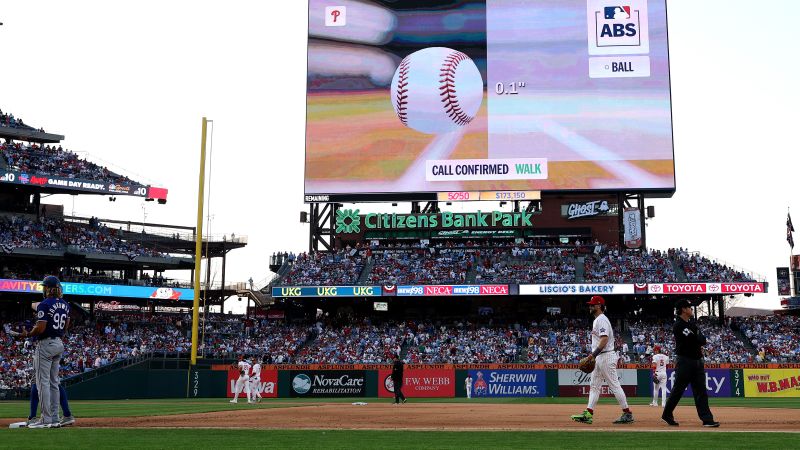
The best-case scenario for baseball’s new automated ball-strike system is that it’s so seamlessly integrated into the flow of the game as to go unnoticed, while also creating viral-worthy moments for the way it exposes or incites intrigue.
Credit to Major League Baseball and the years of testing they put the system through before debuting it in the majors. Because, through the first series of the season, it is meeting both of those criteria.
There were 227 challenges through the first 62 games of the 2026 season. That’s good for a relatively conservative 3.7 challenges per game, less than the two per team allotted at the start of every game (teams retain correct challenges that result in overturned calls).
Most of them were unremarkable successes of the system. They corrected – or not! Pitchers and batters are both worse than a coin-flip at issuing challenges – blown calls in a matter of seconds. If you weren’t watching the game, or weren’t watching closely enough, you didn’t hear about them or notice them.
In spite of a seismic crossing of the technological Rubicon, an abandonment of the centuries-old deference to the naked eye, a codifying and calcifying of the most atomic-level building block of the sport, baseball mostly just looked like baseball.
A handful, however, served as standalone minidramas that ricocheted around the internet over the weekend.
CB Bucknor suffered an ignominious introduction to his robot supervisors to the tune of six overturned calls in a single game. The schadenfreude for frustrated fans peaked when Eugenio Suárez of the Cincinnati Reds successfully challenged two consecutive pitches in a pressure-backed two-out, bases-loaded situation. That at-bat ultimately ended in a ground out – rendering it completely uninteresting if not for the gumption to challenge two pitches in a row and the eye to get it right.
“The loudest cheers of the game – the Reds have hit two homers – come on back-to-back challenges,” Cincinnati’s play-by-play broadcaster John Sadak declared.
For a crowd about to watch a promising inning fizzle out forgetably, that’s incredible praise for the value-add of ABS.
Twins manager Derek Shelton got ejected for arguing with an umpire who had attempted to rule in his team’s favor. After a called ball resulted in a walk to the Twins’ Josh Bell, Orioles pitcher Ryan Helsley issued the rare pitcher challenge. He was one of just six pitchers to challenge and only two to do so correctly through the first few days of the season.
The walk was undone by the reversal of the pitch call, but Shelton thought the challenge was issued too late and shouldn’t have been allowed (elsewhere an umpire decided the Braves’ Matt Olson was actually guilty of a too-slow head tap and refused to send a strike against him to review).
The pitch was not a ball. The robots are unequivocal and perfectly accurate. And yet still the skipper got himself rung railing against an inconvenient truth to an intermediary who, presumably, would have just as soon let the Twins have their base runner and save himself the humiliation.
“He’s arguing with the robots!” Orioles broadcaster Kevin Brown marvels. “You can’t defeat the robots!”
Is this not good theater?
Those are examples of the new dynamics ABS has introduced into the rich tapestry of the sport. As the season unfolds we’ll see how teams develop and deploy strategies and then adapt to one another. Along the way we’ll learn something new or confirm what we already suspected about individual players.
Randy Arozarena is just as audaciously self-assured when challenging a strike call against himself as he is, well, all the rest of the time. Fifteen-year veteran catcher and captain of both the Kansas City Royals and WBC champ Team Venezuela Salvador Perez has an elite understanding of the strike zone. The small-sample-size resurgence of a decline-era Mike Trout is bolstered by evidence that he could still be among the best in baseball at something.

Some players – like Cardinals catcher Pedro Pagés, who has called for four unsuccessful challenges behind the plate – have yet to win an ABS challenge. They’re bad at this! It won’t hold and they’ll get better, but for now it’s a goofy weakness to poke fun at, if you’re so inclined.
There will be controversies. Pitches that just barely graze the rigid outer edge of the strike zone prompted questions about how infinitesimally accurate the HawkEye technology that underpins ABS can be. Indeed, absolute perfection is elusive. But a “buffer zone,” or whatever pedantic critics would offer as an alternative to accepting what the system dictates would introduce more questions, not fewer.
There will be unchallenged missed calls that turn out to be pivotal in the ultimate outcome of the game. And instances of a team having burned their challenges early only to need one late. These will prompt the most vociferous and pointed outcry. The demand will be for full ABS. Why allow any blown calls if the technology exists?
The answer is simple: Baseball exists not to reach a definitive endpoint as efficiently as possible, but to provide a stage for imperfect effort. Robots made the challenge system possible; humans – full of hubris and frustration – have made it entertaining.
Do we want baseball to be perfectly fair or do we want it to be more fair and also more interesting?

Baseball has always been about the games within the game – pitch sequencing, outfielder positioning, even the signs that the catcher uses to call a game creating a puzzle that can be cracked. Every snapshot second can be analyzed from a multitude of angles with an elaborate decision tree driven by analytics behind each element.
The challenge system is more of that. More emphasis on the importance of situational leverage (when is the game really on the line) and count leverage (flipping the call on a 2-0 pitch is not nearly as valuable as doing so on 1-1).
Instead of eradicating catcher framing like full abdication to the robots would have, the challenge system adds new layers to the charade of trying to sell strikes. Can you convince not just the umpire but also the batter who has the ability to call your bluff? Would a catcher ever attempt to reverse-frame in an effort to elicit an ill-fated challenge that would rob the opposition of the ability to challenge later? (Probably not, but I like thinking about it.)
The people who say baseball is boring are waiting for the ball to be put in play. But ABS encourages fans to watch each pitch closely, consider the stakes of the immediate situation carefully and compare your eye for the strike zone to that of a pro player. Avid fans will become experts on the way different counts dictate approach for both the batter and the pitcher.
There is so much strategy simmering in every inhale before the action. The robots haven’t robbed us of that.
About the Author