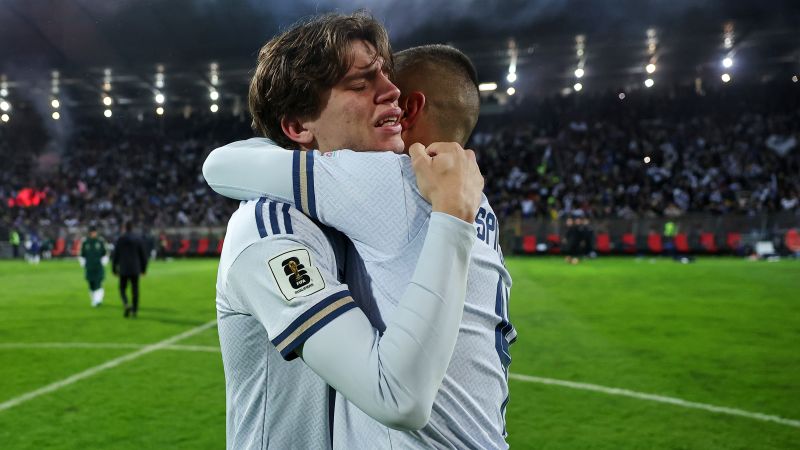
After letting the final Bosnian penalty slip under his reach on Tuesday, Italy goalkeeper Gianluigi Donnarumma remained on his knees, putting his hands on his head in utter disbelief.
The rest of his teammates, lined up near the halfway line, either fell to the floor or stood motionless as the home crowd erupted at the same time as the Italian players’ worlds came crashing down around them.
The Azzurri had just lost to world No. 65 Bosnia and Herzegovina in a penalty shootout – the result meaning Italy will not play in this year’s World Cup, the third consecutive edition that it has failed to qualify for.
Italian outlet Gazzetta dello Sport led with a headline calling it “the third apocalypse” – a sign of what soccer means to the nation.
That reality is scarcely believable for a country that has produced some of the best players in history and a team that has won the World Cup on four previous occasions, most recently back in 2006.
It was also a reality that hit the current crop of Italian players hard in the Bosnian city of Zenica.
“We still don’t believe it, that we’re out and that it happened in this manner,” Italy defender Leonardo Spinazzola said after the defeat.
“It’s upsetting for everyone. For us, for our families, and for all the kids who have never seen Italy at a World Cup.”
The fact that Italy even had to play Bosnia and Herzegovina in a World Cup playoff is a sign of how bad things have become for the national side.
While the rest of Europe’s elite booked their place for this year’s World Cup by winning their qualifying groups with ease, the Azzurri finished second behind Norway.
It meant the team was condemned to the playoffs, where it successfully navigated Northern Ireland to set up a winner-takes-all tie against Bosnia.
It was a tie they couldn’t lose. Despite having to travel to play in tough conditions, Italy still boasted a team full of elite players who ply their trade in the biggest club teams in the world, like Inter Milan, Juventus and Manchester City.

There also seemed to be confidence in the camp, with Italy’s players seemingly happy after they discovered they would be playing the Zmajevi (“Dragons”) instead of Wales for a place at the World Cup – a tie that was arguably easier on paper.
But the “Beautiful Game” is a sport that often cares little for reputation or statistics, and Italy got a harsh reminder of that on Tuesday, trading one set of dragons (Y Dreigiau) for another.
In truth, Italy started the game on top, scoring in the 15th minute through Fiorentina forward Moise Kean to set up what should have been a smooth, routine win.
But the contest was turned on its head before the break, when Inter defender Alessandro Bastoni was sent off for bringing down a Bosnian attacker when he was through on goal.
Down to 10 men and feeling the weight of expectation more than ever, the Azzurri seemed to crumble, being pushed back for much of the remaining minutes and eventually conceding a goal in the 79th minute to Haris Tabaković.
However, against the odds, Italy managed to force a penalty shootout but missed twice from the spot, ultimately allowing Bosnia to qualify for just its second World Cup as an independent nation.

Meanwhile, it will be at least four more years until Italy features in another World Cup, and its woes stretch back even further.
The last two World Cups that Italy qualified for were in 2010 and 2014. On both occasions, the Azzurri were knocked out in the group stages. It means the last World Cup knockout match that Italy played in was the 2006 World Cup final, which it won on penalties.
There has been a random bright spot in the past two decades of misery, though. Italy won Euro 2020, beating England on penalties inside Wembley Stadium to secure the nation its second European Championship.
That result now looks like it was just papering over some systemic cracks.
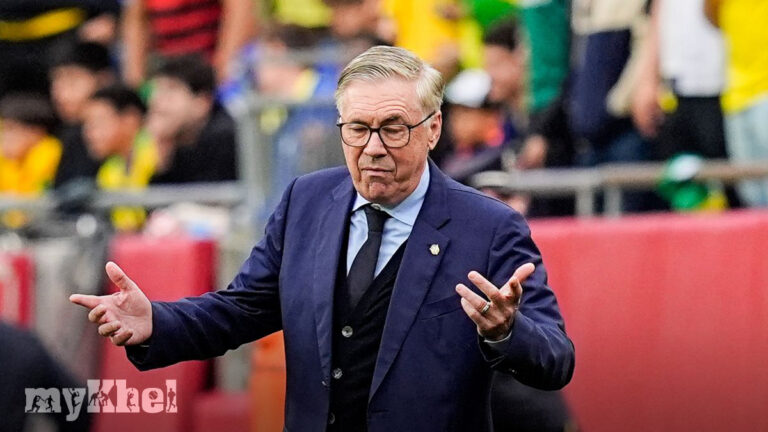
Legendary Italian player Gennaro Gattuso took over as Italy’s manager last year, tasked with reversing the bad run. The 48-year-old was a no-nonsense player, and the engine room in Italy’s last World Cup success.
But even his passion and experience as a player couldn’t light a fire in this new generation of stars, who look lost playing on the international stage.
And while it’s not yet clear whether Gattuso will stay in his role, you sense that the manager is not the real issue, with the Italian Football Federation (FIGC) president Gabriele Gravina facing fresh calls to resign.
“That has to happen or Italy will be doomed to relive this again and again,” Italian sports journalist Tancredi Palmeri told CNN Sports’ Amanda Davies, speaking about the need for big changes in the FIGC.
“Obviously, Gattuso is not the problem, but he is not even the solution. He was a temporary coach who came on last June. His task was to restore a sense of belonging to the Italian team, to the national team, to the players. He actually succeeded in that, but football is not only about that.”

The national team’s struggles are a symptom of a wider problem in Italian soccer. The country’s top club teams are no longer the best in Europe – while Inter Milan made the 2025 Champions League final, it was blown out by Paris Saint-Germain 5-0 – and Serie A, Italy’s top division, is slowly falling behind other leagues on the continent.
There are also concerns about the investment in youth soccer, with the country crying out for young talent to kickstart a new chapter of success.
These issues go back years, with former Italian talisman Roberto Baggio – arguably the greatest Italian soccer player ever – hinting at problems in the FIGC when he abruptly resigned from his position as technical director in 2013. Baggio had been hired three years earlier to help fix issues in the system after Italy’s disastrous 2010 World Cup campaign.
On his departure, Baggio told state broadcaster RAI, “I haven’t been allowed to work: my 900-page program has remained a dead letter. €10 million has been allocated, but I haven’t received a cent yet. I’m bearing the consequences; I’m no longer available to continue.”
CNN Sports has reached out to the FIGC for comment.
The country’s politicians have now demanded answers from under-pressure Sports Minister Andrea Abodi, with Italy’s former prime minister Matteo Renzi calling the result “a sign that Italian soccer has failed.”
He added: “Soccer isn’t just entertainment in our country; it’s part of our culture and national identity.”
It’s sentiment that explains why the fallout from this third failure might sound so dramatic to those looking in from the outside.
For a country that has produced players such as Baggio, Paolo Maldini and Gianluigi Buffon – some of the greatest of all time – it’s unimaginable that the nation is no longer competitive on the biggest stage.
The post-mortem of how the latest failings have transpired has only just begun, but it will involve attempts to completely reshape almost everything about how Italian soccer is run.
For now, though, millions of fans in Italy will have to accept watching another World Cup without their team in it. Worryingly for them, it’s becoming the new normal.
About the Author