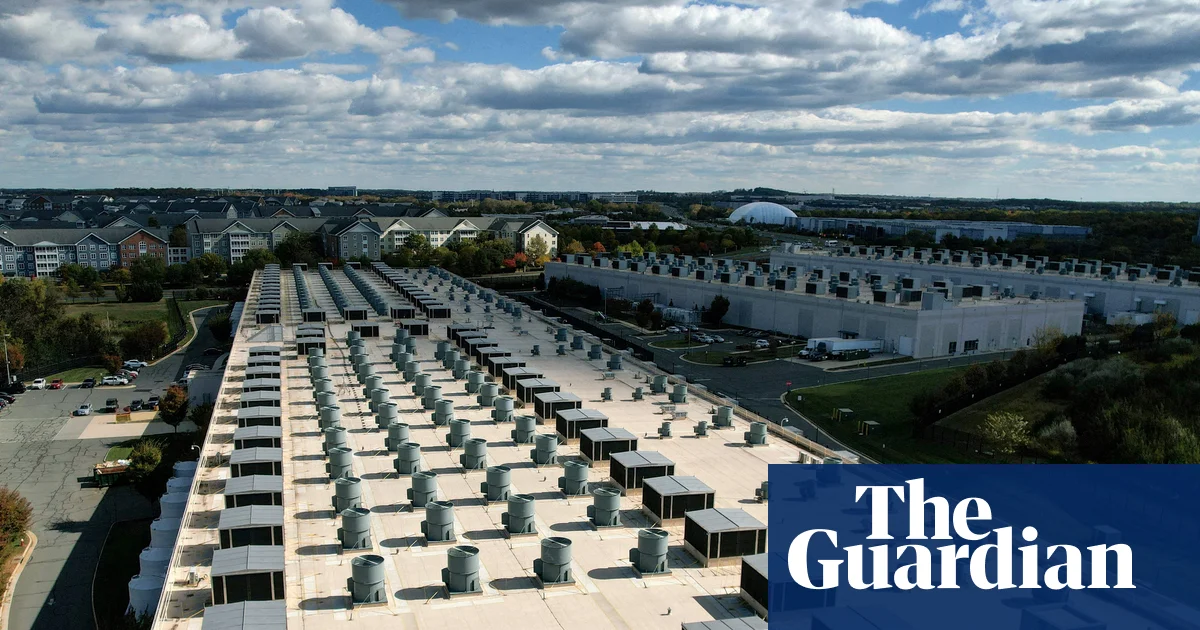
Amid an unprecedented energy crisis and the rapid buildout of artificial intelligence infrastructure, progressive lawmakers have unveiled a new policy to place a moratorium on the construction of AI datacenters.
“Despite the extraordinary importance of this issue and its impact on every man, woman and child in this country, AI has received far too little serious discussion here in our nation’s capital,” Sanders told reporters on Wednesday. “I fear that Congress is totally unprepared for the magnitude of the changes that are already taking place.”
The policy, announced by Bernie Sanders, an independent senator from Vermont, and Alexandria Ocasio-Cortez, a New York Democratic representative, on Wednesday morning, aims to ensure the AI boom protects the environment and communities, and benefits workers instead of harming them. A temporary ban, the lawmakers say, would give the US government time to create strong federal safeguards for AI, which is “affecting everything from our economy and wellbeing to our democracy, warfare and our kids’ education”.
“AI and robotics are creating the most sweeping technological revolution in the history of humanity,” Sanders said in an emailed statement. “The scale, scope, and speed of that change is unprecedented.”
The moratorium proposed in Sanders’s Senate bill would go into effect immediately if passed, and remain in place until laws are enacted to curb datacenters’ harmful effects. That includes quelling their climate and environmental impacts, ensuring they do not push up utility costs, preventing job displacement and “ensuring the wealth generated by [AI] companies is shared with the people of the United States”.
It would also impose a ban on the export of computing hardware, such as AI chips – or specialized processors – to any country without such protections on the books, including China.
Ocasio-Cortez will introduce a companion bill in the House.
The proposal comes as calls to halt AI datacenter expansion have gone from the margins to the mainstream. Since August 2025, towns and counties across the country – including in Missouri, Indiana, Georgia and North Carolina – have passed temporary bans on datacenter buildout. At least 11 states are now considering similar policies, according to Good Jobs First, a watchdog group tracking economic development.
In December, more than 200 advocacy groups led by the national environmental organization Food and Water Watch also sent House and Senate leaders a letter calling for a federal datacenter moratorium, citing concerns about the sector’s impacts on electricity bills and the climate crisis. Sanders became the first lawmaker to back their demand and it has since gained steam with progressive lawmakers such as Maxwell Frost, a Florida representative, and Pramila Jayapal, a Washington representative.
“A few months ago, when I proposed a moratorium on AI datacenters, it was perceived as a radical, fringe and Luddite idea,” Sanders wrote in a February statement. “Well, not anymore.”
Survey data shows Americans are increasingly worried about AI’s many impacts. A June 2025 poll found that half of US adults are more concerned than excited about its increasing use in daily life, while a December 2025 poll found 60% of Americans believe the sector should be better regulated to limit its potential negative effects on society.
Voters are also troubled about the effect of datacenters on increased utility costs and energy consumption, data shows. When a February poll asked participants to select the more concerning issue in randomized contests against datacenter-related issues, they selected utility costs 64% of the time and energy consumption 59% of the time.
Datacenters’ need for vast quantities of water to cool down equipment has also sparked controversy, especially in drought-ridden areas. So have the facilities’ climate effects. Though AI proponents claim the sector can help to lower emissions, an October report from green group Center for Biological Diversity estimates that if current trends continue, datacenters may account for nearly half of all US emissions from the power sector that current national climate targets allow.
Datacenters’ electricity demand is also raising electricity prices in some areas. One Bloomberg analysis found that some regions with especially high concentrations of datacenters have already seen power costs surge by 267% over the past five years.
Amid increasing worry about these costs, the Trump administration this month hosted tech executives at the White House to “pledge” that their companies will shield Americans from utility rate hikes tied to their datacenters’ growing energy demand. Critics say the pledges are unenforceable, and most Americans are skeptical of them, a March poll shows.
“We cannot sit back and allow a handful of billionaire Big Tech oligarchs to make decisions that will reshape our economy, our democracy and the future of humanity, said Sanders in his emailed statement. “We need serious public debate and democratic oversight over this enormously consequential issue. The time for action is now.”
Americans are also concerned about the AI revolution’s impact on labor, the lawmakers said at Wednesday’s press conference.
“Last year alone, AI was responsible for over 54,000 layoffs nationwide,” said Ocasio-Cortez. “And when we talk about those jobs, it’s not just a number. These are industries, these are communities, these are families.”
Another concern: the detrimental effects AI could have on mental health.
“What does it mean for young people to form friendships with AI and become more and more lonely and isolated from other human beings?” Sanders asked. “Everybody understands we have a major mental health crisis for our young people right now. I fear that AI could make it even worse.”
Sanders said he is also troubled by the ways AI companies could degrade online privacy, and also imperil democracy with the proliferation of “very convincing fake images”, including of politicians. He added that leading scientists have told him that “AI could soon surpass human intelligence and operate independently, beyond our control, and if that happens, what they acknowledge is, it poses a profound threat to the very survival of the human race.”
The Vermont senator also spoke about the need for AI safeguards on the Senate floor on Tuesday night. “These multibillionaires are investing in AI and robotics because those investments will increase their wealth and power exponentially,” he said.
Mitch Jones, managing director of policy and litigation at Food and Water Watch, applauded the new proposal.
“We need a halt to the explosive growth of new AI datacenter construction now, because political and community leaders across the country have been caught completely off guard by this aggressive, profit-hungry industry,” he said. “It has yet to be determined if – not how – the industry can ever operate in a manner that sufficiently protects people and society from the profusion of inherent hazards and harms that datacenters bring wherever they appear.”
Sanders’s new proposal is highly unlikely to pass the Senate, particularly as the Trump administration works to promote unfettered AI growth. On Wednesday, Trump announced the nomination of big tech billionaires to a new advisory committee to discuss artificial intelligence policies.
“The story of AI is a story of corruption,” said Ocasio-Cortez. “It is fueled and funded by the same multi billion dollar corporations lobbying politicians to sit back and do nothing while they harm our communities.”
Yet the policy reflects the growing outrage from many Americans’ about both datacenters and the AI technologies they power.
“Big tech’s datacenter boom is an ecological disaster in the making that’s choking neighborhoods with diesel fumes,” said Camden Weber, a senior policy specialist at the Center for Biological Diversity. “These corporate giants are draining our drinking water and driving up electricity bills with their fossil fuel-powered projects. We’ve got to hit pause on the environmental recklessness of the AI tsunami before it’s too late.”
About the Author