
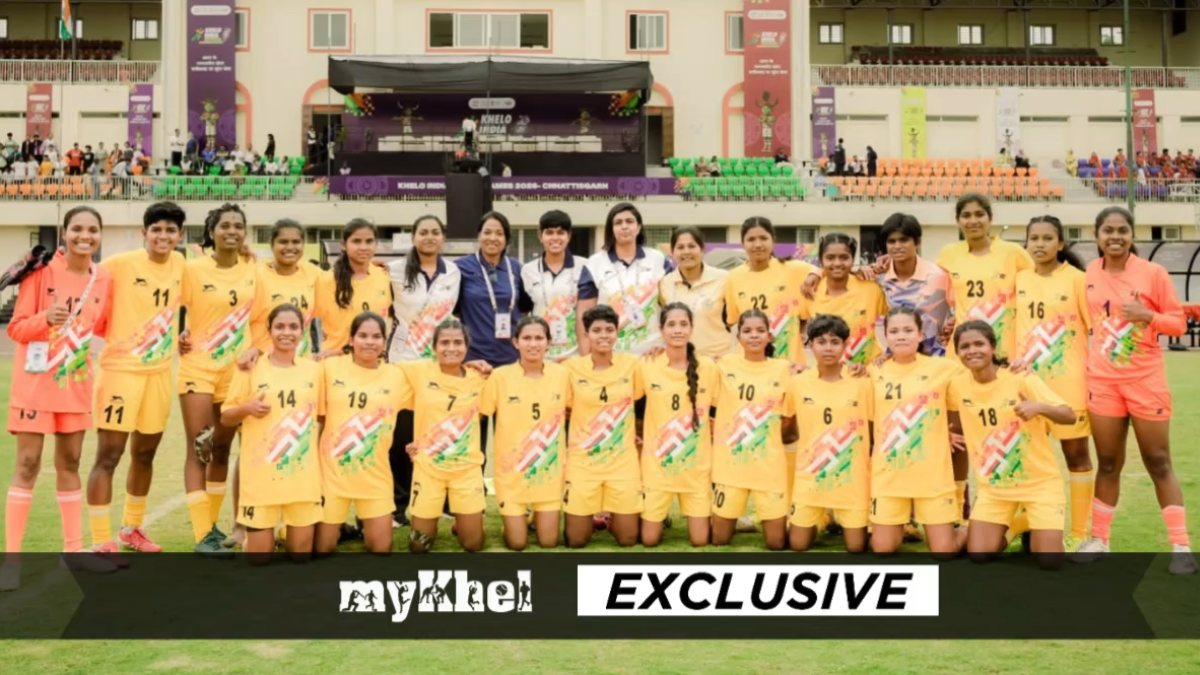
Raipur, April 9: Deep inside the forests of tribal-dominated Bastar district in Chhattisgarh, an ashram has been quietly defying the odds for nearly five decades. The Mata Rukmani Devi Ashram in Village Dimrapal, some 50 kilometers from Jagdalpur (Bastar district), is home to over 3,000 girls from the tribal communities of one of India’s most underserved regions. Of those, 550 are footballers.
Not recreational players. Not participants in a school PE class. Footballers – girls who train daily, compete in state leagues, and have now found their way into the Indian Women’s League, representing clubs like Gokulam Kerala and Kerala Blasters.
In the just concluded Khelo India Tribal Games, Chhattisgarh women’s football team bagged a gold medal and around 10-11 of that team comprised of players from the Mata Rukmani Devi Ashram.
In 2022, Mata Rukmani FC made their debut in the Indian Women’s League (IWL) in Bhubaneswar. They were, by most measures, the smallest club in the competition – no proper training ground, no reliable nutrition setup, no corporate backer. Their budget runs almost entirely on CSR donations.
The Man Behind It All
The Mata Rukmani Devi Ashram did not start as a football academy. It started with a 46-year-old man, a handful of reluctant families, and a belief that girls in Bastar deserved an education.
Dharampal Saini – a freedom fighter, a Gandhian, and a disciple of Vinoba Bhave – arrived in Bastar in the mid-1970s and opened the ashram’s doors on December 13, 1976. He named it after Bhave’s mother. In those early months, he went door to door, facing ridicule, trying to convince families to send their daughters to school. After three months, four families agreed. He started with eight girls.
Today, more than 3,000 live and study there.
Now well into his nineties, Saini – affectionately called Tauji by everyone at the ashram – has not stepped back. The girls speak of him with a mix of warmth and awe. “Even at his age, he comes to the ground and watches how we play,” Payal Kawasi, one of the footballers from Dimrapal, tells myKhel. “He believed that if girls are given an opportunity, they can achieve anything.”
His entry into football was driven by instinct. Impressed by the physical strength and stamina the girls at his ashram displayed, Tauji began teaching them the game himself. He later became a driving force behind building a full football programme for the girls of Bastar. “He made sports a priority,” says Rupika Koora, another player from the ashram. “He created a culture where girls could dream freely.”
First-Generation Footballers
Payal Kawasi, Rupika Koora, Kritika Poyam, and Muskan Salam – all part of the Chhattisgarh women’s football team – hail from Dimrapal. None of them had a conventional path into football – except Muskan, whose father played in local village tournaments.
“My father used to play football in local tournaments,” Muskan says. “He sent me to the ashram, and from there my football journey started.”
For the others, the push came from something simpler – seeing other girls from their own village play. “We saw other girls from our village studying and playing here,” says Kritika Poyam. “That inspired us to come and start playing.”
For Payal and Rupika, it was entirely new territory. “No one in my family had played football before,” says Rupika. “I am the first.”
That is true for hundreds of the 550 girls currently training at the ashram. They come from villages where schools often end at Class 8, where sport for girls barely registers as a concept, and where sending a daughter to a residential hostel goes against deeply rooted social expectations.
“People in the village used to taunt our families,” says Kritika. “‘Why send girls away? They should be getting married.’ They even criticised how we dressed.”
The resistance was real. The decision to stay was not easy.
What the Ashram Builds
Life at Mata Rukmani Devi Ashram is structured. Training, education, discipline – and for the footballers, daily running across varied terrain, often beginning before the rest of the village wakes up.
But what the ashram provides is not just physical preparation. For many girls, it is the first time they have lived away from home, operated within a team, and been told that they can compete – and win. “Our coaches supported us a lot and kept motivating us,” says Payal Kawasi. “That gave us confidence.”
That confidence has reached beyond the pitch. Families that once resisted are now enquiring. “Earlier, parents only wanted girls to study,” says Muskan. “Now they are also sending them to play sports.” Kritika adds: “When we talk to Kiran, she tells us what it takes to reach that level. It motivates us.”
The Kiran she refers to is Kiran Pisda – the first footballer from Chhattisgarh to represent India, and the captain of the victorious Chhattisgarh team. She is, for the girls of Mata Rukmani Devi, what possibility looks like in a person.
Building a Team From Scratch
For Sarita Kujur, head coach of the Chhattisgarh women’s team, the challenge goes far beyond tactics. She first met Tauji in 2004. “He was inspired to see a woman coaching football,” she recalls. “He later decided to support women’s football in Bastar.”
On what sort of changes Mata Rukmani Devi Ashram has brought, she notes, is the broader social shift. “Earlier, people believed only education could secure a future. Now they see sports as a platform too.” She pauses before adding: “Today, children from villages are shining at higher levels because of sports. A large part of the Chhattisgarh team now comes from Bastar.”
Today, a significant portion of the state team comes from Bastar, and not just that, “Players are even getting picked by big clubs,” she adds. Asked about challenges, she notes, “The potential is huge, we just need better infrastructure.”
The Numbers Tell the Story
Mohanlal, General Secretary of the Chhattisgarh Football Association and an AIFF Executive Committee member, has watched the state’s women’s football ecosystem develop up close.
“The work we started five to six years ago is now showing results,” he says. The Chhattisgarh Women’s Football League – which Mata Rukmani FC won twice in 2020 and 2022 – gave players the match exposure they had never had before.
“We launched the state women’s league to give players regular match exposure. That is why Chhattisgarh teams are now playing in the Indian Women’s League. Players from our state are now playing for clubs like Kerala Blasters, Gokulam Kerala, and others,” Mohanlal says.
The ashram has been central to that progress. “Most of these girls come from Mata Rukmani Devi Ashram, where hundreds train year-round. Over the last few years, many talented players have emerged from there. Big clubs and SAI have started scouting talent from here.”
But Mohanlal is also candid about the gaps. “Infrastructure and transportation are still major challenges in remote areas.” Financial support from corporates has helped – “without such support, many districts would not even be able to participate” – but it is not enough to fix everything. “There is still a lot of talent in districts like Sukma and Bijapur waiting to come forward.”
Kiran Pisda: The Proof, and the Push
If there is one name that crystallises what is possible for these girls, it is Kiran Pisda.
The first Chhattisgarh footballer to represent India, Pisda was associated with Mata Rukmani FC for about two years – the period when they qualified for their first IWL season. “I already knew that the girls there are extremely hardworking,” Pisda tells myKhel. “Even today, around 10 to 12 players from there are performing well.”
She watches their progress with both pride and pragmatism. “They are playing very well, but if you want to compete at a higher level, you need to think at that level too. At higher levels, small things like fitness, diet, and recovery make a big difference.”
She is not being dismissive. She is being precise – because she knows the gap is closeable. “The girls from Bastar are very hardworking, but lack of infrastructure is holding them back. Most of them are still very young – under-20 or under-21 – and have a long way to go. If they get the right opportunities, they can definitely play for India.”
More Than a Football Story
The 550 footballers at Mata Rukmani Devi Ashram are part of something larger than a sports programme. “If more girls in villages play football, it can bring positive change,” says Kritika Poyam.
Her teammate adds something that sounds almost like a tactical observation but applies well beyond the pitch: “Defence is the most important. You may score goals, but without a strong defence, you cannot win.”
What Tauji built in Bastar – with eight girls, no resources, and no guarantee of success – now looks like a foundation. More than 20,000 children have completed their matriculation through his network of 37 schools. Many graduates have returned as teachers. Others now work in the Bastar government.
And 550 girls are training every day, dreaming of India caps and IWL contracts. “He believed that if girls are given an opportunity, they can achieve anything,” Payal Kawasi says of Tauji.
And the girls of Dimrapal are making sure that belief is not misplaced.
Get breaking news alerts.
Allow Notifications
You have already subscribed
About the Author