
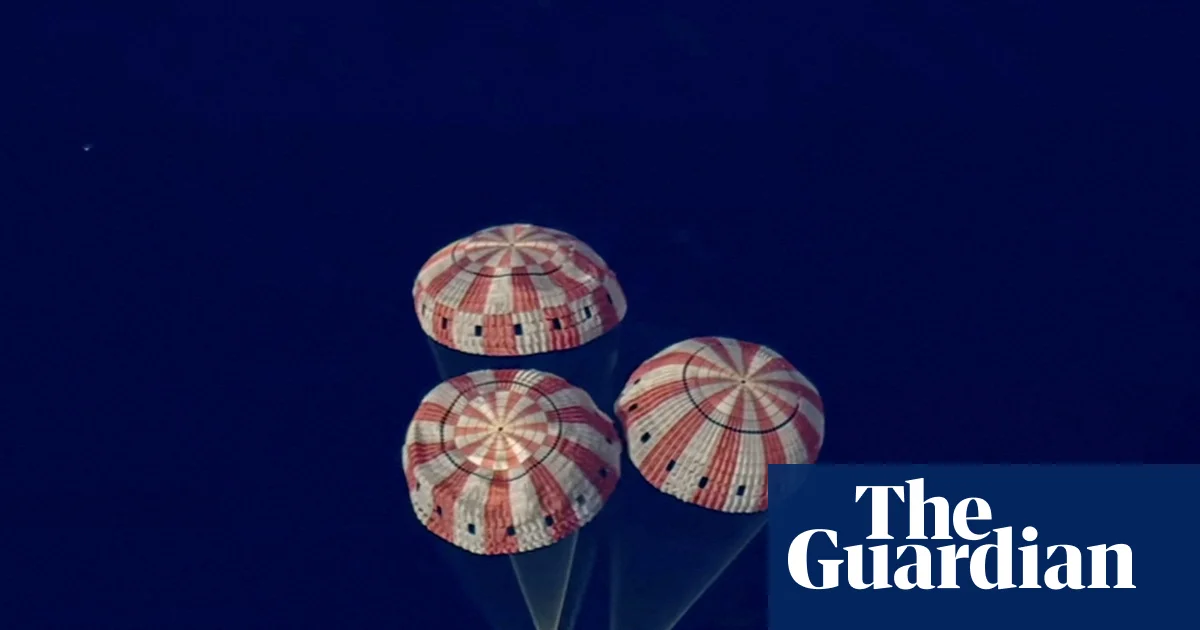
The Artemis II, and the four astronauts aboard the Orion space capsule, splashed down into the Pacific Ocean off the coast of San Diego on Friday night, with all four astronauts in good health.
“53 years ago, humanity left the moon. This time we return to stay. Let us finish what they started. Let us focus on what was left undone. Let us not go to plant flags and leave, but to stay with firmness in our purpose, with gratitude for the hands who built the machines and with love for the ones that we carry with us,” Nasa’s associate administrator Amit Kshatriya said at the late-night press conference after the astronauts landed.
The spacecraft touched down at 5.07pm (1.07am BST) making the journey around the moon and back officially 9 days 1hr and 32min. The Orion spacecraft traveled 694,481 miles (1,117,659km), Nasa said. Despite barely passing a ninth day, it will be recorded officially as a 10-day mission because blast-off day was treated as “flight day one”.
Commander Reid Wiseman, pilot Victor Glover, and mission specialist Christina Koch of Nasa, and the Canadian Space Agency’s Jeremy Hansen, have just become the first humans to travel to the moon, and return to Earth safely, since the crew of Apollo 17 in December 1970.
They join an exclusive club of just 24 other humans who have travelled to the moon and returned safely to Earth.
As the Orion capsule descended below 17,000 miles from the planet’s surface, Wiseman gave a description of the Earth as it came into view. “There’s a great blue hue to it. It’s beautiful,” he said.
Sean Quinn, Nasa’s exploration ground systems manager, said he had taken a phone call from Wiseman as he awaited the start of Friday night’s briefing: “It was so great to hear his voice and tell us that all the crew is OK, and we could say that we did our mission. We accomplished what we set out to do.”
After landing in the Pacific Ocean, a recovery crew from the USS John P Murtha stood ready to retrieve the Artemis crew, pulling up in boats to an inflatable “porch” attached to Orion’s hatch. Crew members were then assessed by navy personnel and transferred to the navy ship by helicopter.
Nasa administrator Jared Isaacman, speaking from the deck of the USS John P Murtha while waiting for the astronauts to arrive, said of the team: “Our crew members that we’ve all had an opportunity to observe over the last 10 days, they’re absolutely professional astronauts, wonderful communicators, almost poets. These were the ambassadors from humanity to the stars that we sent out there right now.
“This is not a once in a lifetime, which you hear sometimes around here. No, it’s not. This is just the beginning. We are going to get back into doing this with frequency, sending missions to the moon until we land on it in 2028 and start building our base.
There is a lot to celebrate right now on the mission well accomplished for Artemis II, and at the same time we’ve got to start getting ready for Artemis III.”
Nasa has proven it can once again send humans safely to and from cislunar space, the void between Earth and its nearest celestial body, and will build on the knowledge gained to further propel the Artemis program towards a scheduled crewed moon landing in 2028, 56 years after the last.
The rest of humanity, meanwhile, appeared to come together for a rare moment of unity to enjoy stunning video footage and high-resolution images of the lunar surface – and Earth from afar – as well as some profound and heartfelt words from usually unsentimental astronauts as they described what they were seeing.
“I just had an overwhelming sense of being moved by looking at the moon,” the Nasa astronaut Christina Koch said of her first impressions of Orion’s closest approach on Monday, 4,067 miles (6,545km) above the lunar surface.
“It lasted just a second or two and I actually couldn’t even make it happen again, but something just threw me in suddenly to the lunar landscape and it became real.
“The moon really is its own unique body in the universe. When we have that perspective and we compare it to our home of the Earth, it just reminds us how much we have in common. Everything we need, the Earth provides, and that, in and of itself, is somewhat of a miracle.”
Koch became the only woman to have travelled to the moon and back during a mission of firsts. Jeremy Hansen of the Canadian Space Agency became the first non-American. Victor Glover, the Artemis II pilot, became the first person of color to do so.
Collectively, with the mission commander, Wiseman, the four travelled farther from Earth than any human before them, reaching 252,756 miles, more than 4,000 beyond the previous record set by the Apollo 13 crew in April 1970.
It was not all plain sailing during their 695,000-mile voyage. Orion’s glitchy toilet in a capsule the size of a small camper van malfunctioned more than once, necessitating the temporary deployment of urine collection bags and inflight repairs from Koch in her alternative role of plumber.
There were moments of fun. The crew enjoyed an egg hunt of sorts on Easter Sunday, trying to find packets of dehydrated scrambled eggs hidden around the spacecraft. A plushie named Rise – the mission’s official mascot designed by eight-year-old California second-grader Lucas Ye, appeared regularly on camera during crew press conferences.
Probably the most emotional episode came on Monday, when the crew proposed dedicating a previously unnamed moon crater to Carroll Taylor Wiseman, wife of the Artemis II commander and mother of their daughters, Katey and Ellie, who died of cancer in 2020. Hansen struggled to get the words out, prompting tears and hugs among the four.
During the “business” side of the mission, the astronauts evaluated Orion’s life support systems, radiation detectors, next-generation spacesuits and tested other operations that will be crucial to future deep-space missions and Nasa’s longer-term plans for the Artemis program, including an ambitious $20bn moon base to be built within a decade.
The agency sees the first splashdown of a returning moon crew in more than five decades as an important next step. Although not as visually mesmerizing as the fiery 1 April launch from Florida’s Kennedy Space Center that sent Artemis II into the heavens, the landing still required a similar level of intricate planning, precision and execution.
Changes to the heat shield after anomalies arose on the uncrewed Artemis I mission of November 2022 gave Nasa confidence that Orion would withstand temperatures up to 5,000F (2,760C) at its 25,000mph re-entry to Earth’s atmosphere; and mission managers selected a steeper, direct path of re-entry to reduce heat stress.
A succession of deployments of Orion’s 11 parachutes at various altitudes was designed to slow the spacecraft to 325mph, then 130mph, before the three main chutes, their canopies stretching a combined 80 yards (73 meters), release for a further deceleration to a 17mph splashdown.
Coast Guard and Nasa recovery crews were positioned to cover a landing zone about 550 miles in diameter. After medical checks following hatch opening and a brief stopover at a San Diego military base, the crew’s next destination is Houston’s Johnson Space Center, which they last saw on 27 March, and a reunion with their families.
Nicky Fox, associate administrator of Nasa’s science mission directorate, summed up the importance and impact of the mission in a briefing with reporters this week.
“Our four Artemis II astronauts, Reid, Victor, Christina and Jeremy, took humanity on an incredible journey around the moon and brought back images so exquisite and brimming with science, they will inspire generations to come,” she said.
About the Author