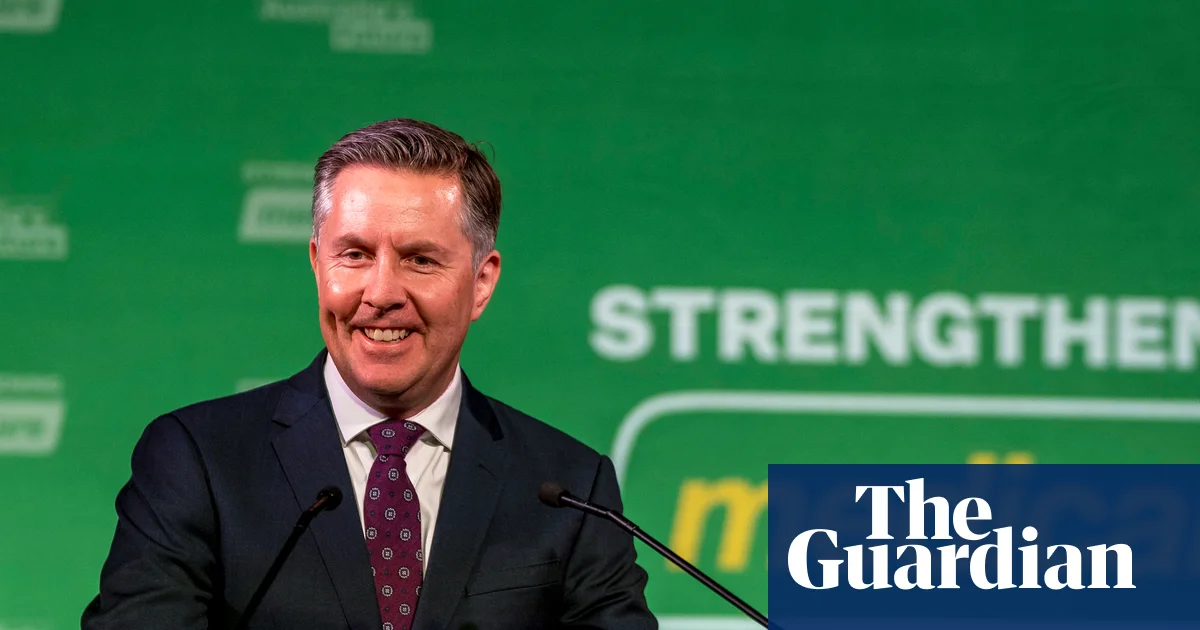
Australia will not cave in to pressure from pharmaceutical giants and the Trump administration by removing consumer price protections on common medications, the health minister, Mark Butler says.
Donald Trump imposed a new 100% tariff on branded pharmaceuticals imported into the US overnight, Australian time, trying to force manufacturers to agree to drug-pricing deals or commit to making their products domestically.
It is the latest challenge for Australian manufacturers selling products to American consumers and comes as the White House tries to force changes to Australia’s Pharmaceutical Benefits Scheme, which guarantees lower prices for prescription holders here.
Under a new executive order signed by Trump, large pharmaceutical companies will have 120 days to announce plans to avoid the new tariff, while smaller companies have 180 days.
Companies agreeing to move manufacturing to the US can see a reduced 20% tariff, with some carve-outs given to companies agreeing to preferred pricing deals for US consumers.
Australia exports about $2bn worth of drugs to the US every year. Manufacturing giant CSL makes up the bulk of those exports with blood plasma products, expected to receive exemptions from the new tariffs.
CSL last month opened a new manufacturing facility in Illinois.
Butler said on Friday that the federal government would not succumb to pressure to lift prices in Australia.
“We keep sending this clearest of possible messages to the US because we know they get the big drug companies in their ear trying to unpick the PBS here in Australia and equivalent schemes in other countries around the world,” he said.
“We are not negotiating about those fundamentals.”
Trump’s plan is expected to exempt generic drugs and maintain more favourable tariff rates for drugs produced in the European Union, Japan, South Korea and Switzerland. The UK has its own separate tariff deal.
American consumers pay far more for prescription medicines than Australians, a source of frustration for Trump, who has struggled to help ease cost-of-living pressures in the US. Affordability is set to be a key issue in the November midterm congressional elections.
Butler told Channel Seven the federal government would study the latest tariff move.
“Our immediate concern, obviously, is our great exporters that have been sending product to America for many years, for 20 years under a free trade agreement with no tariffs.
“The biggest of those exporters has very big manufacturing operations over in America, so we’re pretty confident they’ll be carved out.”
A CSL spokesperson told Guardian Australia the company was reviewing information from the US but did not anticipate material impact from tariffs.
“The vast majority of our trade into the US are plasma therapies that are made entirely from US-sourced plasma and we recently announced plans to spend $1.5bn to expand our plasma therapy manufacturing capabilities in the US,” they said.
The communications minister, Anika Wells, told ABC TV the tariff decision was disappointing.
“But the Australian PBS is not for sale. We will not be compromising on our PBS, it is something Australians value very highly and we’re really proud it’s world leading.
“The quality of Australian pharmaceuticals is world class and it’s not something we’re prepared to compromise on.”
The opposition leader, Angus Taylor, called for Labor to negotiate exemptions with Trump.
“I’m a strong believer that that’s ultimately good for Australians and that includes in pharmaceuticals and it’ll be important now for the government to work and seek and assert themselves to get exemptions to this for Australian exporters,” he said.
“This is obviously not welcome news. We don’t want to see it. We’ll work with the government to do anything we have to get it overturned or get an exemption for Australian exporters.”
Australia had received the lowest 10% rate under Trump’s so-called Liberation Day tariff regime, announced in 2025, but struck down in a US supreme court ruling in February.
About the Author