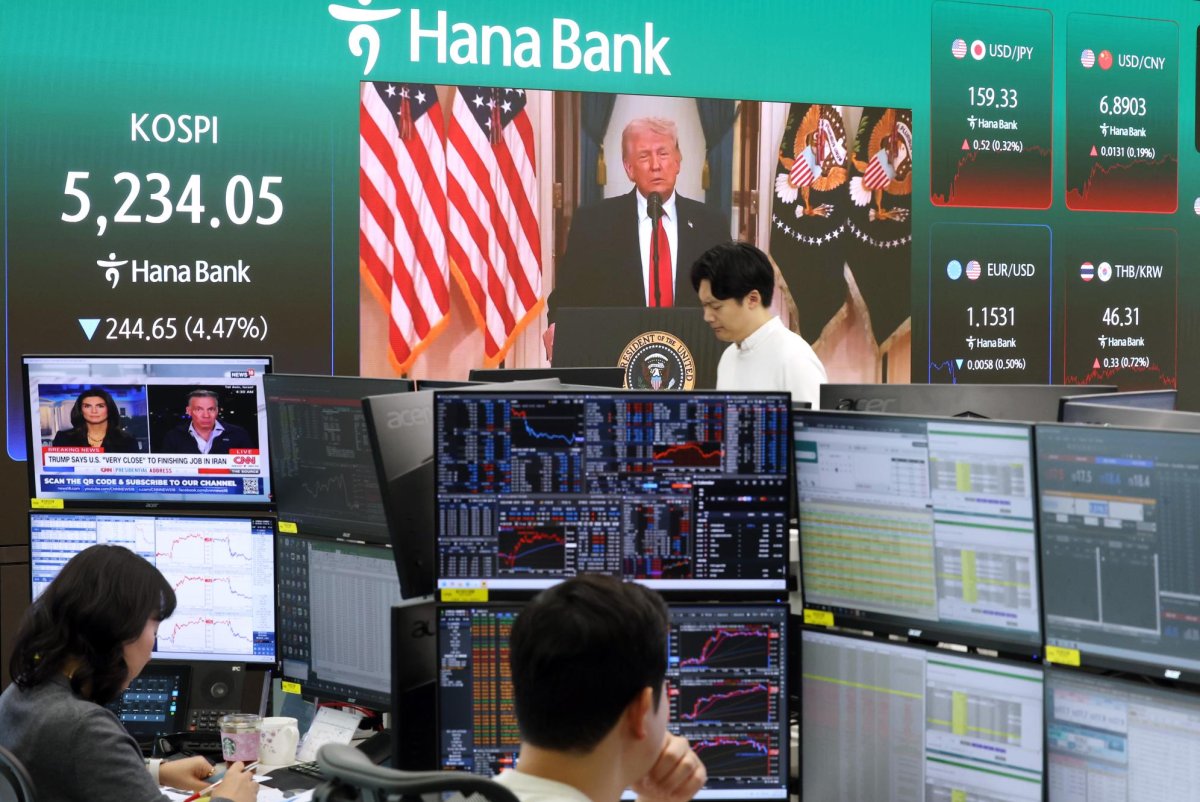
This photo, taken Thursday, shows the trading room of Hana Bank in central Seoul as U.S. President Donald Trump gives a televised address. South Korean stocks plunged more than 4 percent on Trump’s renewed threat of strikes against Iran. Photo by Yonhap
Seoul stocks fell sharply Thursday, as U.S. President Donald Trump’s renewed threat of strikes against Iran rattled investor sentiment and pushed up global oil prices. The Korean won weakened against the U.S. dollar.
The benchmark Korea Composite Stock Price Index (KOSPI) fell 244.65 points, or 4.47 percent, to 5,234.05.
Trade volume was a bit heavy at 1.42 billion shares worth 32.95 trillion won (US$21.72 billion), with losers outnumbering winners 814 to 90.
Institutional and foreign investors sold a net 1.45 trillion won and 136.43 billion won worth of shares, respectively, while individuals purchased a net 1.21 trillion won.
The index opened more than 1 percent higher, tracking overnight gains on Wall Street, amid hopes for an end to the monthlong war in the Middle East, which began in late February following U.S.-Israeli strikes on Iran.
But it turned negative and came under heavy downward pressure after Trump said in a prime-time address earlier in the day that the United States would hit Iran “extremely hard over the next two to three weeks” and “bring them back to the Stone Age,” while warning that Iranian energy facilities could be targeted if a deal is not reached.
The renewed uncertainty pushed up global oil prices, with Brent crude jumping more than 4 percent to well over $100 a barrel.
The Korea Exchange (KRX), the country’s main bourse operator, activated a sell-side sidecar at around 2:46 p.m., temporarily halting program-driven sell orders in KOSPI futures for five minutes.
A sell-side sidecar was also triggered on the tech-heavy Korea Securities Dealers Automated Quotation (KOSDAQ) market. The KOSDAQ finished at 1,056.34 by falling 5.36 percent.
“Despite earlier remarks by U.S. and Iranian leaders suggesting the possibility of an end to the conflict, Trump’s latest message indicating the war could continue disappointed investors,” Kang Jin-hyuk, an analyst from Shinhan Securities, said. “Risk-off sentiment is strengthening as expectations for a ceasefire fade.”
Losses were broad-based and deep, with tech shares coming under heavy pressure.
Market bellwether Samsung Electronics dropped 5.91 percent to 178,400 won, while its chipmaking rival SK hynix sank 7.05 percent to 830,000 won.
Top automaker Hyundai Motor fell 4.61 percent to 465,500 won, while its sister affiliate Kia declined 3.03 percent to 150,600 won.
Leading battery maker LG Energy Solution decreased 0.61 percent to 404,500 won, and major steelmaker POSCO slid 1.45 percent to 341,000 won.
Nuclear power plant builder Doosan Enerbility plunged 6.02 percent to 93,600 won, and major financial group KB Financial lost 1.21 percent to 146,500 won.
Leading shipbuilder HD Hyundai Heavy fell 2.77 percent to 439,000 won, while its rival Hanwha Ocean plummeted 6.06 percent to 119,300 won.
Bio shares finished mixed. Bio giant Samsung Biologics rose 0.83 percent to 1,585,000 won, while Celltrion went down 4.51 percent to 196,700 won.
Among gainers, defense giant Hanwha Aerospace surged 6.3 percent to 1,417,000 won, and Samsung SDI advanced 2.55 percent to 443,000 won.
The local currency closed at 1,519.7 won against the U.S. dollar, down 18.4 won from the previous session’s close.
Bond prices, which move inversely to yields, closed lower. The yield on three-year Treasurys rose 10.7 basis points to 3.477 percent, while the return on the benchmark five-year government bonds added 11.2 basis points to 3.679 percent.
Copyright (c) Yonhap News Agency prohibits its content from being redistributed or reprinted without consent, and forbids the content from being learned and used by artificial intelligence systems.
About the Author