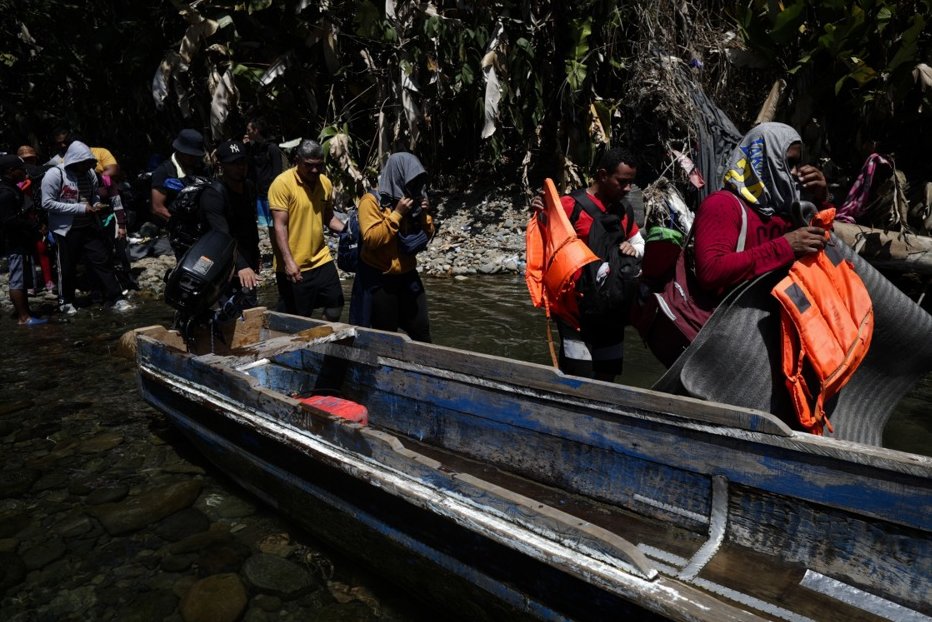
1 of 2 | Migrants wait in the jungle for canoe transport from Quebrada Leon to Bajo Chiquito, Panama, on March 10, 2023. An IOM report found a sharp decline in northbound migration as routes within South America gain importance. File Photo by Bienvenido Velasco/EPA
Nov. 19 (UPI) — Migration patterns across Latin America are shifting, with a sharp decline in migration toward the United States and growing movement within South America, according to a report by the International Organization for Migration, or IOM.
The IOM report, published Wednesday, examines migration flows from January through June 2026. It found that movements are becoming increasingly fragmented and multidirectional, with migrants returning to their home countries, settling temporarily elsewhere or embarking on new journeys.
One of the most significant changes occurred in the Darién Gap, a jungle region along the Colombia-Panama border, where crossings fell 97% compared with the first half of 2024.
For years, the Darién Gap was a major route for migrants from South America, the Caribbean and other regions seeking to reach Central America and continue north to the United States, despite the dangers of crossing the vast, roadless jungle.
According to official statistics from Panama’s National Migration Service, more than 520,000 people crossed the Darién Gap in 2023, a record that fell to about 302,000 in 2024. In 2025, the number plunged to just 3,091, a 99% decline from the previous year.
The shift is also reflected in migration movements along the Panama-Colombia border, where the predominant direction of travel has reversed.
According to the Mixed Migration Review 2026, published Nov. 10, authorities recorded 22,833 southbound migration movements in 2025, compared with just 3,091 northbound crossings through the Darién Gap.
The IOM also recorded a 75% decline in migration flows through Honduras and a drop of more than 90% in movements monitored in Guatemala, compared with levels recorded in 2024 and 2025.
By contrast, the Andean migration route, which includes movements through countries such as Ecuador and Peru, has seen more frequent returns, temporary settlements and cross-border movements. Venezuelans remain the largest nationality group among migrants using the route.
Along South America’s eastern migration route, Brazil and Uruguay are becoming increasingly important as destinations for settlement rather than merely transit countries.
The IOM estimates that several thousand Cubans enter Brazil each month, while Uruguay recorded a net migration gain of 5,946 Cuban nationals between January and May 2026. The organization also identified movements of Haitian migrants through charter flights arranged for family reunification.
According to the Mixed Migration Centre’s report, Cuban migrants are increasingly redirecting their journeys toward Latin American countries, particularly Brazil, Uruguay and Costa Rica, amid growing restrictions on entering the United States.
In 2025, Brazil received 6,400 Cubans and Uruguay 1,250, while another 19,000 traveled through Honduras on their way north.
About 137,600 Cubans sought international protection worldwide, making them the second-largest group of protection seekers from the Americas and the eighth-largest globally, according to the report.
Cuba’s economic and political crisis continues to drive emigration despite migration restrictions. The report also cites independent demographic estimates from late 2025 suggesting that as many as 2.75 million people have left Cuba since 2020.
The changing migration patterns come amid tighter U.S. immigration restrictions under President Donald Trump, who strengthened border enforcement after returning to the White House in January 2025.
Among his first measures, Trump ordered increased immigration detentions and deportations, restricted legal entry pathways and ended the use of the CBP One app as a means for migrants to schedule appointments to enter the United States.
However, the decline in traditional northbound migration flows has not prevented new caravans of Central American migrants from forming and attempting to cross Mexico to reach the United States.
The situation has fueled tensions between Washington and Mexican President Claudia Sheinbaum’s administration after Trump threatened to double tariffs on Mexico unless it stopped the caravans.
On Nov. 12, Sheinbaum acknowledged the presence of two migrant groups in the southern state of Chiapas, including one from Honduras, but said neither had reached the U.S. border.
A day later, Sheinbaum said 24 migrant caravans had dispersed in southern Mexico since January 2025. She said Mexican authorities were providing humanitarian assistance and information about restrictions on entering the United States.
About the Author