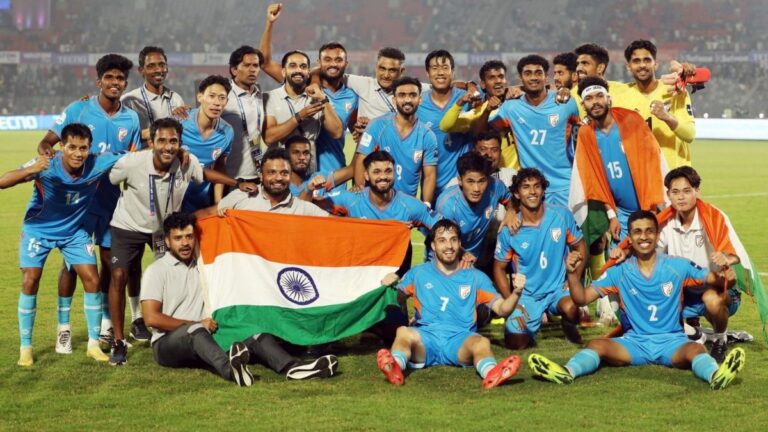
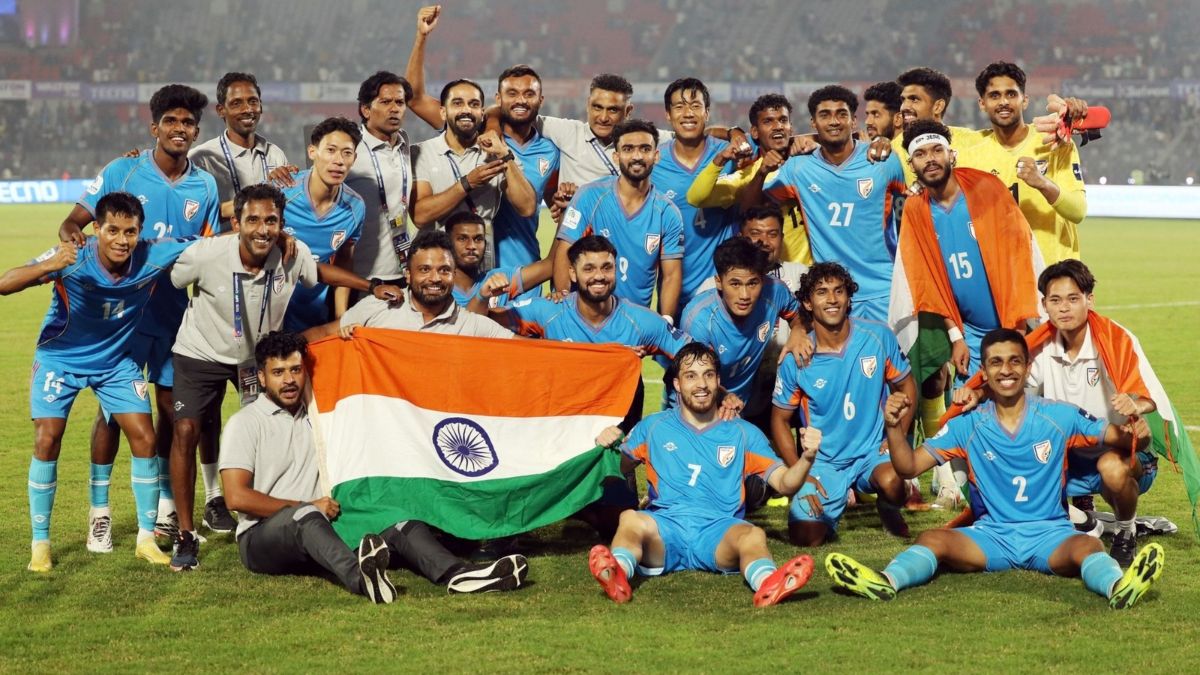
India produced a memorable comeback to defeat arch-rivals Pakistan 2-1 in a thrilling SAFF Championship 2026 final at the National Stadium in Dhaka on Tuesday, November 17. Sandip Mandi emerged as the unlikely hero, scoring a dramatic 88th-minute winner to help the Blue Tigers lift their 10th SAFF Championship trophy.
The victory was particularly special for Indian football as Naushad Moosa’s team became the first side to win three consecutive SAFF Championship titles. India also extended their record as the most successful team in the tournament’s history.
With the final heading towards extra time, Mandi rose above the Pakistan defence to connect with Abdul Rabeeh’s corner. His powerful downward header bounced off the ground before finding the top corner, leaving goalkeeper Yousuf Butt with no chance.
What followed was an unforgettable celebration as Mandi took off his shirt and sprinted towards his teammates, knowing that he had delivered a historic moment for Indian football.
However, India’s path to the trophy was far from straightforward. Pakistan, playing in their maiden SAFF Championship final, gave the defending champions a serious test and looked the more threatening side for large periods of the first half.
Moosa decided against making changes to the starting XI that had defeated Bhutan in the semi-finals. However, India struggled to establish their rhythm during the opening exchanges as Pakistan used their pace and attacking width to put the Indian defence under pressure.
Arsh Anwer Shaikh was called into action early in the contest. The Indian goalkeeper had to be alert after Muhammad Ali Khan attempted to capitalise on his advanced position, while McKeal Abdullah also came close with an acrobatic effort from close range.
Shaikh produced crucial saves to keep India in the contest as Pakistan continued to create opportunities. The Blue Tigers found it difficult to move the ball forward consistently and spent considerable time defending inside their own half.
India gradually improved after the cooling break, with Yousuf Butt forced to make an important save from a powerful long-range attempt. However, Pakistan continued to look dangerous and eventually found the breakthrough in first-half stoppage time.
Junaid Shah’s delivery from the left took a deflection before reaching Alamgir Ghazi. The midfielder controlled the ball brilliantly and curled a right-footed effort into the far corner to give Pakistan a 1-0 advantage at the interval.
Realising the need for greater attacking intent, Moosa introduced Macarton Nickson in place of Manglenthang Kipgen at half-time. The substitution immediately brought more energy to India’s forward play.
In the 51st minute, Nickson produced an excellent run through the middle before releasing Vishnu PV on the left. Vishnu’s attempt beat Butt but struck the post, denying India a deserved equaliser.
The decisive turning point arrived in the 59th minute when Junaid Shah was involved in a dangerous challenge on Brison Fernandes.
Initially, the referee allowed play to continue. However, following a VAR review, he was asked to check the pitchside monitor and subsequently showed Junaid a straight red card.
Pakistan were reduced to 10 players, and India wasted little time in taking advantage of the situation.
Just a minute after the dismissal, Khaiminthang Lhungdim delivered a dangerous ball from the right. Nickson failed to make clean contact with his attempted finish, but Suhail Ahmad Bhat reacted quickly and guided the ball into the net in the 60th minute.
India had restored parity at 1-1, and the momentum had shifted firmly in favour of the defending champions.
With a numerical advantage, India began to dominate possession and put the Pakistani defence under sustained pressure.
Brison Fernandes attempted to put India ahead with a forward run through midfield, but his effort went over the crossbar. Vishnu PV also tested Butt with a low shot after controlling the ball well inside the penalty area.
Moosa continued to make attacking changes, bringing on Abdul Rabeeh and Irfan Yadwad in the 72nd minute in place of Fernandes and Vishnu.
The substitutions added fresh energy to India’s attack. Irfan soon created another opportunity with a low cross from the right, but Rabeeh’s first-time attempt was blocked by the Pakistan defence.
Despite enjoying greater possession and creating several openings, India were unable to find the decisive goal for much of the second half. Pakistan defended deep, attempting to take the final into extra time.
However, the Blue Tigers refused to give up.
Just when it appeared that another 30 minutes might be needed to decide the champions, India found their breakthrough in the 88th minute.
Rabeeh won a corner and delivered an excellent outswinging ball into the penalty area. Sandip Mandi timed his jump perfectly and directed a powerful header towards the goal.
The ball bounced off the turf before rising into the top corner, leaving Butt helpless.
The Indian players rushed towards Mandi as the defender celebrated wildly after scoring what proved to be the winning goal of the final.
Pakistan had no time to recover, and India held on to complete a remarkable 2-1 comeback victory.
For Moosa, his players and Indian football supporters, it was a night to remember. India had overcome an early setback, made their numerical advantage count and found a match-winning moment when it mattered most.
The Blue Tigers are once again the kings of South Asian football, extending their remarkable SAFF Championship record to 10 titles and completing an unprecedented hat-trick of consecutive championships.
About the Author