US officials said they would seek a “final end” to the war between Russia and Ukraine, beginning with trilateral talks in Abu Dhabi on Tuesday in the first substantive negotiations between the two countries since February.
The talks are also the first since the US launched joint strikes with Israel against Iran, and they follow bruising midterm elections that have weakened Donald Trump at home.
Part of the Trump administration’s proposal involves drawing a new “long-term security architecture” between Russia and Europe, administration officials have said.
European officials are concerned that Russia may stick to its hardline demands that Nato should roll back its military footprint across eastern Europe, which would threaten to leave allies vulnerable to Moscow’s influence at a time of historic tensions with the west.
Since his first decade in power, Vladimir Putin has complained about Nato’s eastward expansion and sought to renegotiate the balance of power between Nato and Russia – but never before have those demands been embraced by a sitting US administration, which has made it clear that it is desperate to get to a deal.
Previewing the discussions, a US administration official said the US would “need Europe at the table” to end the war. He said negotiators could also revive the Nato-Russian council that was suspended after Russia’s full-scale invasion in 2022, and potentially lift sanctions against Russia to get to a deal.
The US officials also claimed that they had discussed with Russia potential security guarantees to Ukraine similar to Nato’s article 5, which protect member states in case of an attack. Russia has strongly opposed Nato admitting Ukraine or western countries placing troops in Ukraine.
“What they would be getting would be effectively very similar to Nato,” an administration official said.
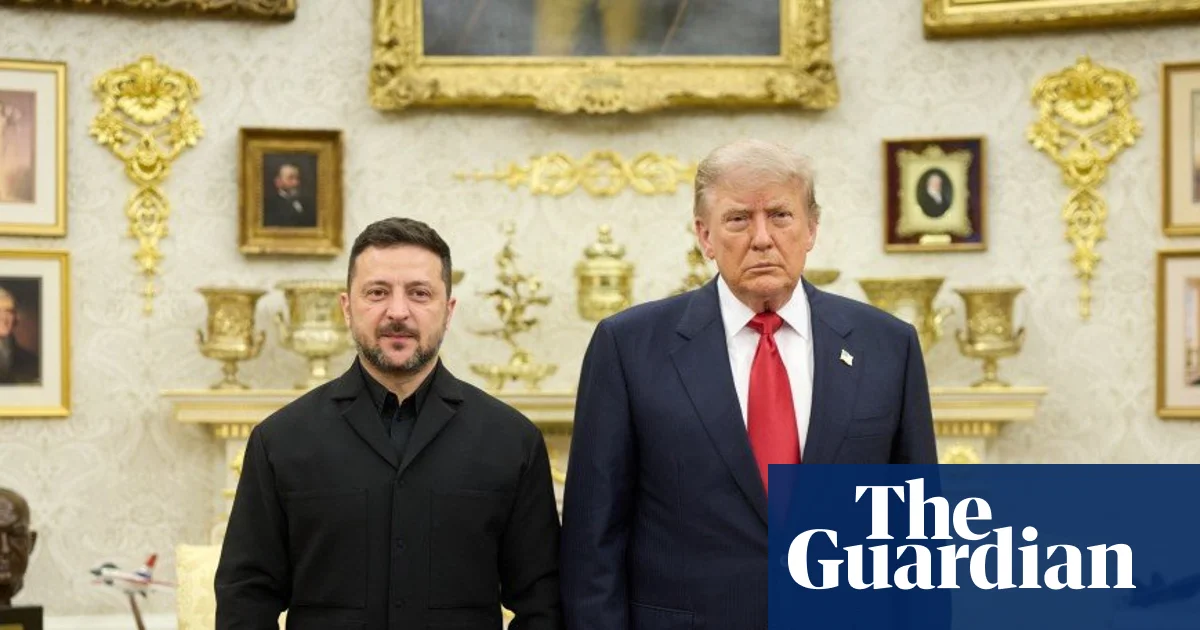
“Getting a US security guarantee is a really, really big deal,” the official added, saying it would be up to Donald Trump and Ukraine’s Volodymyr Zelenskyy to discuss. “And if he wants to do that, that’s that’s a very, very big deal in terms of resources and funding and military support.”
Critics have expressed skepticism about what may trigger those security guarantees, however, noting that article 5 does not oblige Nato member states to defend others, and that cyber-attacks and other forms of hybrid warfare have blurred the line for what would require a military response.
Jared Kushner, Trump’s son-in-law and a lead negotiator for the United States, described a potential new framework for European in general terms on Monday, saying the US would seek “stronger consultation, reliable crisis communications, greater military transparency, and reciprocal measures to reduce escalation risks, while fully respecting the sovereignty and independent decision-making of every nation”.
European delegations from Germany, France, the United Kingdom, Italy and the European Union will meet US negotiators in Abu Dhabi to discuss the “long-term security architecture between Russia and Europe in order to figure out how to reduce future conflicts”.
A European security official from a country attending the talks said that the US proposal was not yet clear and that they were bracing themselves for the US to pose serious concessions to Russia during the Abu Dhabi consultations.
“We already have a European security architecture in place,” said Kaja Kallas, the European Union’s top diplomat, at a G7 foreign ministers meeting on Monday. “This includes international agreements under which Russia has undertaken obligations, including with regard to sovereignty and territorial integrity. The problem is that Russia is not respecting these agreements.”
Donald Trump has also said that Ukraine would like be expected to give up territory in a final deal, and would end with a “little bit different shape“.
Trump last week after meeting with Kremlin advisor Kirill Dmitriev said he would seek a “big, beautiful agreement” that “might involve all of Europe”. Critics are concerned that Trump and Putin could try to go over the heads of European leaders in order to negotiate a peace that gives serious concessions to Russia.
“There’s a lot of baggage that people in Europe have about this idea,” said a US administration official, pointing specifically to Russia’s 2021 proposal that was viewed as an ultimatum to Nato to get out of eastern Europe.
In 2021, Russia issued a list of demands to Nato that included a ban on expansion to new countries including Ukraine, a rollback of troops to its pre-1997 borders, and limits on where it could place missiles. Nato rejected that proposal and Russia invaded Ukraine less than a month later.
“We have to build something new that works today… Because if all the old architecture was working well, then we wouldn’t be in this long war. And so obviously something’s not working, and we need to come up with a way that when we end this war, it really is a final end to the war,” said the US administration official.
The content of those proposals are not clear yet, although the secretary of state, Marco Rubio, claimed on Monday “there’s been some advances made in what that architecture should look”.
“We obviously have to get past the conflict to get to that point,” he added.
About the Author