
Mumbai, India
Naveena Vanamala sits very still as her makeup artist leans in close, carefully pressing tiny white dots of pigment in an arc above her brows on the most important day of her life. Her phone keeps ringing. Flowers for her hair are missing.
Normally the father of the bride handles problems with vendors, as part of his role as ceremony funder and host, but her father died six months ago, and now she’s making last-minute decisions about a Mumbai wedding she isn’t sure she can afford.
The 26-year-old social media marketing executive earns about $145 a month. Yet, what began as an already stretched wedding budget of $3,200 quickly doubled. She took out a bank loan. Her fiancé, who already had a home loan, borrowed against his house again.
“It wasn’t worth taking so much loan,” Vanamala says. “But we had no option. We had to do it.”
STREAMING NOW: Big wedding expectations force many into debt in India. Upgrade to watch the full report.
Across India, weddings are often large, multiday celebrations, fueling an industry worth around $130 billion, according to analysts at US investment bank Jefferies.
Here, marriage and money are bound together by social pressure that dictates that the bride’s parents pay for a lavish wedding, and in some cases dowry –– gifts given to the groom’s family that are now officially outlawed but still change hands.
For poorer households, expectations of a large event with gifts of gold, cash, household goods and even vehicles can turn a daughter’s wedding into a financial crisis.
At the other end of the spectrum, gold jewelry stacked in velvet trays, intricately embroidered lehengas (long skirt) and professionally choreographed dance routines in front of thousands of guests have become hallmarks of high-end Indian weddings –– a scale of spending that, the Jefferies analysis notes, sees Indians on average spend roughly twice as much on their nuptials as they do on education.
Kaveri Mehta’s father lingers near the entrance, eyes flicking between the road and his phone as he waits for his daughter’s wedding guests. He admits he is a little concerned.
It’s an auspicious day, and wedding traffic across the area in Delhi has clogged the roads.
For him, the moment carries the weight of two years’ worth of planning –– coordinating vendors, managing bookings, keeping every moving part on track. “We do all the preparations. And then on the day, we are all happy and enjoying the party,” said Rajiv Mehta. “But a lot of work goes into the preparations.”

Abhinav Singh arrives for his lavish wedding in Delhi

As he waits, he catches a glimpse of his daughter passing by, and smiles, briefly pulled into the celebration he has spent months building. Inside, everything is already in place –– a scene set down to the last detail. Crystal chandeliers glow alongside long tables of food and towering arrangements of fresh flowers. The air carries the smell of flowers, butter and cardamom.
Kaveri Mehta is there to marry her childhood schoolmate turned sweetheart Abhinav Singh. Dressed in shimmering red and ivory, they sit side by side on a flower-covered stage, gleaming as friends and family line up to congratulate them.
Their wedding includes hundreds of guests, elaborate décor and relatives flying in from around the world. Behind the glittering stage and endless food counters, a team of nearly 150 people –– from decorators to caterers ––worked to make this wedding happen.

Even though Mehta had once imagined something more intimate, she says keeping the guest list small was never really an option. “There are social protocols,” she explains. “You invite people because they invited you to their weddings.”
In many families, weddings are as much about community and relationships as they are about the couple. “It is not considered okay to keep it closed,” she says.
Her father watches the celebrations with a quiet smile. “It looks good for others,” he says. “But we know what has gone into it.” Weddings like this can cost hundreds of thousands of dollars.

Luxury wedding planner Vikramjeet Sharma, who organized the celebration, says his clients spend anywhere from $500,000 to $3 million on these elaborate multi-day events.
Over two decades, he says, the scale and extravagance of weddings has surged beyond almost any other comparable event. The result is a growing expectation for each wedding to feel bigger and more distinctive than the last.
“These are well-travelled guests. Luxury isn’t new to them,” Sharma says. For $3 million, he adds, couples can secure palace properties in Rajasthan, multi-day full buyouts, premium liquor, elaborate décor, and top-tier performers.
The spending doesn’t just begin at the wedding. Often, it starts long before a match is even found.
In a sleek apartment in Delhi, three women behind The Vows matchmaking service spend their days helping families find suitable spouses.
Payal Mehta Chugh tells CNN that families arrive with detailed expectations: education, income, appearance, and strong family credentials.
“People are looking for everything. They want the marriage to be a good marriage, a well-known family. It should help them climb up the social ladder,” she says. “And they were looking for love, respect, all the other intangible stuff.”

Some of those demands can be surprisingly specific, her colleague Ritika Bawa Sachdev adds. “They want someone similar looking,” she says bluntly. “We can’t have a fat girl with a thin guy, or vice versa.”
Despite the rise of dating apps and love marriages, some estimates suggest over 90% of marriages in India are still arranged with the involvement of parents or professional matchmakers.
Money is also a consideration for many families, they say.
“Bank account, yes,” Mehta Chugh says candidly. “In lots of cases it is very transactional. Bank balance is the gamechanger, the dealmaker unfortunately.”
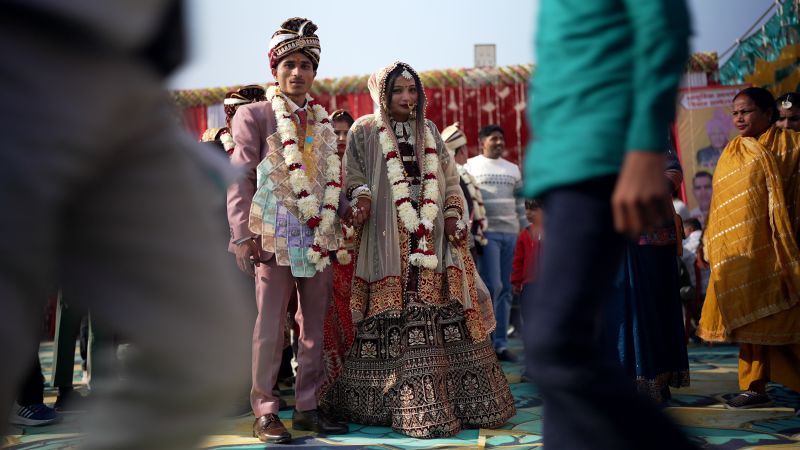
In northern India, 19-year-old Anamika Upadhayay is getting ready to marry a man she’s only met once. But she isn’t the only bride here.
Rows of young couples sit beneath a long canopy decorated with red cloth and plastic flowers. Loudspeakers crackle with devotional music. The air is thick with the smell of ghee and wood smoke from the sacred fires.
Upadhayay is here because her single mother could not afford a traditional wedding at home.
“I thought the wedding would happen in our village,” she says. “The happiness at home is the most. There you have your whole family and friends. Here it’s just parents and a few brothers and sisters.”

What she lost in intimacy, her family gained in financial relief. Rows of household goods are neatly stacked nearby: televisions, sewing machines, wardrobes and pressure cookers.
Each couple receives a set of items worth about $1,000 that would traditionally be given by the bride’s family as part of dowry. For many families here, that is more than a year’s income.
The ceremony is organized by Tejpal Singh, a community leader and local politician who says he started the event after seeing families struggle to pay for their daughters’ weddings.
“The biggest problem is moneylenders,” he says. In many rural areas, parents borrow money at extraordinarily high interest rates to pay for wedding expenses and dowry demands.

Some Indian couples looking to save money get married in group weddings.

Singh says mass weddings allow families to marry their daughters without taking those loans –– and also to spend more on their children’s education instead.
Dowry is illegal in India, but it remains widespread. According to India’s National Crime Records Bureau, more than 6,000 dowry-related deaths are reported every year –– cases where women are killed over disputes linked to dowry payments. Activists say the true number may be much higher.
Lawyer Kunal Madan, who often handles these cases, says the demands are frequently indirect but relentless. “These are not ordinary demands,” he says. “They are demands for exorbitant amounts of money, property or gold –– things most women simply cannot provide.”
Priyanka Dabla says her marriage began with celebration but quickly turned into demands.


Her father spent about $32,000 on the wedding and gifts –– far beyond what the family could comfortably afford, she said, but the requests continued afterwards.
Dabla, 31, alleges her husband’s family began asking for more money, and even a house. When their demands weren’t met, she says she was physically abused, including while she was pregnant.
When contacted by CNN, her husband denied the allegations. He acknowledges that a motorcycle was given during the wedding but says it was a voluntary gift, not dowry, and that the other claims made against him of violence are false.
Despite strict laws banning dowry, Madan, the lawyer, says many women hesitate to file complaints because of social stigma, family pressure and the slow pace of India’s overburdened court system.
Back in Mumbai, the bride Vanamala’s mother moves through the modest wedding venue, greeting relatives who have come to celebrate the couple.

For many families, marrying off a daughter carries both joy and relief. “One day we have to give our daughters away,” she says quietly. “When the girl goes, our burden becomes lighter.”
In much of India, daughters are expected to marry and move into their husband’s household. Parents often worry that as a woman grows older, her chances in the marriage market may shrink, where age, reputation and family background are closely scrutinized.
More than 500 guests attend Vanamala’s celebration. Photographers crowd around the bride like paparazzi as plates of food keep arriving at the tables.

“The feeling of being celebrities, something we had only seen on TV –– we experienced it today,” she said smiling broadly, a bright red streak of vermilion in the parting of her hair –– a traditional sign of marriage.
The celebration lasts only a few days but for Vanamala, the loans will linger much longer.
“The wedding was everything I dreamed of,” she says. “But I’ll be stressed until the loans are finished.”
About the Author