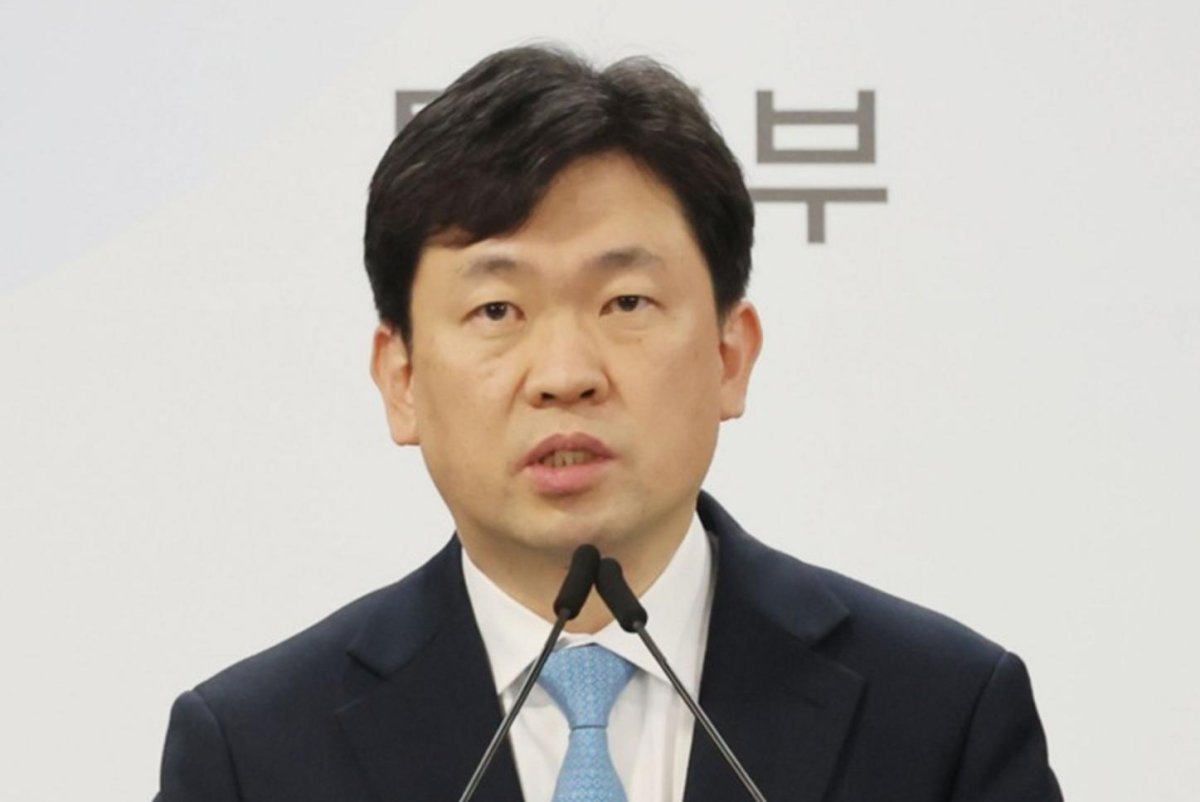
Yoon Min-ho, spokesperson for the unification ministry handling inter-Korean affairs, speaks during a press conference at the government complex in Seoul, 02 February 2026. Photo by YONHAP / EPA
March 30 (Asia Today) — South Korea’s Ministry of Unification has published new education materials reflecting a policy shift toward peaceful coexistence between the two Koreas as separate states.
The National Institute for Peaceful Unification Education, affiliated with the ministry, released its 2026 unification education textbooks on Monday, incorporating what it described as a “peaceful two-state” framework.
In Understanding Unification Issues 2026, the institute outlines the Lee Jae-myung administration’s policy of peaceful coexistence on the Korean Peninsula. The text states that inter-Korean relations should be developed into a cooperative relationship aimed at eventual unification, while acknowledging the current reality of two separate systems.
Unification Minister Chung Dong-young has repeatedly emphasized peaceful coexistence in official remarks. At a joint academic conference last week, he referred to North Korea using formal state terminology, signaling a stance that acknowledges the North’s political system.
The textbook also references North Korea’s own “hostile two-state” concept and notes growing public discussion in South Korea about the need for peaceful coexistence. It calls for dialogue between the two Koreas to establish agreements that could support a sustainable coexistence framework.
The definition of unification in the new materials has been revised. Last year’s description emphasized integrating two systems under a liberal democratic order and market economy. The updated version defines unification as “the process of forming a new, unified community.”
Terminology describing relations between North Korea and other countries has also been adjusted to reflect naming conventions used by Pyongyang, such as “North Korea-U.S.” instead of “U.S.-North Korea.”
The institute said the updated textbooks aim to emphasize dialogue, cooperation and factual objectivity, while also reflecting changes in the global environment, including U.S.-China strategic competition and the prolonged war in Ukraine.
A companion volume, Understanding North Korea 2026, provides a fact-based overview of developments in the North’s political, military and economic systems, including outcomes from its recent party congress and legislative session.
The report notes that persistent power shortages have led North Korean residents to rely on small solar panels, batteries and transformers imported from China for daily life and small-scale industrial activity.
It also finds that while government control over markets continues, private economic activity is expanding. The use of Chinese currency has increased significantly under leader Kim Jong Un, and economic cooperation with Russia has grown following a 2024 partnership agreement, particularly in energy, food supply and labor exchanges.
The materials describe gradual improvements in living conditions due to increased access to goods, but highlight widening inequality. A wealthier class able to afford high-end housing, vehicles and consumer goods has emerged, while disparities continue to grow.
The institute said it will distribute supplementary teaching guides to schools and make the materials available online and through a mobile app.
— Reported by Asia Today; translated by UPI
© Asia Today. Unauthorized reproduction or redistribution prohibited.
About the Author