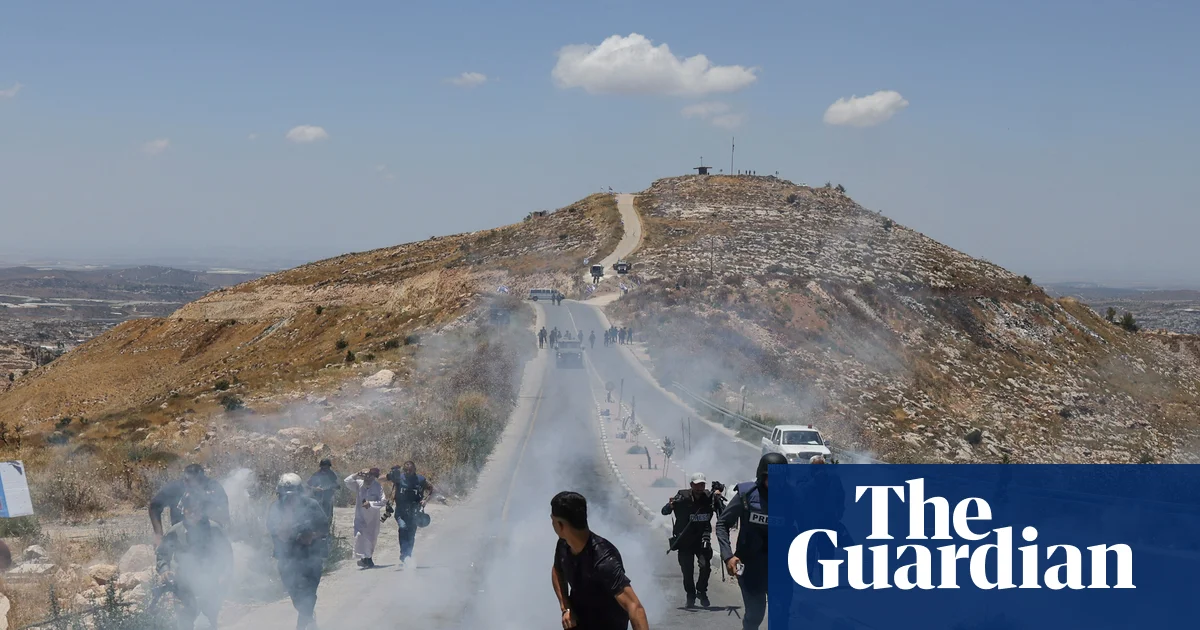
Settler terrorists supported by Benjamin Netanyahu’s government are committing ethnic cleansing in the West Bank, Ed Miliband has said, in the UK’s starkest condemnation since the foundation of the Israeli state.
Andy Burnham, the prime minister, said he would “not stand by” as horrific suffering continued, writing in the Guardian that for too long, the UK had been hesitant to act, “fearful of being accused of being anti-Israel”.
In the Commons, the foreign secretary said the government would now take the official position that Israel’s occupation of the West Bank was unlawful in its entirety, as he announced sweeping sanctions on trade with Israeli settlements.
The dramatic shift in the UK’s position comes after a summer of intense diplomacy against a backdrop of increasing settler violence in the West Bank, which has resulted in 12 nations – including France and Canada – announcing they would impose sanctions.
In a joint statement Burnham, Emmanuel Macron and Mark Carney said: “The time has come to take further action to uphold our commitment to protect the two-state solution, our interests and to stand up for our values, before it is too late.”
In response, the Israeli foreign minister, Gideon Saar, announced the closure of the UK consulate in Jerusalem and that 12 British MPs and activists – including Jeremy Corbyn and Labour MP Diane Abbott – would be banned from entering Israel.
Saar accused Miliband of “outrageous lies” and said the UK government was “systematically working against the state of Israel”. Washington’s ambassador to Israel, Mike Huckabee, warned that the US could take retaliatory action over trade.
However, the US secretary of state, Marco Rubio, said Washington would “obviously” not follow the UK’s course of action, and did not want to see the West Bank destabilised, but declined to comment further. Burnham had briefed Donald Trump on the plan in advance.
In his statement to parliament, Miliband said the UK government would enact:
-
An import ban on goods from illegal settlements in the occupied territories and a new ban for arms licences and other exports that “materially contribute to the occupation”.
-
A comprehensive sanctions regime against providing services such as construction or financing for Israeli settlements and a ban on advertising them in the UK.
-
Personal sanctions against key individuals accused of promoting settler violence.
-
A new ban for arms licences and other exports that “materially contribute to the occupation”.
The foreign secretary said the UK’s actions would show that “Britain is not silent in the face of deep injustice and nor is it powerless”. In an emotional statement, he described the agony he had heard from Palestinians in the West Bank whose homes had been destroyed and from doctors in Gaza who had seen children dying waiting for medical treatment.
The UK’s actions have been made increasingly urgent by Israel’s plans to expand the E1 settlement project east of Jerusalem, which could in effect cut off the north from the south of the West Bank, threatening the viability of any future Palestinian state.
Ministers expect the legislation to enforce the trade ban and sanctions to be in place within nine months, although they could be subject to legal challenge, which would result in a delay.
Miliband stopped short of describing Israel’s actions in Gaza as a genocide, as some on the left have demanded, saying the UK would wait for the determination of the international courts, but that there was evidence of “war crimes”.
Speaking in the Commons, he said: “The British government agrees that there is ethnic cleansing of Palestinians in areas of the West Bank, perpetrated by settler terrorists.
“All too often the Israeli government has turned a blind eye to this and worse, members of it have made statements and taken actions to support the forced displacement of Palestinians.
“I recognise the gravity of saying this, but the truth is the least the people who face such suffering deserve. And it should be the prelude to justice.”
Miliband suggested that Keir Starmer had been reluctant to take action against West Bank settlers during his time as prime minister. “I’ll say very bluntly we should have acted earlier. And it has taken the new prime minister to come in and recognise the gravity of the situation,” he told MPs.
Burnham, who apologised for Labour’s stance on Gaza when he became prime minister, attempting to shore up votes on the party’s progressive flank, also said the previous government had been too slow to act.
Writing in the Guardian , he said: “We have called for years for a two-state solution in the Middle East, but we must recognise that those words are meaningless unless we back them up with action. For too long, we have been hesitant to act, fearful of being accused of being anti-Israel.”
Miliband said he was taking the action as foreign secretary but also as a “proud British Jew” with relatives who had found safety in Israel after the Holocaust. “I am proud of my Jewishness and unwavering in my support for the state of Israel,” he said.
“And there is absolutely no contradiction between this and my support for the state of Palestine. Indeed, quite the opposite. The two-state solution is based on an explicit belief that the only route to security for both peoples is to live side by side in peaceful coexistence with freedom, security and self-determination.”
The foreign secretary said that to respond to threats against Jews around the world, the UK would also impose sanctions on Lebanese Hezbollah’s financing arm, Al-Qard al-Hassan, and reimpose major economic sanctions on Iran in line with the EU and US.
The action marked the beginning of a new approach towards Israel and Palestine, he said, one that not only condemned but took action. “Our argument is not with the people of Israel, with whom the UK has unshakeable bonds. Our argument is with the conduct of its government.”
Burnham wrote that the British Jewish community must not be blamed for the actions of the Israeli government. “[It] is wrong, plain and simple. And it is antisemitism, plain and simple,” he said.
“I met with the representatives of the Jewish community just last week. I know the fear they live with day by day. My government will stop at nothing to ensure they are safe and to stamp out antisemitism in every part of our society.”
The shadow foreign secretary, Tom Tugendhat, said “illegal settlements are wrong” but suggested that Miliband was introducing policies the Foreign Office did not believe would work. Whitehall insiders denied this was the case.
The senior Conservative MP also said there was a risking of harming Palestinians who worked in the West Bank and that “the economies of Palestine and Israel were too interconnected” for a ban on goods for illegal settlements to work.
But the veteran Tory MP Edward Leigh gave full backing to the sanctions. “I am proud to say as the longest serving member of the Conservative Friends of Israel that I absolutely and fully support what he is doing today because it is about standing up for freedom, for morality and justice for all people in this world,” he said.
The move forms part of a broader attempt by Burnham’s government to reset British policy towards Israel, in part to regain the trust among Muslim and progressive voters in the UK they lost in the early days of the conflict.
It was overwhelmingly welcomed by Labour MPs, many of whom have been struggling with the issue in their constituencies, although some sounded a note of caution about the potential impact on local Jewish communities.
Emily Thornberry, the Labour chair of the foreign affairs select committee, said: “At last! I am so very happy to see a British government – a Labour British government – finally doing the right thing and taking a strong stance … no longer a bystander wringing their hands.”
About the Author