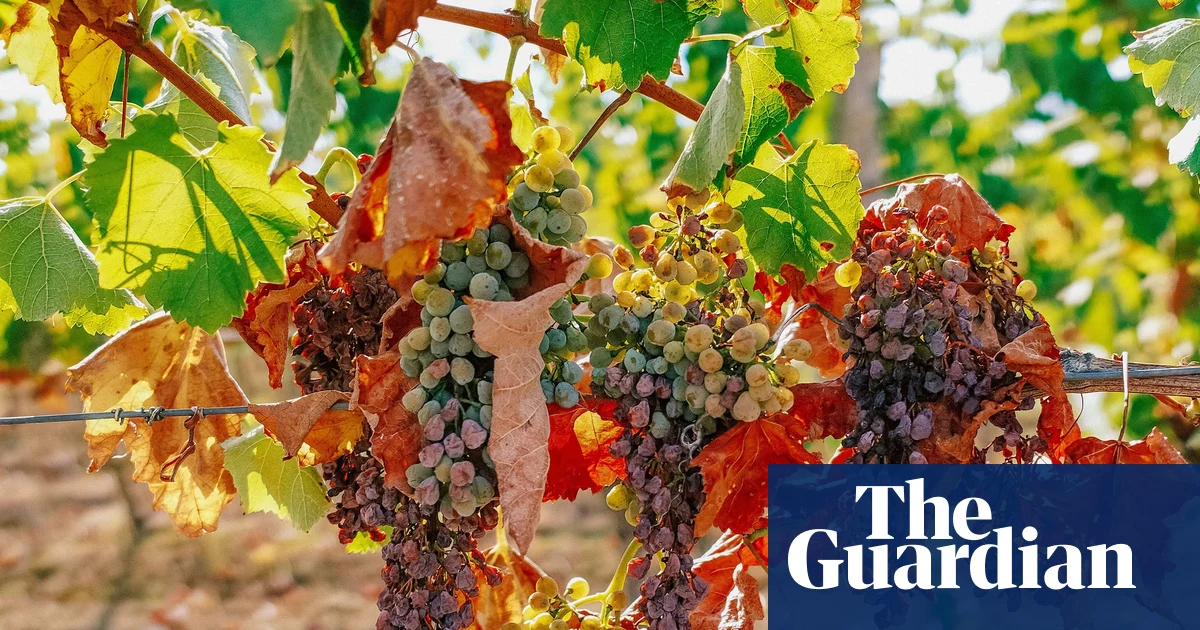
French vineyards hit by severe drought and heatwaves are expected to report a 30-year low in wine production after the country’s hottest ever recorded summer, according to the agriculture ministry.
Initial estimates suggest winemakers will produce just under 34m hectolitres from this year’s harvest: a drop of 6% on last year, and 17% less than the 2021-2025 average.
Agreste, the government’s farming food, forestry and fishing statistics body, said the drop was partly caused by a reduction in the number and size of vineyards, but mostly the result of extreme weather conditions.
“The summer was particularly hot and dry: soil drought has intensified throughout the country and heatwaves have caused localised sun scald, scorching, defoliation, and wilting of the grapes, reducing harvest volumes,” it reported.
However, some winemakers say with grape harvests still being conducted it is too early to make credible predictions.
The disappointing forecast comes after an optimistic start to the year, with heavy spring rains that encouraged grape growth. “The hot and dry summer conditions meant a deterioration of the [harvest] forecast,” Agreste reported.
A series of heatwaves saw the highest summer temperatures recorded in France since records began in 1900, with averages of 24C in June, July and August. Almost half of the country recorded temperatures on or above 40C.
Among the worst hit wine regions is Champagne where the grape harvest, which started unusually early in mid August, is predicted to be almost half that of last year. The Jura region in the east was the next worst hit with an estimated 37% loss. This year’s Burgundy-Beaujolais region grape production was expected to be one-third down, Agreste reported.
Winemakers in Bordeaux and the Languedoc-Roussillon as well as those in the south-east and south-west reported higher harvests this year but all except the Savoie region were down on the 2021-2025 five-year average for production.
However, Cécile Mathiaud of the Burgundy wine producers association said she was surprised by the government’s disastrous figures for her region’s vineyards.
“We know we won’t have a full harvest this year, but we have no definite figures and there’s no suggestion the situation is a disaster,” Mathiaud said. “We have some vineyards that have reported not much this year and others where it has been higher than expected.”
Some Burgundy vineyards began their harvest in early August but others are collecting the grapes now, she added. “Our reference is the historically low harvest of 2021 when we produced only 1m hectolitres; we think it will be higher this year, but the question is by how much? I have absolutely no idea how the ministry has come up with these figures.”
after newsletter promotion
Agreste said the figures were estimates and definitive results would not be known until regions made official harvest declarations later this year. It added that 2026 grape harvests were “marked by significant regional disparities”.
Wine harvests have traditionally taken place in France between September and mid October, but the climate emergency has brought dates forward slightly each year for the last four decades. This year, the harvest timetable advanced at least a week compared with last year throughout the country. Some vineyards in Bordeaux began two weeks early.
There are also concerns that vines and grapes in some of France’s best-known wine producing regions, including Bordeaux, have been damaged by smoke from rampant wildfires. No major Bordeaux vineyards suffered direct damage from the flames that came within 15km (9 miles) of the city, but there is concern that smoke has entered the grape skins causing “smoke taint” and affecting the taste of the finished wine.
The agriculture ministry would normally issue harvest estimates in early August, but postponed its analysis at the request of the wine industry because of what it described as “the high level of uncertainty surrounding these forecasts” caused by weather conditions and wildfires.
France’s wine sector is already under pressure owing to a decline in demand. Annual wine consumption in the 1960s in France was 127 litres each year compared with 40 litres a year now.
Wine drinking in the US, France’s largest export market, has also dropped and French wines have been hit by Donald Trump’s tariffs.
About the Author