
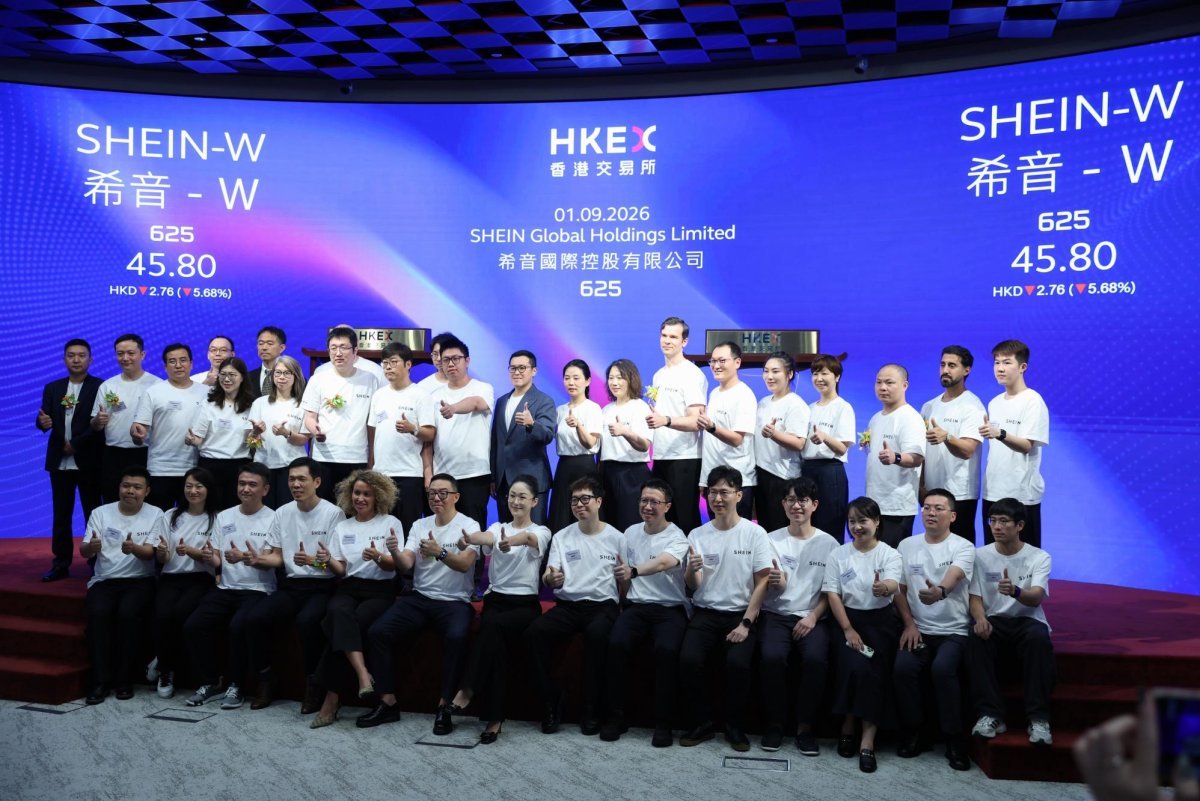
Shein executives and employees celebrate on the floor of the Stock Exchange of Hong Kong on Tuesday ahead of the long-awaited IPO of the Chinese fast-fashion giant. Photo by May James/EPA
Sept. 1 (UPI) — Shares in Chinese fast-fashion giant Shein fell by as much as 10% as trading got underway in its debut on the Hong Kong stock exchange Tuesday but later rebounded to end the day at $6.19, within a cent of the cutoff price set by the firm and sponsors Goldman Sachs, Morgan Stanley and JPMorgan.
The IPO sale of about 280 milllion shares, SEHK’s largest this year, raised $1.73 billion, valuing the company at $26.2 billion, $100 million less than the $26.3 billion anticipated and a little more than a quarter of the $100 billion it was valued at in 2020.
Analysyts said Shein’s listing was being seen a litmus test of investor interest in the online fashion sector and that it had showed Shein’s once incredibly popular model of endless affordable choice on demand, driven by fast turnaround and technology, may have had its day.
“It represents the old tech, as opposed to the new tech. Shein would have had a lot more traction with investors in the 2021 vintage. But the world has moved on from blockbuster e-commerce listings,” Nirgunan Tiruchelvam, who leads the consumer and internet division at Aletheia Capital, told The New York Times.
GlobalData told the BBC that Shein was almost unique in the fact it was a “standalone” e-commerce player capable of being evaluated on its own account.
“Investors have learned to be skeptical,” said Louise Deglise-Favre, a fashion indusry specialist at the London-headquartered research firm, who noted the IPO had been complicated by sustainablitly and ethical worries over firm’s manufacturing and distribution practices.
Asos and Boohoo, which compete in same space, have seen their stock price come under pressure as rivals have emerged and amid scrutiny from regulators.
Advance offers of Shein stock to institutional buyers ahead of Tuesday’s launch saw just 20% of the shares sold, compared to a typical take up rate for sought-after flotations of 50%, according to Weiheng Chen, a senior partner at Wilson Sonsini Law in Hong Kong, who has advised on numerous big-name IPOs.
“It’s a fashion company that is not that fashionable to today’s investors,” he said.
Consumer Edge senior vice president of research and market intelligence, Michael Gunther, said Shein needed to recapture the Gen Z segment of the market that helped propel it into a global player during COVID-19, given it was continuing to lose U.S. market share, mostly among 18-34 year-olds.
“The fact that it’s continuing to lose share more with that group than other groups is notable,” Mr. Gunther said, adding that sustainability and affordability issues could be behind the change after Shein hiked prices for U.S. customers in May 2025.
The raises were in response to U.S. President Donald Trump’s scrapping of the so-called de minimis import tariff exemption on low value packages on which Shein’s business model depends heavily.
The European Union imposed its own flat $3.50 tax on low value imports into its single market, effective July 1, with Britain, another big market for the Chinese online retailers, also expected also expected to implement similar measures in 2028.
The headwinds buffeting Shein saw it post a $99 million loss in Q1, down from a $395 million profit in the same period in 2025.
About the Author