
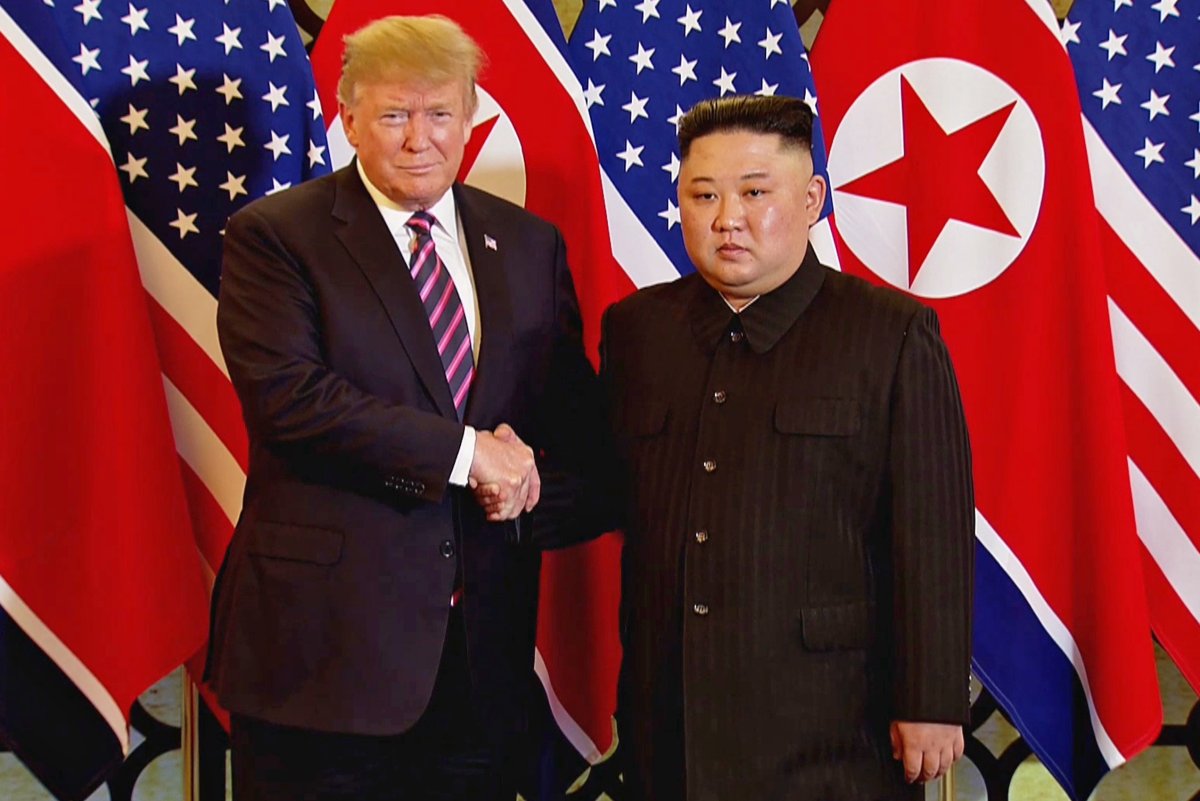
President Donald J. Trump and North Korean leader Kim Jong-Un shake hands during the second U.S.-North Korea summit in Hanoi, Vietnam, in 2019. File Photo by Ritchie B. Tongo/EPA
Aug. 29 (UPI) — A recent article argues that President Trump should pursue what he calls an “achievable” agreement with Kim Jong Un. His proposal would accept north Korea’s nuclear weapons status, impose verifiable limits on parts of its nuclear and long-range missile programs, permanently end U.S.-ROK military exercises, negotiate a peace treaty, improve political and economic relations, and compel Pyongyang to terminate military support for Russia.
I could not disagree more strongly.
What the author presents as pragmatic diplomacy risks becoming strategic capitulation disguised as realism. The problem is not that negotiations are inherently misguided. Diplomacy is an instrument of strategy and should be used whenever it can advance U.S. and allied interests. The problem is that the proposed agreement appears to concede several of Kim Jong Un’s most important strategic objectives before establishing that Pyongyang has surrendered anything remotely comparable.
A deal is not a strategy.
The first question should never be whether an agreement is achievable. The first question should be whether the agreement advances the desired political end state. An agreement can succeed diplomatically and still fail strategically.
The proposal rests on at least two dangerous assumptions.
The first is that Kim Jong Un has somehow abandoned the seven-decade strategy of the Kim family regime: subversion through political warfare, coercion and extortion through blackmail diplomacy, and the threat or use of force to achieve domination of the Korean Peninsula. There is little evidence that this has occurred.
The second assumption is that Kim has abandoned his longstanding objective of splitting the ROK-U.S. alliance and eventually removing U.S. forces from the Peninsula. Again, there is little reason to believe this.
Kim’s strategy remains divide to conquer. Divide the alliance. Weaken extended deterrence. Undermine combined military readiness. Reduce U.S. political commitment. Then increase pressure against the South.
Nuclear weapons are integral to this strategy.
Kim does not possess nuclear weapons simply to prevent an American invasion. They support deterrence, coercion, political warfare, alliance decoupling, blackmail diplomacy, and ultimately the regime’s effort to dominate the Peninsula.
A cap on nuclear warheads or intercontinental ballistic missiles would therefore address only part of the threat. north Korea could retain nuclear weapons, shorter-range missiles capable of striking South Korea and Japan, massive conventional forces, cyber capabilities, special operations forces, chemical weapons, and increasingly sophisticated unmanned systems.
The danger becomes greater if Washington simultaneously weakens the alliance mechanisms designed to deter those capabilities.
Ending combined military exercises would be particularly damaging. Exercises are not diplomatic bargaining chips. They are how combined forces prepare to execute the operational plans upon which deterrence rests.
Deterrence depends upon capability, will, and the adversary’s perception of both. Readiness is what converts military forces from inventory into credible capability.
Why would Washington voluntarily weaken the military instrument that gives diplomacy leverage?
A peace treaty presents similar risks.
Peace does not emerge because governments sign a document containing the word “peace.” A treaty can formalize an existing political condition. It cannot manufacture one. Paper does not trump steel. And there is a lot of steel in the fourth largest army in the world on the north side of the DMZ.
If north Korea retains nuclear weapons, massive conventional forces, offensive cyber capabilities, special operations forces, and an objective of dominating the Peninsula, what precisely has become more peaceful?
Worse, Pyongyang could use a peace treaty politically. The regime could argue that if the war is formally over, the United Nations Command has no purpose. If the UNC is unnecessary, why should U.S. forces remain? If U.S. forces remain, Pyongyang can claim that Washington, not North Korea, is preventing genuine peace.
This is not a hypothetical propaganda line. It is entirely consistent with decades of north Korean political warfare.
Accepting north Korea as a permanent nuclear weapons state would also produce consequences far beyond Pyongyang. South Korea and Japan would inevitably reassess their own security calculations. Questions about independent nuclear capabilities would intensify. Confidence in U.S. extended deterrence could weaken precisely when Washington needs stronger alliance cohesion.
The proper strategic objective should therefore not be a deal for the sake of demonstrating diplomatic accomplishment.
The objective should be a secure and stable Korean Peninsula that protects U.S. interests, strengthens the ROK-U.S. alliance and ROK-U.S.-Japan cooperation, deters aggression, and ultimately creates the conditions to resolve the Korea question through a free and unified Korea.
This leads to the question that should precede every negotiation with Kim Jong Un: What is the acceptable, durable political arrangement on the Korean Peninsula that will support, defend, and advance U.S., ROK-U.S. alliance, and ROK-U.S.-Japan interests in Northeast Asia and globally?
Only after answering that question should Washington decide what agreements, concessions, sanctions, military postures, and diplomatic initiatives advance that end state.
The most dangerous agreement is not one that fails.
It is one that succeeds on paper while advancing the adversary’s strategy.
Before pursuing an “achievable” deal, we should therefore ask a harder question: Achievable for whom?
David Maxwell, executive director of the Korea Regional Review, is a retired U.S. Army Special Forces colonel who has spent more than 30 years in the Asia-Indo-Pacific region. He specializes in Northeast Asian security affairs and irregular, unconventional and political warfare. He is vice president of the Center for Asia Pacific Strategy and a senior fellow at the Global Peace Foundation, where he works on a free and unified Korea. After he retired, he became associate director of the Security Studies Program at Georgetown University. He is on the board of directors of the Committee for Human Rights in North Korea and the OSS Society and is the editor at large for the Small Wars Journal.
About the Author