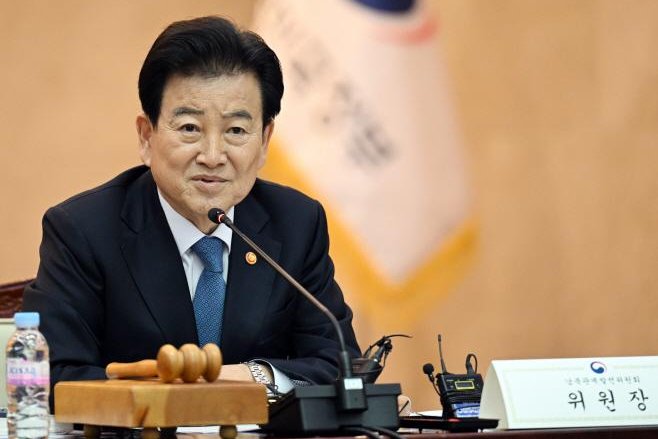
Chung Dong-young, South Korea’s unification minister, speaks at a meeting of the Inter-Korean Relations Development Committee in Seoul on March 19. Photo by Asia Today
March 25 (Asia Today) — South Korea’s government has taken a cautious approach on North Korea human rights issues, with no formal steps taken to launch a long-delayed foundation and uncertainty over joining a U.N. resolution.
The Ministry of Unification has not sent any official request to the National Assembly to recommend board members for the North Korean Human Rights Foundation since President Lee Jae-myung took office, according to government and parliamentary officials.
The foundation’s launch is part of the administration’s 123 national policy priorities announced last year. However, more than six months later, critics say little progress has been made.
Under the law, the foundation can only be established once a 12-member board is formed, including nominees from the unification minister and lawmakers from both ruling and opposition parties.
The ministry had previously sent multiple requests to the National Assembly to nominate board members, including four during the previous administration, but has not issued any since last year.
Observers say the lack of action reflects a broader policy shift aimed at improving inter-Korean relations. Unification Minister Chung Dong-young has expressed skepticism about using human rights as a tool of pressure against North Korea, signaling a preference for a different approach.
A ministry official said the government is pursuing policies focused on inter-Korean cooperation to improve human rights conditions and believes the foundation should be launched after legal revisions are made to better support that goal.
“The administration is working to align its policies with peaceful coexistence and practical improvements in North Korean human rights,” the official said, adding that discussions on amendments to the law are ongoing in the National Assembly.
The cautious stance comes as inter-Korean relations have deteriorated, reducing prospects for engagement. Incidents such as alleged civilian drone intrusions and North Korean leader Kim Jong Un’s endorsement of a “two hostile states” framework have further complicated Seoul’s policy options.
The Foreign Ministry is also weighing whether to join as a co-sponsor of a North Korea human rights resolution expected to be adopted at the U.N. Human Rights Council later this month.
Although South Korea joined a similar resolution at the U.N. General Assembly in November, officials now say they are reviewing the issue in light of changing circumstances.
“There are various perspectives on North Korean human rights, including the importance of dialogue, and questions about whether such resolutions lead to tangible improvements,” a Foreign Ministry official said. “We are considering multiple factors before making a decision.”
The resolution is expected to be adopted between Thursday and Sunday, with a two-week window afterward for countries to join as co-sponsors.
— Reported by Asia Today; translated by UPI
© Asia Today. Unauthorized reproduction or redistribution prohibited.
About the Author