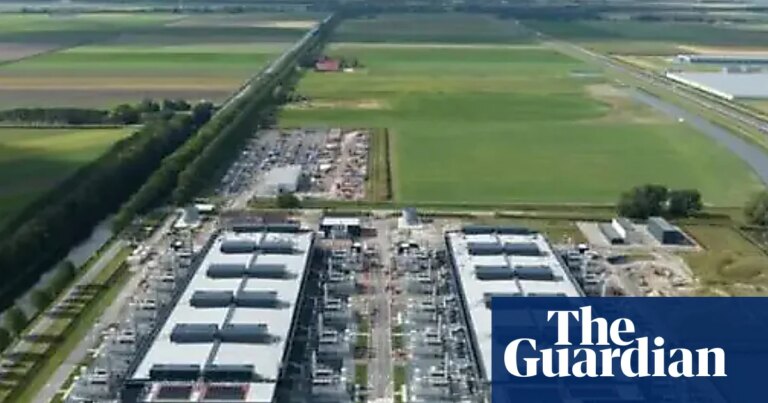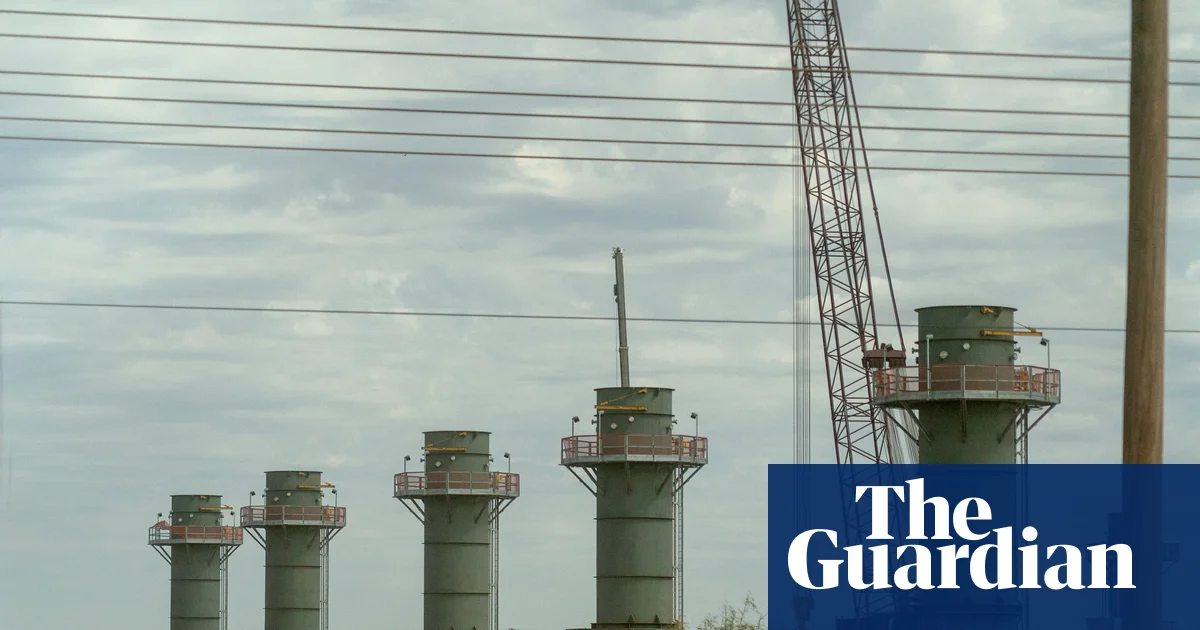
The US has surged ahead of China in the building of new gas-fired power generation, largely to feed a boom in artificial intelligence (AI) that is adding vast amounts of planet-heating emissions, a new analysis has found.
For decades, China’s rapid economic growth has seen it outpace the US in the addition of new gas power generation but a recent “frenzy” in datacenter construction for AI has reversed this, said Global Energy Monitor (Gem) in its new report.
The US is now building twice as much gas-fired capacity as China, and more than any other country in the world, after a stunning 76% increase in under-construction projects in the first half of this year. When adding announced and pre-construction projects, the US is building nearly three times as much as its fellow global economic powerhouse.
Since January, gas power capacity in overall development in the US has ballooned by 50%, rising from 252GW to 378GW – a third of the global total. If all of these projects are ultimately built, the US will increase its gas fleet by around two-thirds at a capital cost of more than $647bn, Gem found.
Around half of the new capacity is directly tied to a rash of upcoming datacenters that require a huge amount of electricity to handle the increased demand from AI. Using gas, a fossil fuel that is dangerously overheating our planet, rather than renewables to power this glut of new datacenters threatens to increase US power emissions by as much as 20%, according to one estimate.
“Six months ago, China had more gas plants under construction but that has now flipped,” said Jenny Martos, a project manager at Global Energy Monitor.
“There has been an enormous surge in datacenter proposals powered by gas in the past year and the climate implications of that is huge. Building all of this gas for AI locks in decades of pollution and it is also locking in dependence on a volatile fuel cost, which will get passed down to rate payers.”
Donald Trump and others in his administration have repeatedly claimed that China, the world’s largest carbon polluter, is expanding its fossil fuel use so much that any emissions cuts by the US would be futile. The president has said of China that “their air is dirty, and it drifts over to us”.
But the rush of new infrastructure for AI, along with the Trump administration’s demolition of environmental regulations and China’s rapid adoption of clean energy, is changing this equation. US spending on power plants fueled by coal and gas will outstrip that of China for the first time in decades, the International Energy Agency has forecast.
The stampede by tech companies, such as Google, Open AI and Amazon, to build datacenters has contributed to a backlog of the most efficient gas turbines used for accompanying power plants. This has led several companies, including Elon Musk’s xAI, to quickly switch to smaller, less efficient turbines which are more heavily polluting.
Concerns over the climate crisis, rising power bills, tax breaks for AI companies and water shortages – two-thirds of more than 800 planned datacenters are located in drought-stricken areas – has fueled mounting local opposition to data center construction.
A recent poll by Heatmap found that three-quarters of Americans do not want to live next to a datacenter, a huge increase in opposition in the past year. Dozens of cities and counties have placed restrictions on new datacenters, with New York in July becoming the first state to enact a temporary ban on new hyper-scale datacenter permitting and construction.
Despite this backlash, which could well hurt Republicans in the November midterm elections, the Trump administration has championed the building of new datacenters and eliminated environmental reviews in order to speed them up. Trump said this month that “data centers could be bigger than oil” and state governors should cut taxes to encourage them.
“Frankly, communities that don’t take a datacenter, they’re making a mistake because there’s plenty of communities that want them,” Trump said in separate remarks to his former lawyer Michael Cohen last week.
“Because it means jobs, and it means tremendous tax revenue coming into the towns and cities that take them.”
About the Author