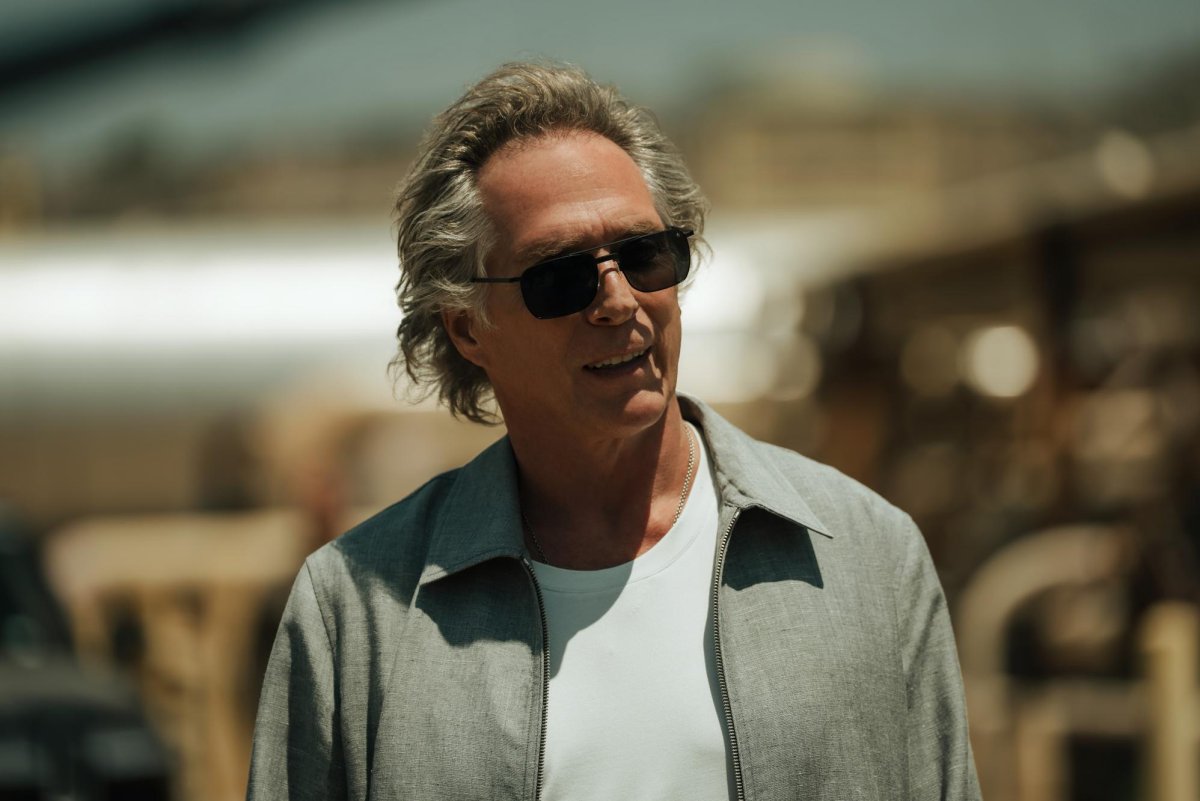
1 of 5 | William Fichtner’s “Lucky” wrapped up its first season Wednesday. Photo courtesy of Apple TV
NEW YORK, Aug. 20 (UPI) — One of the stars of Lucky said he signed on to the Apple TV crime drama knowing full well his character wouldn’t make it out of the season finale alive.
Based on Marissa Stapley’s bestselling novel, the show follows the titular con woman (Anya Taylor-Joy) as she is forced to go on the run after her partner betrays her.
Timothy Olyphant plays Lucky’s scheming father John, Drew Starkey plays Lucky’s husband Cary, Annette Bening portrays Cary’s ruthless mobster mother Priscilla and William Fichtner plays Priscilla’s terrifying boss Wayne.
Spoilers ahead.
Wednesday’s finale saw Wayne confessing to Priscilla that he didn’t want to be a father to Cary because his own dad was such an awful man.
Moments later, Priscilla fatally shoots Wayne, so Lucky and John could escape with the $10 million they stole from Wayne.
Once they get to safety, John steals what he thinks is the recording of a seed phrase for a crypto account and takes off, only to find his daughter knew him better than he thought, recorded a goodbye message for him and handed the account info over to police, so she and John, though broke and estranged, wouldn’t go to prison.
“I knew that this was a character that was only going to be in four of the seven episodes, but, also, when I read the first couple of scripts, it was very interesting to play a character that everyone talks about,” the 69-year-old Beef, Talamasca, Armageddon, Heat and The Perfect Storm icon told UPI about Wayne in a recent Zoom interview.
“By the time he shows up, it’s like, ‘Is that him?’ That’s a great thing for an actor. It’s just such an intro, especially with a guy like me. But I remember when I went through the episodes and I got to Episode 7, I’m like, ‘Oh, I’m in for this episode alone.'”
The car ride where Wayne and Priscilla discuss their past relationship and Cary’s recent death was Fichtner’s favorite scene in the whole show because it allowed him to give Wayne emotional depth, thereby humanizing the villain.
“It’s everything,” the actor said.
“Driving in the car, going to this finale showdown with Annette. I’ve never met Annette before, but I’m such a huge fan and she’s such a lovely woman,” he added.
“It’s that scene in the car where you think you kind of know there’s a few other colors in there, because I really do believe that Priscilla is someone, in a very twisted way, that has meaning to Wayne.”
Although he may have cared deeply for Priscilla at one point, he stands by his decision to not help her raise Cary.
“As he says, ‘This was your journey and I told you that from the beginning,'” Fichtner said.
“So, I don’t believe that Wayne lived his life, not at peace with that. He always told her that it would go that way. When you get a little glimpse of his own upbringing, maybe he didn’t want to take the chance of having anything that resembled that sort of relationship or lack thereof,” he added.
“It’s important for Wayne, in that scene with Priscilla, to say to her: ‘It just wasn’t for me. Remember that. Please don’t look at me like I didn’t do what I said I was going to do.'”
The series is very much an exploration of how much damage criminal parents do to their children, even when they stick around and try to love them the way John does with Lucky.
“I think Lucky and John have a more twisted relationship than me and Priscilla and Cary,” Fichtner laughed.
“We put our cards on the table. Those guys are nuts,” he quipped. “Especially in Episodes 6 and 7, there’s some dynamic turns that are happening with Lucky and her father. It’s sad, what she went through. That, that was an option. There was no adult in the room to go, ‘Hey, maybe this is NOT OK.’ Actually, John says it to her. ‘Maybe I missed it. Maybe I didn’t do it the right way.'”
While John tells Lucky he doesn’t feel badly about stealing from people because he thinks of himself and her as animals and their marks as prey, Wayne regards himself as a businessman.
“Wayne has built an empire that has huge walls,” Fichtner noted.
“Wayne’s removed himself from the craziness of his younger years. He has the money and the influence and the knowledge,” he added. “He’s not out there slinging guns around or anything. He’s making a kale shake, which is probably really good for him. Whatever his reasons, growing up, whatever, he found a world and a life that works for him.”
This isn’t the first time Fichtner and Olyphant have shared the screen. They previously co-starred in the 1999 Sundance Film Festival hit, Go.
“I don’t think I’ve seen Timothy since those days,” Fichtner said.
“I’ve always been a fan of his,” he added. “In the course of a career and over time, you meet so many wonderful people and that’s the joy of the people that we meet along the way, but, there’s only so many hours in a day. … You wish them well and you go on.”
An exception to this type of experience 2001’s Black Hawk Down.
“By the time we finished, I knew that Canadian actor Kim Coates, I met my best friend at 44 years old, and Eric Bana? And another guy, Johnny Strong, who played one of the snipers in it? By the time we all said ‘goodbye’ after five months, I knew we would talk to each other forever,” Fichtner said.
“Sometimes that happens.”
About the Author