
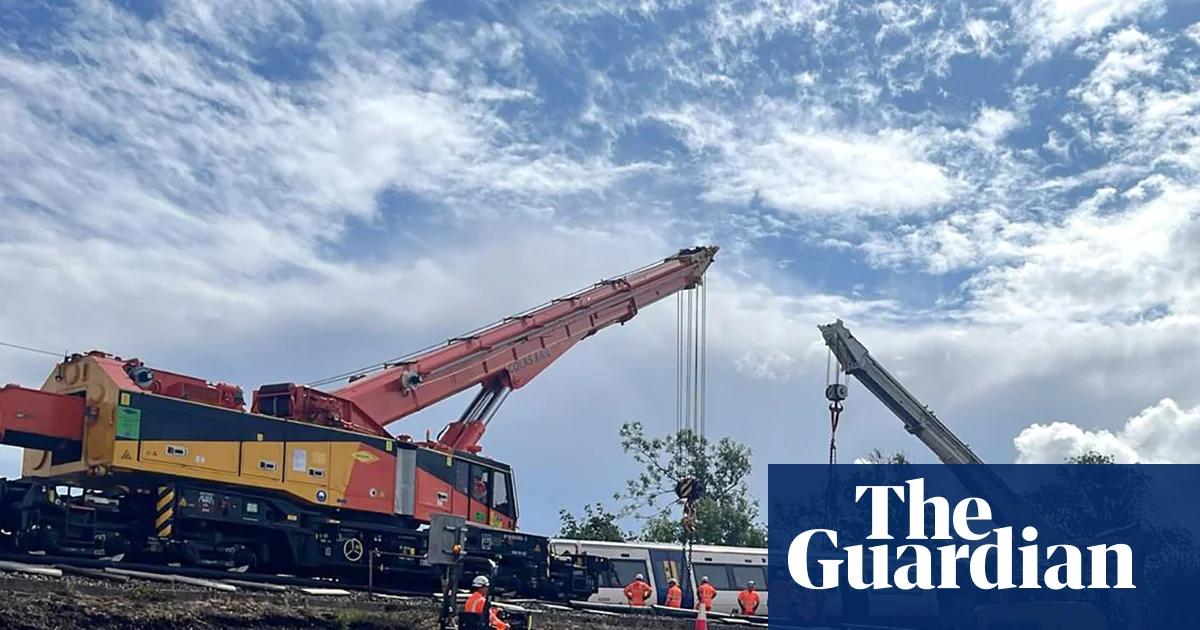
The East Sussex railway line on which a train derailed will reopen in September as crews continue to remove the carriages that left the track.
Rail bosses said they were prioritising reopening the route before the end of the school holidays, despite recovery workers operating under “very challenging circumstances”.
Three carriages at the back of the train operated by Southern derailed on 13 August, injuring 30 people and trapping passengers on board.
An initial report by the Rail Accident Investigation Branch (RAIB) on Wednesday found a track defect on the approach to where the train derailed, which happened on the hottest day of the year so far.
Twenty people were taken to hospital and two suffered serious injuries, which are not deemed to be life-threatening.
The stretch of railway between Lewes and Haywards Heath is scheduled to remain closed until 1 September. That will give time for the train to be recovered – a complex job involving the derailed carriages being lifted by crane – and for recovery teams to make sure evidence is preserved.
Lucy McAuliffe, the Sussex route director for Network Rail, said: “I can only apologise for the disruption that this incident is causing to people’s journeys, and I want to personally thank people for their patience and their understanding alongside the many rail industry colleagues supporting the recovery.
“The location of the derailment, which happened in close proximity to the River Ouse, means that reinstatement of the site is particularly complex, with teams working round the clock to reopen the line for customers as soon and as safely as possible.
“The recovery is being carried out with careful consideration for the area around the derailment site, ensuring the area’s ecology is protected and being mindful of residents living nearby.”
Images showed a crane holding up one of the carriages on Thursday afternoon as staff took luggage and bicycles off the vehicle.
John Whitehurst, the chief executive of Greater Thameslink Railway, which owns Southern, said: “Getting the line open in time for the end of the school holidays is an absolute priority for us and we are working closely with Network Rail to achieve this despite very challenging circumstances.”
The RAIB’s initial report included an image that appeared to show the track had buckled – something that can happen in high temperatures – before the train derailed.
The train, which had about 150 people on board, came off the track at 3.54pm last Thursday, doing “significant damage” to the carriages and the rail infrastructure, the watchdog said.
The report pointed to “a sustained period of hot and dry weather” and said the ambient air temperature at the time was about 27C, according to the nearest weather station to the site.
About the Author