Burnham announces drive to get thousands of rough sleepers off streets for Christmas
Hello and welcome to the UK politics live blog.
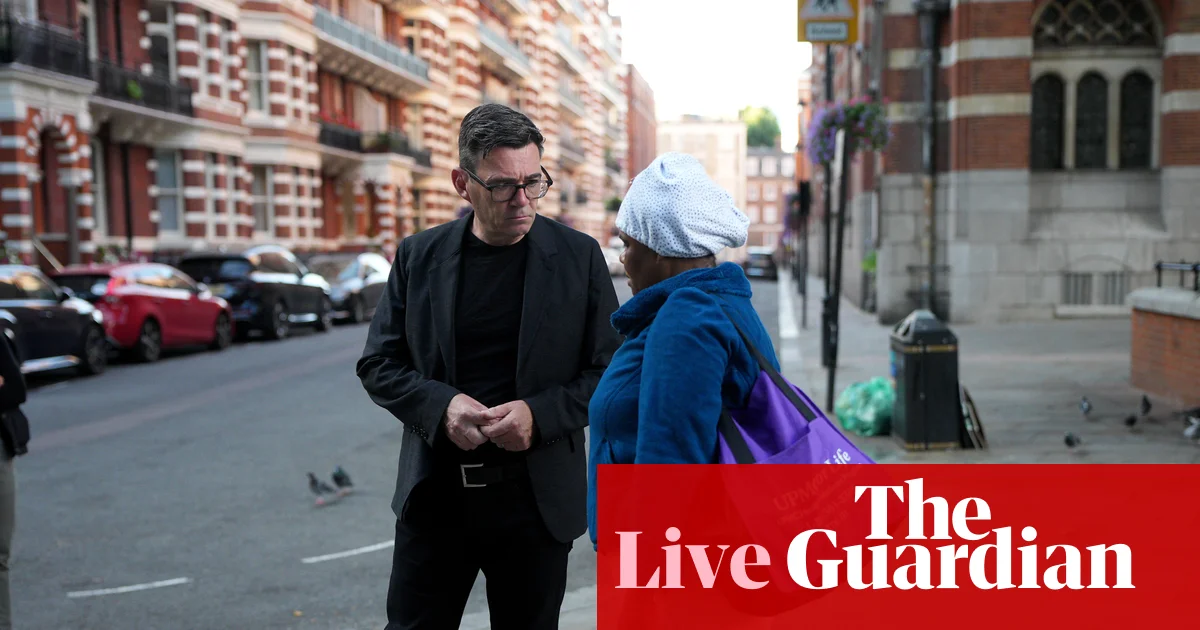
Andy Burnham has pledged to work to “get everyone in for Christmas” as he continues to build on his policy to end rough sleeping.
Arguing in the Guardian that rough sleeping has become so common it now “feels like part of the scenery”, Burnham promised he would mount a Covid-style campaign to get everyone off the streets this winter.
The announcement solidifies tackling homelessness as a central policy for Burnham’s government, and gives voters a measure by which to judge his success – although without a concrete target for ministers to hit.
Homelessness campaigners welcomed the move, but warned more will need to be done to tackle the longer-term temporary accommodation crisis, which has given the UK the worst homelessness problem in the western world.
In his article for the Guardian, he writes:
We see people bedded down in doorways and sat outside stations, carrying their lives in rucksacks and sleeping bags on their backs. And I think most people have the same reaction: this isn’t right.
It shouldn’t be happening here. But we’ve lived with it for so long that something that used to shock us now feels like part of the scenery.
He added:
We did it in the pandemic. We got people out of the cold because, as a country, we decided it had to be done. We can do it again.
That’s why the first thing I announced when I became prime minister was a commitment to end rough sleeping. Not to manage it, not to reduce it – but to end it. And today, we’re taking the first step in getting it done.
We’re putting £442m behind a national drive to get everyone in for Christmas.
The prime minister is expected to visit to a homelessness charity in the north-east later today.
Read the full story here:
In other developments:
-
Burnham confirmed a new partnership between the government and the West Midlands Combined Authority (WMCA) to take local control of bus services in the region. Burnham said the “absolutely massive” move would protect thousands of jobs, which were threatened after the parent company behind local operator National Express indicated it was leaving the market.
-
Burnham said “nothing of consequence” was exchanged when he was text messaging somebody impersonating Donald Trump’s chief of staff Susie Wiles. “All politicians are receiving these pressures and these challenges, but I did everything right. There was a minimal exchange of information of zero consequence, and it was quickly reported,” he told reporters.
-
Burnham said he will present findings on a review of the early release scheme in England and Wales when parliament returns in two weeks’ time. Justice secretary Alex Norris is drawing up plans to “maximise public safety and minimise the early release of prisoners”, the prime minister said.
-
The green energy entrepreneur and Labour donor Dale Vince has urged the prime minister to allow more drilling for oil and gas in the North Sea, in a reversal of his previous position. Vince, who has given more than £5m to Labour over several years, said he had told Andy Burnham that the Rosebank and Jackdaw projects should be approved as long as the oil and gas produced were subject to price controls to make them cheaper than energy imported from overseas.
Key events
The Tories believe they can cut energy bills by £540 a year for the next two decades by prioritising cheap energy over net zero.
Speaking in London, the shadow energy secretary Claire Coutinho said, when she was a minister, civil servants had been unable to prove to her that wind and solar energy was cheaper than fossil fuels.
She said:
Roughly half the savings come from having to build much less grid, fewer pylons and less cables carving up the countryside. The rest of the savings come from lower wholesale prices, lower balancing costs and subsidies.
Basically, we’d pay a lot less money to switch wind farms off when it’s too windy, or for back up when it’s not windy enough.
Coutinho added:
Our expensive electricity is pushing our industry overseas. It’s harming our ambitions in AI and it’s hurting living standards. These things are widely acknowledged.
Labour ‘could lose up to 50 seats’ to Greens if new drilling in North Sea approved
Matthew Taylor
Labour could lose dozens of seats to the Green party if the government allows new drilling in the North Sea, according to internal research shared with the Guardian.
Green party analysis suggests up to 50 Labour MPs – including key Andy Burnham ally Louise Haigh – could lose their seats at the next election if the government fails to make urgent climate action a priority or allows new drilling for oil and gas in the North Sea.
The research found that voters in these key Labour v Green seats want “bold action” to tackle the climate crisis, which has contributed to record heatwaves, devastating wildfires and crippling droughts this summer in the UK – and say Labour MPs will pay the price if the demands are not met.
Rachel Millward, deputy leader of the Green party, said: “If Labour won’t be swayed by the science or the moral imperative to leave all fossil fuels in the ground, perhaps they will listen to the polling. The data is clear: voters want more from our government on climate change, and they certainly don’t want our new prime minister to back away from his party’s bare minimum commitments.”
Labour dismissed the claims, pointing out that since Burnham took office the number of seats the Green party is projected to win at the next election has fallen from 20 to seven.
Last month, Burnham, who has been tight lipped about the climate crisis since tacking office, said he would be “pragmatic” about oil and gas and that decisions on new drilling would be made “in due course”. “The question isn’t whether Britain will still be using oil and gas, the question is where does it come from,” he said.
Do not cut benefits for disabled young people, dozens of UK charities urge ministers
Rowena Mason
More than 40 of the UK’s leading charities have warned ministers against imposing tougher benefit sanctions or cuts on disabled young people, as the government considers how to encourage more young people into work.
The charities raised concerns that an imminent review of young people and work by Alan Milburn could bring in stricter eligibility rules for keeping disability benefits – or remove them altogether – as part of a wider plan to boost flagging youth job rates.
Nearly 1 million 16- to 24-year-olds in the UK are classed as Neet (not in employment, education or training). Milburn has warned this is economically unsustainable and disastrous for a generation of young people.
In their joint letter to Milburn and Pat McFadden, the work and pensions secretary, charity leaders warn cutting support or bringing in sanctions risks pushing thousands of vulnerable youngsters deeper into poverty and further away from employment.
The charities fear that a previous Labour government proposal for the health element of universal credit to be removed for under-22s with a disability or long-term sickness, saving around £300m a year, may be resurrected.
Milburn – a former minister in the Tony Blair government – has made it clear England’s welfare, education and skills infrastructure needs to be overhauled but has so far refused to be drawn on whether he will recommend specific cuts to benefits.
However, his interim report, published in May, argued that state support was too focused on benefit support at the expense of practical programmes to help young people into work, inadvertently “trapping” them on benefits.
Angela Rayner accused Tory frontbencher James Cleverly of “scaremongering” over rules for illegal traveller sites.
Rayner said the government is making the rules “stronger and clearer” around unauthorised developments.
Cleverly, the shadow housing secretary, claimed changes to national planning policy frameworks will make it easier for travellers to get sites “rubber stamped” retrospectively, “often when they’ve already erected permanent structures”.
The Tories have vowed to “crack down on illegal traveller sites”, as communities were being “forced to tolerate illegal encampments and breaches of planning laws”, as well as “antisocial behaviour and petty crime, by a small minority of travellers”.
Speaking to Nick Ferrari on LBC, Rayner said:
He’s building a straw man, because what we’ve actually done is made things stronger and clearer throughout the rules around unauthorised development, making it harder, making it really clear that people who try and do this unauthorised development are stopped from doing it.
We explicitly tackle any potential environmental damage and transport impacts, and we’re making it harder for people to get retrospective permission for development which was built intentionally without approval, which the previous government did nothing about.
So I think he’s trying to scaremonger at the moment, and I don’t think it’s it’s OK, what he’s doing.

Andy Burnham
I’ve always thought you can tell something about a country by what it learns to walk past. And, somewhere along the way, we’ve got used to seeing people sleeping rough on our streets.
We see people bedded down in doorways and sat outside stations, carrying their lives in rucksacks and with sleeping bags on their backs. And I think most people have the same reaction: this isn’t right; it shouldn’t be happening here. But we’ve lived with it for so long that something that used to shock us now feels like part of the scenery.
That’s not on the public. It’s on us as politicians. For decades, Westminster has treated rough sleeping like a problem to step around rather than solve. It’s a philosophy that took hold in the 1980s and came back full force in the era of austerity: this idea that rough sleeping is just a fact of life rather than something government has a responsibility to end.
I’ve never accepted that. Britain is the fifth largest economy in the world. We’ve built the NHS, developed life-saving vaccines and invented the world wide web. But it’s somehow beyond us to get our own people off the streets? I don’t believe it for a minute. We did it during the pandemic. We got people out of the cold because, as a country, we decided it had to be done. We can do it again.
That’s why the first thing I announced when I became prime minister was a commitment to end rough sleeping. Not to manage it, not to reduce it – but to end it. And today, we’re taking the first step in getting it done.
Rayner also insisted that it is not a demotion for the chancellor that No 10 North will be taking charge of driving economic growth.
Asked by Sky News whether it was a demotion for John Healey, Rayner said:
Not at all, no. The chancellor is working really hard with the prime minister, with myself and other cabinet colleagues.
You’ll have seen the statement that the cabinet made I think now two weeks ago, where we were really clear on our intent to put devolution and community empowerment at the heart of this government.
So we saw in Greater Manchester, where Andy had more powers, we saw the economy growing faster than the rest of the UK, and the prime minister said he wants to see that growth in every postcode.
She added:
So working with No 10 North around how we devolve and work with businesses, with local partners to drive that economic investment in local areas, because they know what their economy is like, they know what the challenges are that they face, but they feel powerless at times when the power is so centrally controlled in Whitehall.
And what we’re all saying, including the chancellor, is that we’re going to work with partners to ensure that they feel empowered in this process, so they can drive their local economies.
Housing secretary Angela Rayner defended Andy Burnham’s record of tackling rough sleeping in Greater Manchester, arguing that it is “really difficult to do in isolation”.
Asked by Sky News about rough sleeping numbers in Greater Manchester dipping but then rising again, Rayner said:
We’ve got to keep a relentless focus on it. I think that’s the message from both what happened at the pandemic and also what happened in Greater Manchester.
The other lesson from Greater Manchester is it’s really difficult to do in isolation. We saw the figures go down, but obviously then we drew in people from other areas into Greater Manchester who knew that there were an offer there …
But that real focus has to be driven continually by the government and by our partners, rather than it be a focus for a time-limited period or in just one location.
Rayner said she is “very confident” that enough accommodation can be found to get everyone off the streets by Christmas.
Speaking to Nick Ferrari on LBC, she added:
It’s not just about taking people off the streets, it’s about that longer-term and medium-term goal of giving them the support they need to then get them a more secure housing situation, to get them employment, to get them support if they’ve got mental health or addiction issues.
So it’s a real drive to not just, you know, get people off the streets this winter and to solve it, but then for us to come back again next year.
Because this investment is more about putting the foundations down to say it’s not just about making your streets look clean and nobody’s on them, it’s about giving people the support they need to really say we care.
Burnham announces drive to get thousands of rough sleepers off streets for Christmas
Hello and welcome to the UK politics live blog.
Andy Burnham has pledged to work to “get everyone in for Christmas” as he continues to build on his policy to end rough sleeping.
Arguing in the Guardian that rough sleeping has become so common it now “feels like part of the scenery”, Burnham promised he would mount a Covid-style campaign to get everyone off the streets this winter.
The announcement solidifies tackling homelessness as a central policy for Burnham’s government, and gives voters a measure by which to judge his success – although without a concrete target for ministers to hit.
Homelessness campaigners welcomed the move, but warned more will need to be done to tackle the longer-term temporary accommodation crisis, which has given the UK the worst homelessness problem in the western world.
In his article for the Guardian, he writes:
We see people bedded down in doorways and sat outside stations, carrying their lives in rucksacks and sleeping bags on their backs. And I think most people have the same reaction: this isn’t right.
It shouldn’t be happening here. But we’ve lived with it for so long that something that used to shock us now feels like part of the scenery.
He added:
We did it in the pandemic. We got people out of the cold because, as a country, we decided it had to be done. We can do it again.
That’s why the first thing I announced when I became prime minister was a commitment to end rough sleeping. Not to manage it, not to reduce it – but to end it. And today, we’re taking the first step in getting it done.
We’re putting £442m behind a national drive to get everyone in for Christmas.
The prime minister is expected to visit to a homelessness charity in the north-east later today.
Read the full story here:
In other developments:
-
Burnham confirmed a new partnership between the government and the West Midlands Combined Authority (WMCA) to take local control of bus services in the region. Burnham said the “absolutely massive” move would protect thousands of jobs, which were threatened after the parent company behind local operator National Express indicated it was leaving the market.
-
Burnham said “nothing of consequence” was exchanged when he was text messaging somebody impersonating Donald Trump’s chief of staff Susie Wiles. “All politicians are receiving these pressures and these challenges, but I did everything right. There was a minimal exchange of information of zero consequence, and it was quickly reported,” he told reporters.
-
Burnham said he will present findings on a review of the early release scheme in England and Wales when parliament returns in two weeks’ time. Justice secretary Alex Norris is drawing up plans to “maximise public safety and minimise the early release of prisoners”, the prime minister said.
-
The green energy entrepreneur and Labour donor Dale Vince has urged the prime minister to allow more drilling for oil and gas in the North Sea, in a reversal of his previous position. Vince, who has given more than £5m to Labour over several years, said he had told Andy Burnham that the Rosebank and Jackdaw projects should be approved as long as the oil and gas produced were subject to price controls to make them cheaper than energy imported from overseas.
About the Author