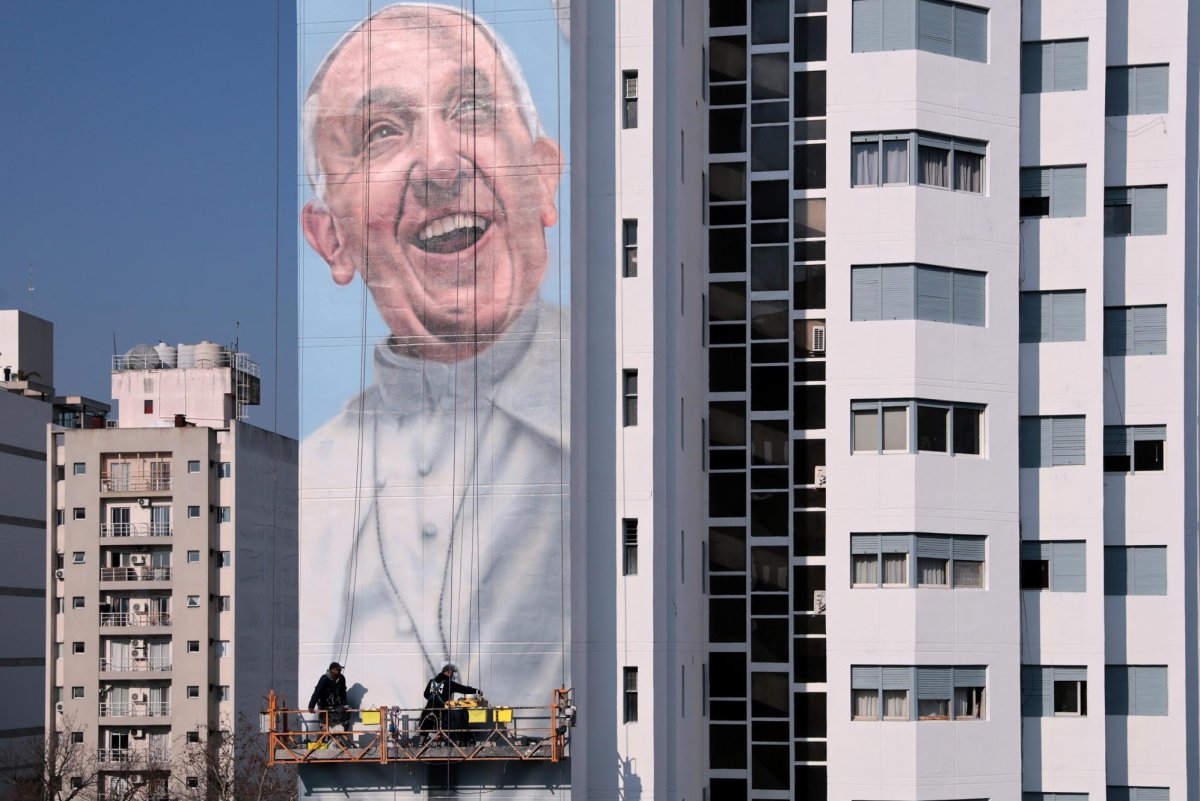
A mural on a multi-storey building depicts Pope Francis, painted by Argentine urban artist Martin Ron in La Plata, Argentina, in July 2025. File Photo by STR/EPA
Aug. 14 (UPI) — For centuries, Catholicism was so deeply woven into Latin American identity that the two sometimes seemed inseparable. That assumption can no longer be made.
The Catholic Church remains the region’s largest religious institution, and Latin America still holds a significant share of the world’s Catholics. But its dominance has declined sharply, even as evangelical and Pentecostal churches have expanded and growing numbers of Latin Americans say they belong to no religion at all.
The shift is changing more than how people worship; it is gradually reshaping the region’s social and political landscape.
Catholicism’s roots in Latin America run deep. Priests accompanied Christopher Columbus on his second voyage in 1493, and religious orders such as the Franciscans, Dominicans and Augustinians later carried out much of the evangelization of the continent.
Some church figures, most famously Bartolomé de las Casas, also defended Indigenous people against abuses committed by colonists. Over the centuries, Catholicism became one of the region’s spiritual foundations, surviving the wars of independence, the secularizing movements of the 19th century and repeated conflicts with governments seeking to curb its influence.
During the 20th century, a new transformation began.
The Second Vatican Council and the rise of liberation theology in the 1960s and 1970s drew parts of the Catholic Church more deeply into questions of poverty and social justice, and some priests and lay Catholics developed close ties to the political left, though the church itself never spoke with a single political voice.
At roughly the same time, Pentecostal and evangelical churches began expanding from what had once been a marginal presence.
Their growth was especially striking in working-class and rural communities, where small congregations could take root almost anywhere. Pastors often came from the communities they served, worship emphasized personal conversion, and many churches held socially conservative positions close to the values of their members.
What began as a religious development eventually acquired political consequences.
Recent Pew Research Center surveys show how much the landscape has changed. Catholic identification has declined substantially in Argentina, Brazil, Chile and Colombia.
But those leaving Catholicism have not all moved in the same direction: some have become Protestants or evangelicals, while many others now identify with no religion at all. In Chile, roughly one-third of adults surveyed in 2024 were religiously unaffiliated.
Latin America, in other words, is not simply becoming less Catholic and more evangelical — it is becoming more religiously plural.
Evangelical churches nonetheless possess one characteristic that makes their growth especially significant politically: organization.
Congregations build networks of pastors and believers that reach deeply into neighborhoods and communities. In Brazil, that organization is the Bancada Evangélica, or Evangelical Parliamentary Front, which numbers roughly 244 federal deputies and senators and has become one of the country’s most influential congressional blocs.
It has played a prominent role in debates over abortion, sexuality, education and religious liberty.
Elsewhere in the region, evangelical voters have become an important constituency in those same debates.
That influence should not be overstated. Evangelicals no more constitute a single political movement than Catholics do. Their views differ according to denomination, country and social background, while collective political mobilization often focuses on a limited number of issues rather than a complete ideological program.
Still, the shift is unmistakable, and it is unfolding against a broader political realignment in which conservative leaders have gained ground across the region. Religion alone does not explain that movement.
Concerns about crime and economic frustration have played major roles, as has dissatisfaction with established political parties. But evangelical communities have increasingly become part of the coalition behind conservative politics in country after country.
Colombia offers the most recent, and most vivid, example. Ahead of the June runoff, the country’s two evangelical political parties, Colombia Justa Libres and MIRA, both endorsed Abelardo de la Espriella, who went on to win the presidency by roughly 250,000 votes.
He courted congregations directly, preaching from the pulpit at megachurches in Bogotá and Cartagena, where one pastor introduced him as the leader Colombia needed in near-biblical terms. When he was sworn in on Aug. 7, the ceremony reflected that alliance. An evangelical pastor led the assembly in prayer alongside a Catholic priest and a rabbi.
It is a pattern already familiar elsewhere in the region where candidates have learned that evangelical congregations offer not just votes, but networks capable of mobilizing them.
This creates an unusual moment for Latin American Christianity. The Catholic Church is not disappearing — it remains an enormous spiritual and social force, and Pope Leo XIV’s pontificate may help shape how it responds to these changes.
Nor is Latin America simply turning evangelical. Secularization is advancing alongside evangelical growth, particularly among younger and more urban populations. What is ending is the old religious monopoly.
For five centuries, Catholicism supplied much of Latin America’s common moral vocabulary. The landscape ahead will be far more contested, as Catholic, evangelical and secular currents compete to shape how the region understands family, community and public life. The political consequences of that competition are only beginning to unfold.
Nibia Pizzo is a Uruguayan psychologist with a master’s degree in management and development of social impact projects. She specializes in severe pathologies and drug misuse. She is the academic director of Legacy of the Americas, a project of the Global Peace Foundation. The views expressed are solely those of the author.
About the Author