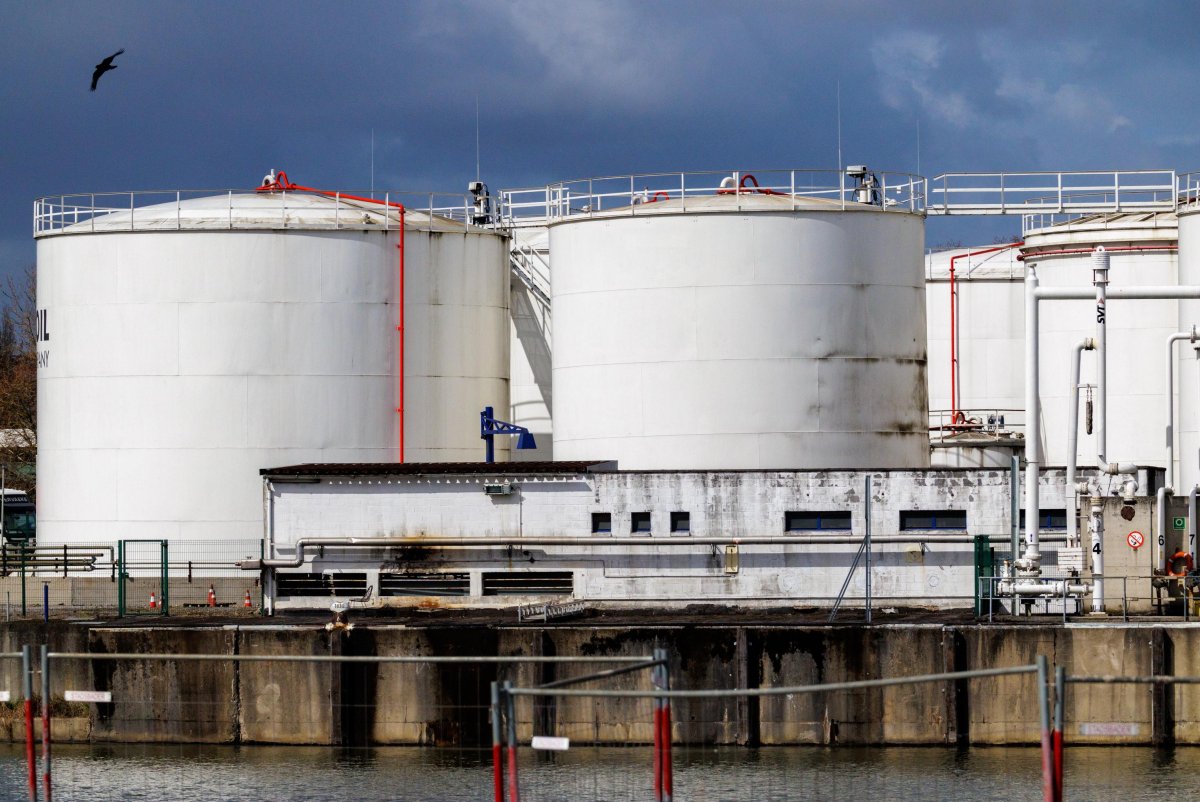
The International Energy Agency warned Wednesday of sharp drop in oil stocks amid renewed disruption to exports from Gulf producers with the Iran war seeing “lower volumes” transiting the seas to markets around the world. File photo by Olivier Matthys/EPA
Aug. 12 (UPI) — The International Energy Agency warned Wednesday of a sharp drop in global oil stocks amid renewed disruption to exports via the Hormuz Strait and Caspian Sea resulting in “lower volumes of oil” transiting the seas to markets around the world.
In its August Oil Market Report, the agency said total measurable global oil inventories — strategic reserves and on tankers at sea — plunged by 69 million barrels to just under 7.9 billion barrels at the end of July, down by 410 million barrels from the start of the war at the end of February.
Onshore stocks declined by just 6 million barrels as the pace of IEA releases of its emergency stocks eased, even as China continued to draw down on its crude oil reserves.
“Although the market is projected to return to surplus towards the end of this year, risks remain substantial and the urgency of reopening the Strait has increased, as previously available inventory buffers are rapidly depleting,” the IEA said.
The IEA data comes two days after the U.S. Department of Energy said the country’s Strategic Petroleum Reserve had fallen to less than 300 million barrels in the previous week, its lowest level in 43 years — but still well above the 70 million barrel minimum for it to run as intended.
President Donald Trump ordered 172 million barrels to be released in March after exports from Gulf producers including Saudi Arabia Kuwait, Bahrain, and the UAE were severely curtailed by Iran closing the Strait of Hormuz.
Use of other routes to move oil and the drawing down of inventories, including China’s massive 1.4 billion barrel reserve which has seen a sharp drop in its oil imports, have so far helped ward off the damaging global oil shortage it was feared the closure of the Hormuz Strait would trigger.
The IEA also warned that the destruction of global demand for oil was escalating, driven by the continuing closure of the Strait of Hormuz and high fuel prices suppressing consumption, forecasting a 1.6 million barrels per day drop in demand in 2026, up from its previous estimate of 1 million barrels per day.
However, it said said the pace of market contraction would slow, down from a 4.9 million barrels per day decline in the second quarter to a 2.8 million barrels per day drop in the third quarter, and return to growth in the final quarter, with expansion of global demand of 2.4 million barrels per day expected in 2027.
On the supply side, the IEA said overall production for 2026 would fall more sharply than demand, but would bounce back to outpace demand in 2027.
Production rose by 2.4 million barrels per day to 101.5 barrels per day in July, but remained well short of the 6.3 million barrels per day supply growth pace seen in July 2025, with 8.3 million barrels per day of Persian Gulf output “still shut in.”
“Renewed hostilities and maritime disruptions in July and early August undermined the recovery efforts, reducing projected third quarter 2026 oil supply by 1.7 million barrels per day compared with last month’s report.
“Global oil supply is now projected to decline by 4.3 million barrels per day on average in 2026 and rebound by 8.3 million barrels per day next year to 110.3 million barrels per day,” the IEA said.
About the Author