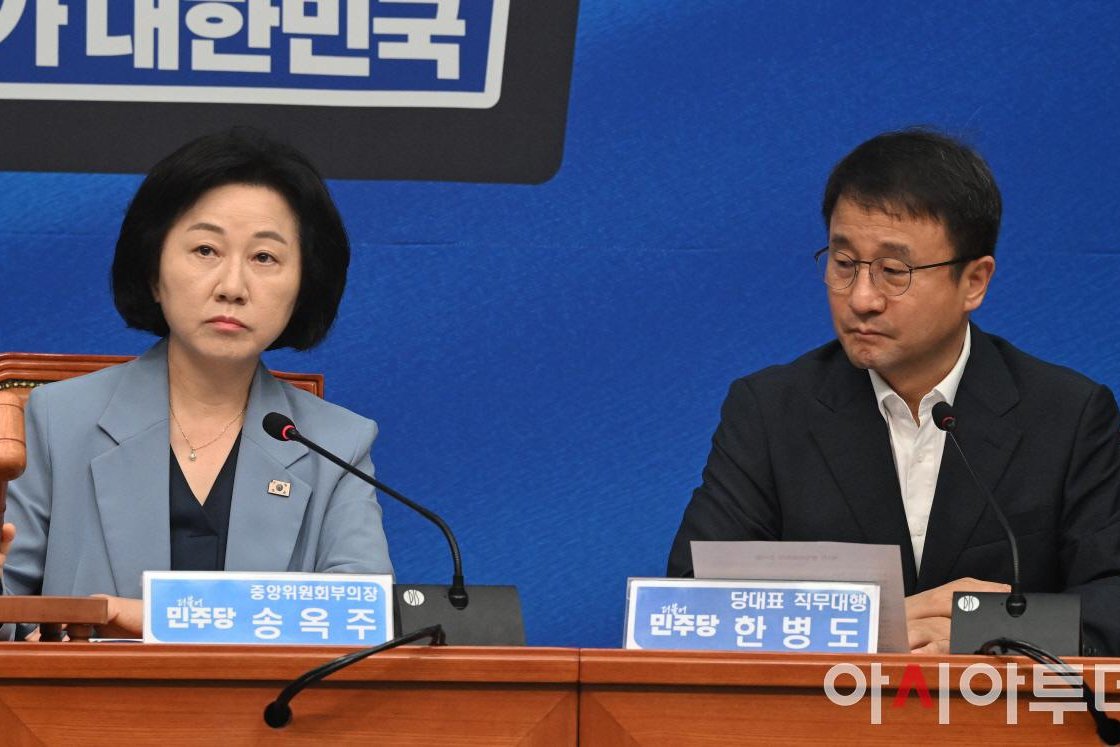
Song Ok-ju, vice chairwoman of the Democratic Party’s Central Committee, bangs the gavel during a Central Committee meeting at the National Assembly in Seoul on Tuesday. Han Byung-do, acting leader and floor leader of the Democratic Party, is at right. Photo by Asia Today
Aug. 11 (Asia Today) — South Korea’s Democratic Party approved revisions to its platform and party charter Tuesday, including language giving historical significance to what the party calls the “Revolution of Light.”
The party’s Central Committee approved two packages of revisions covering its political platform and internal charter.
Of 653 Central Committee members, 465, or 71.21%, participated in the vote.
The platform revision received 456 votes in favor, or 98.06%, while the charter revision received 451 votes, or 96.99%.
The revised preamble to the party platform will include the historical significance of the “Revolution of Light.”
The party uses the term to describe the civic movement that it says defended South Korea’s constitutional system during the Dec. 3 martial law crisis.
The Democratic Party said the revision is intended to carry forward the democratic principles demonstrated by citizens at the time.
The revisions also define “popular sovereignty democracy” as a central goal of the party.
To address issues affecting young people, the platform will guarantee greater youth participation in policymaking and seek to expand their role in decision-making.
The platform also adds policy goals involving balanced regional development, science and technology and education reform as South Korea enters what the party describes as an era of major transformation driven by artificial intelligence.
The revised charter also addresses inconsistent use of the terms “strategic region” and “vulnerable region” within party rules.
It clarifies how strategic regions are designated.
Individual party bodies will conduct their own reviews before the party’s Supreme Council makes a final determination.
The party’s Social Economy Committee will also be renamed the Social Solidarity Economy Committee to reflect international standards and the government’s policy direction.
Additional language governing the election of city and provincial party chairs was revised following the introduction of a one-person, one-vote system.
The charter also allows city and provincial party chairs to handle certain matters after receiving delegated authority from their standing or operating committees.
— Reported by Asia Today; translated by UPI
© Asia Today. Unauthorized reproduction or redistribution prohibited.
About the Author