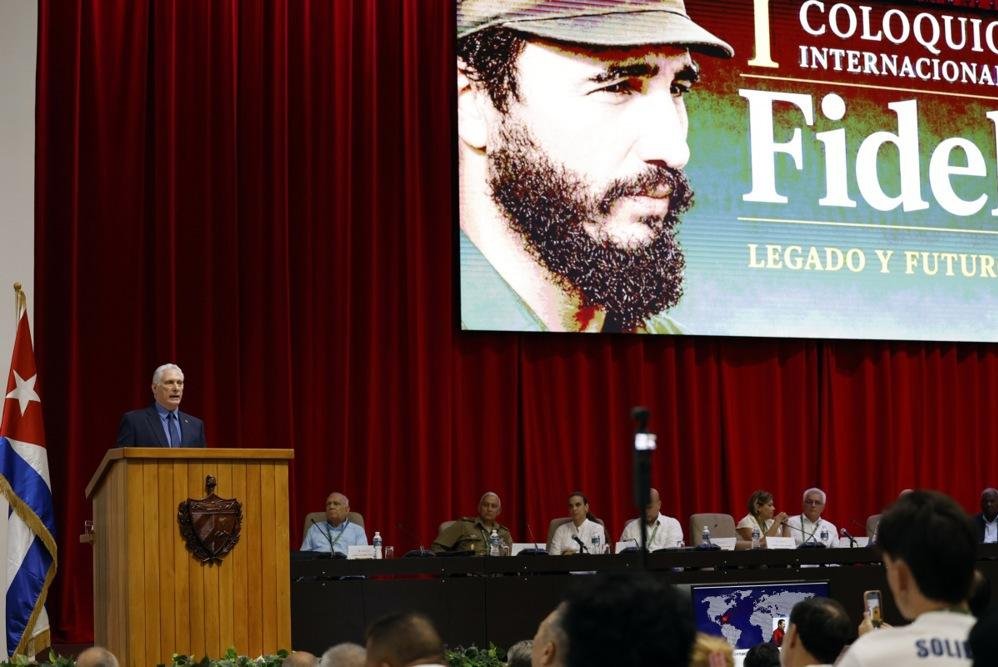
Cuban President Miguel Diaz-Canel speaks during the opening of the 1st International Colloquium “Fidel: Legacy and Future” at Havana Convention Palace in Cuba on Monday. The conference marks the centenary of the birth of Fidel Castro and runs from through Thursday.
Aug. 10 (UPI) — Cuban President Miguel Díaz-Canel accused the United States of waging “psychological warfare” against Cuba and linked recent reports of increased CIA operations on the island to what he described as an attempt by Washington to destabilize the Cuban government.
Díaz-Canel made the remarks Saturday during the closing session of the 24th International Meeting of Communist and Workers’ Parties, held at the Palace of Conventions in Havana.
“We are living through the most dangerous period since the October Crisis,” Díaz-Canel said, using Cuba’s name for the 1962 Cuban Missile Crisis.
He said that, in addition to economic pressure, Cuba is facing a “high-intensity unconventional war” that he said includes “digital subversion,” funding for “internal mercenaries,” media smear campaigns and influence networks.
Díaz-Canel directly linked those accusations to recent reports published by U.S. media outlets about an alleged increase in CIA operations involving Cuba.
“We are not at all surprised by the revelations in recent days by major U.S. media outlets about an increase in CIA operations in Cuba to subvert the internal order,” he said.
“These are not random leaks, as they are being portrayed, but part of the deliberate plan by the U.S. regime to wage psychological warfare against Cuba,” he added.
Díaz-Canel also accused the U.S. government of intensifying military threats and maintaining a policy of “regime change” toward Cuba. He also criticized the island’s continued inclusion on the U.S. list of state sponsors of terrorism.
During the speech, the president cited recent remarks by Secretary of State Marco Rubio about sanctions against Cuba and said Washington is seeking to prevent the Cuban government from finding ways to ease economic pressure.
The remarks come as Cuba faces a prolonged economic and energy crisis that has led to power outages that, according to Díaz-Canel, can exceed 20 hours a day in some parts of the country. The president attributed much of the situation to U.S. sanctions and difficulties importing fuel and other resources.
Díaz-Canel said about 1,400 megawatts of distributed generation capacity remain offline because of a lack of diesel and fuel oil. He said that if the capacity were available every day, power outages could be reduced to about three hours.
The president also described difficulties in Cuba’s healthcare system. According to figures he presented, 98,500 patients are awaiting surgery, including 12,000 children, while only 30% of the country’s basic medicines are available. He also said the technical availability of ambulances stands at 22%.
Díaz-Canel said U.S. sanctions and other measures are intended to increase social discontent to bring about political change in Cuba and called on the communist parties and allied movements gathered in Havana to intensify their opposition to U.S. policy toward the island.
The president also urged those organizations to use digital platforms to counter what he called a “fascist media siege” and a “disinformation machine,” as well as to mobilize parliaments, labor unions and social movements against U.S. sanctions.
About the Author