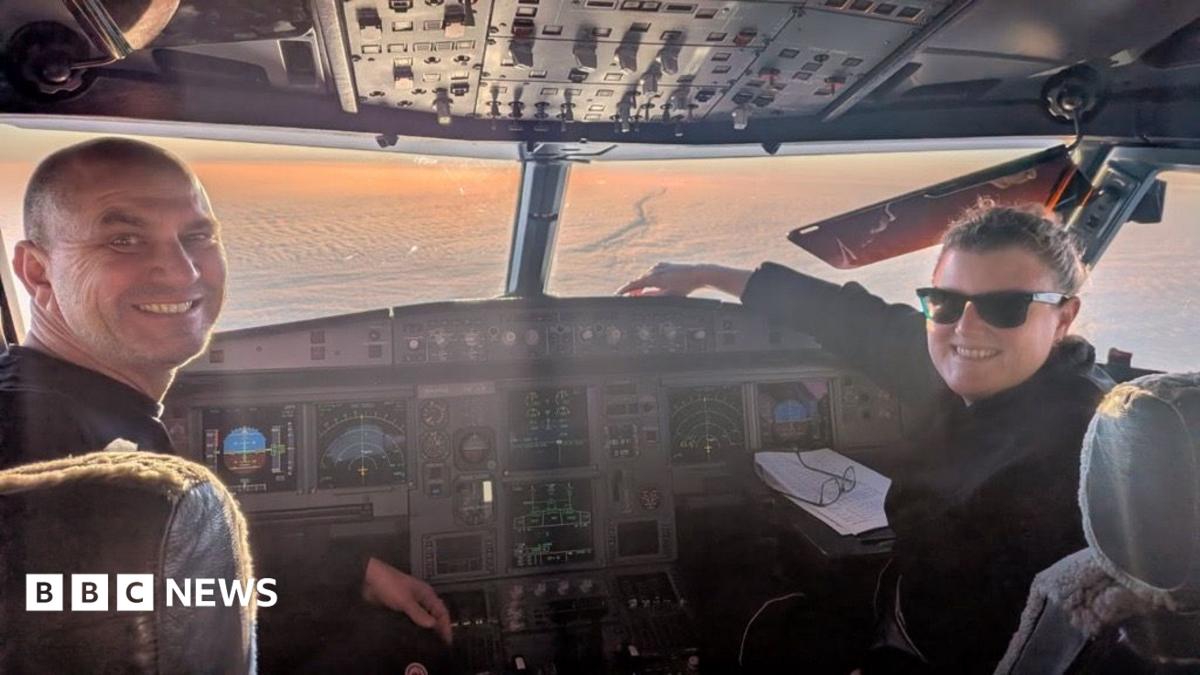
It was a “major operation” for the plane to be correctly configured in time by engineers and a design team, who fitted a stretcher in the back.
The configuration took 24 hours, Robertson said, but takeoff was then delayed for another 12 hours while the crew waited for a suitable window in the weather.
“We had quite a narrow time frame that we could actually fly down to Antarctica because there was a snowstorm on the first day that we were intending to go down which stopped the operation.”
The storm prevented crew at the station from getting to the runway, made of compacted snow, which had to be graded and groomed to make it smooth – a six-hour job.
The plane eventually took off from Hobart in the early hours of Friday morning.
The ground crew “did a phenomenal job to make a 3-km-long runway available for us given the conditions they were also facing, -45C and strong wind,” Robertson said.
The flight crew spent exactly one hour on the ground at Phoenix Airfield before taking off again for Christchurch.
Another pilot on the mission, Captain Al Wallach, said the success reflected the specialist expertise of the team, which included the flight crews, meteorologists, operational planners, runway teams and medical personnel.
“Every Antarctic mission demands absolute precision, but winter operations raise the complexity significantly,” he said. “The conditions we encountered were right on the edge of even the most specialised aircraft capability.”
Emma Campbell, head of the Australian Antarctic Division, said the operation “highlights both the capability of our people and the strong partnerships that underpin Antarctic programmes around the world”.
Skytraders carried out a similar mission in March 2020, when the US requested help evacuating a member of the US Antarctic Program also based in McMurdo, although temperatures were slightly warmer at -30°C.
About the Author