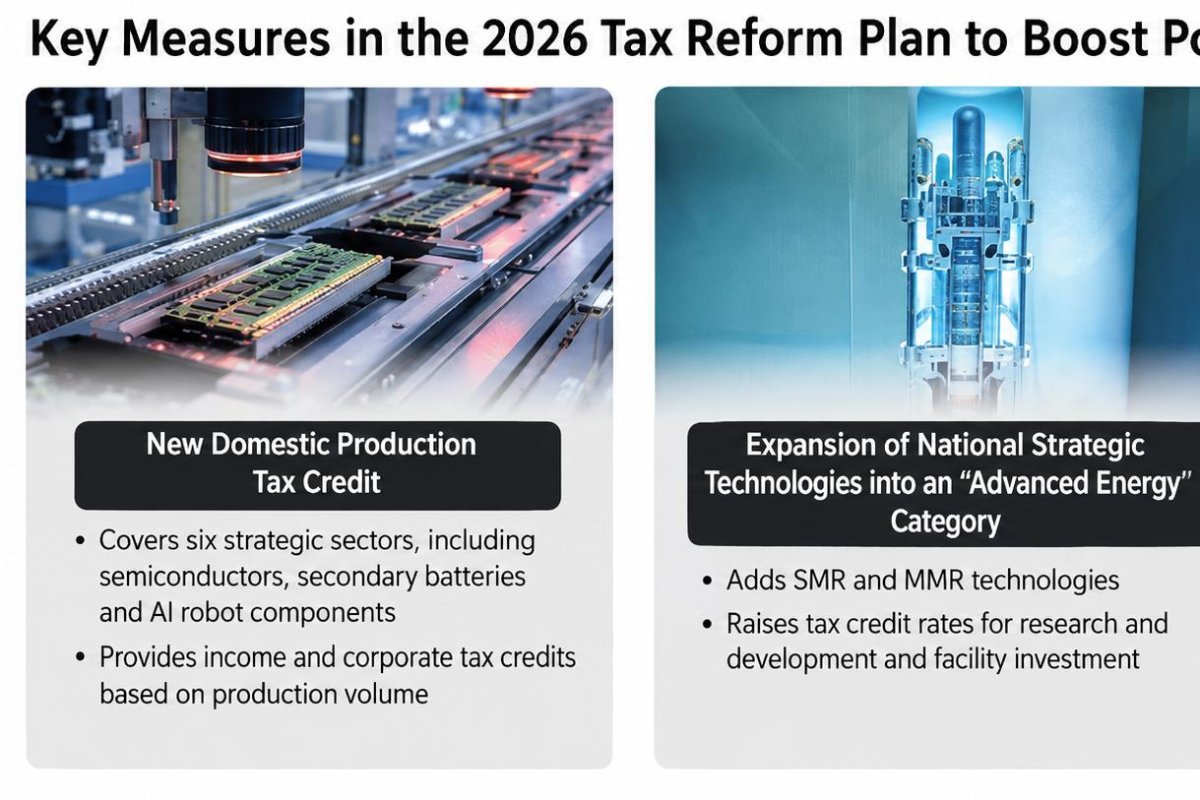
An infographic outlines key measures in South Korea’s 2026 tax reform plan, including a domestic production tax credit, expanded incentives for advanced energy technologies and a tax-advantaged investment account. Data from Courtesy of the Ministry of Finance and Economy. Graphic by Asia Today and translated by UPI
Aug. 3 (Asia Today) — South Korea plans to introduce tax credits for domestic production and create a tax-advantaged investment account as part of its efforts to revive the country’s potential economic growth rate.
The government will provide production-based tax credits to six strategically important sectors, including secondary batteries, semiconductors and components for artificial intelligence-powered robots, the Ministry of Finance and Economy said Monday.
The credit will be calculated by multiplying the volume of qualifying products manufactured and sold by a standard credit amount.
Only products directly manufactured and sold in South Korea by domestic taxpayers will qualify.
The government also plans to provide larger benefits for production outside the Seoul metropolitan area.
The standard credit amount will be multiplied by a regional adjustment factor, with companies operating in designated areas outside Seoul, Gyeonggi Province and Incheon eligible for credits of up to 1.5 times the standard amount.
Officials said the policy is intended to support the domestic production of critical components and strengthen the competitiveness of industries that depend on them.
Deputy Prime Minister and Minister of Finance and Economy Koo Yun Cheol said support for key components could improve the competitiveness of entire industries.
“In the case of electric vehicles, for example, tax support for essential components such as secondary batteries can create a structure that strengthens the competitiveness of the electric vehicle industry,” Koo said.
The government will also expand its list of national strategic technologies eligible for enhanced research and investment tax credits.
The current hydrogen technology category will be reorganized as a broader advanced energy category that includes small modular reactors and micro modular reactors.
Qualifying research and development spending will be eligible for tax credits of up to 50%, while investments in related facilities will qualify for credits of up to 30%.
The government said the reactor technologies are important for improving energy security and meeting future electricity demand.
Details of the products, technologies and facilities covered by the domestic production credit and national strategic technology program are expected to be included in a scheduled revision of the Enforcement Decree of the Restriction of Special Taxation Act in February 2027.
The government also plans to introduce a Productive Finance Individual Savings Account to encourage long-term investment in South Korean companies and capital markets.
The account will allow investments in domestic stocks, the National Growth Fund and business development companies.
Interest and dividend income earned through the account will be fully exempt from tax.
The account will be available through 2029 and will have a total contribution limit of 200 million won ($139,800), twice the limit applied to standard individual savings accounts.
A separate account for people younger than 34 with annual employment income of no more than 75 million won ($52,400) will also provide an income tax deduction equal to 10% of contributions.
Koo said the account would concentrate tax benefits on long-term investment in the domestic market.
“We will encourage market funds to flow into productive sectors of our economy by introducing a Productive Finance ISA that provides focused benefits for long-term domestic investment,” Koo said.
“The youth account will also provide an income deduction equal to 10% of contributions to ease the financial burden on young people and support their asset building.”
— Reported by Asia Today; translated by UPI
© Asia Today. Unauthorized reproduction or redistribution prohibited.
About the Author