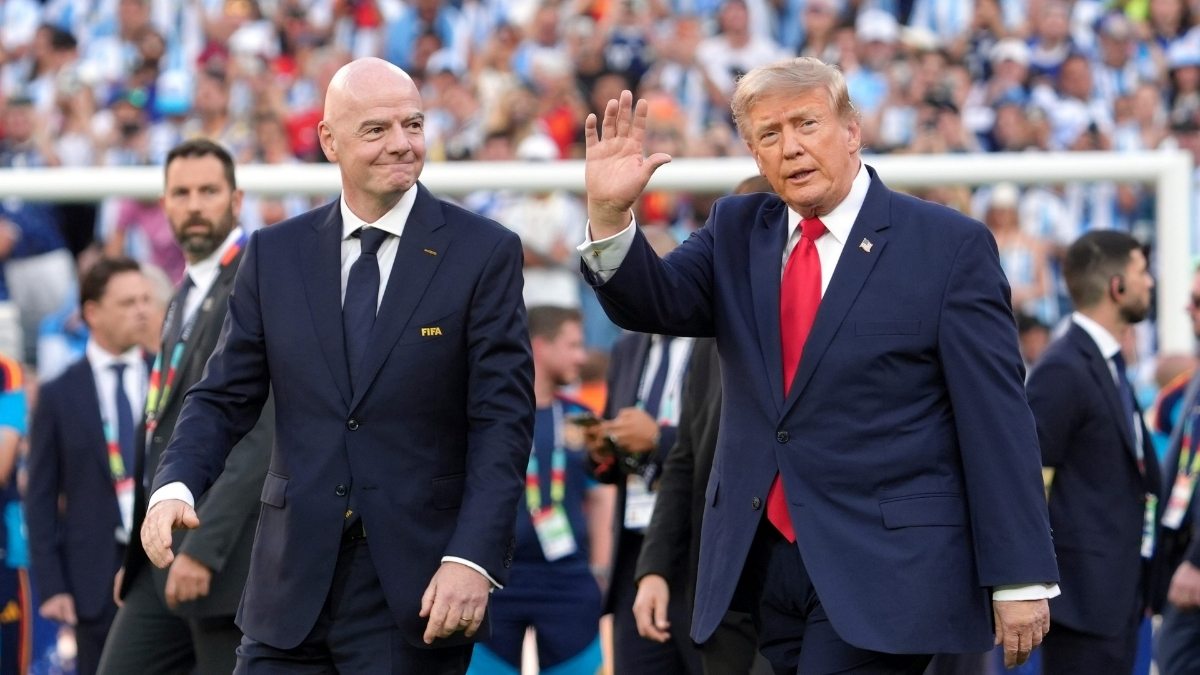
FIFA president Gianni Infantino has abandoned his controversial proposal to bring private investors into FIFA’s commercial operations, less than a week after unveiling the plan and following unprecedented opposition from football’s governing bodies, member associations and senior FIFA officials.
The decision ends one of the biggest governance crises in FIFA’s recent history and leaves fresh questions over Infantino’s leadership ahead of the FIFA presidential election in March 2027.
Here’s everything you need to know.
What was FIFA’s proposal?
FIFA wanted to create a new commercial subsidiary called FIFA Forward Enterprise (FFE), which would manage the governing body’s commercial rights, including:
- Men’s and Women’s World Cups
- Broadcasting rights
- Sponsorships
- Ticketing
- Hospitality
- Licensing
- Tournament operations
FIFA planned to sell minority, non-controlling stakes in the new company to outside investors.
The proposal was valued at around $20 billion, with FIFA hoping to raise approximately $4.2 billion in external investment.
American venture capital firm Thrive Eternal, founded by Joshua Kushner, was expected to lead the investor group, while JP Morgan acted as financial adviser.
Why did FIFA say it wanted private investment?
Infantino argued the proposal would generate significantly higher revenues for football development worldwide.
Under the plan:
- Every one of FIFA’s 211 member associations would receive $20 million in FIFA Forward funding between 2027 and 2030.
- Associations could also voluntarily access another $20 million through the proposed FIFA Fast Forward Programme.
- FIFA projected development funding would eventually increase to $24 million per association by the 2035-39 cycle.
Infantino insisted FIFA would retain complete control over governance, competitions and sporting decisions.
Why was the proposal controversial?
Critics argued that even minority private ownership would fundamentally change how FIFA competitions are run.
The biggest concerns included:
- Investor pressure to maximise profits.
- Expansion of tournaments to generate greater revenues.
- Increased fixture congestion.
- Commercial interests outweighing sporting considerations.
- Loss of independence in football governance.
A leaked 25-page JP Morgan presentation intensified those concerns.
According to reports, the document outlined future growth through:
- More tournaments.
- Higher ticket prices.
- Debt financing.
- Expanded commercial partnerships.
- Greater monetisation of media rights.
The document also reportedly referenced increasing FIFA’s global tournaments from around 200 annually to roughly 450.
Critics also noted there was no mention of the women’s game in the sales material.
Why did UEFA oppose it?
UEFA led the resistance.
Its 55 member associations unanimously rejected the proposal, stating:
- “The World Cup is not for sale.”
- “Football cannot mortgage its future.”
- “Governance by intimidation.”
UEFA argued football’s biggest competitions belong to supporters and future generations rather than investors seeking financial returns.
The organisation warned that every future decision on competition formats and calendars would inevitably be influenced by shareholder expectations.
Which football bodies opposed FIFA?
By Friday, opposition had spread across much of world football.
UEFA (55 members)
- Unanimously rejected the proposal.
- Threatened to boycott FIFA competitions unless it was abandoned entirely.
CONCACAF (41 members)
- Officially rejected the proposal.
Asian Football Confederation (46 members)
- Declared solidarity with UEFA and CONCACAF.
CONMEBOL
- Requested further clarification and additional information rather than immediately backing the proposal.
CAF and OFC
- Planned further discussions but had not formally adopted a position before FIFA withdrew the proposal.
Had UEFA, CONCACAF and AFC members voted together, FIFA would likely have fallen well short of the required majority among its 211 member associations.
Internal FIFA opposition
The backlash was not limited to external stakeholders.
Carlos Cordeiro, one of Infantino’s senior advisers, resigned over the proposal, describing it as:
“A bad deal for football” and “one that would “mortgage football’s future.”
FIFA chief operating officer Kevin Lamour also publicly criticised the project, saying even FIFA’s own administration had been “deceived” and describing it as “the project of one person.”
Those public interventions significantly increased pressure on Infantino.
Why did Infantino withdraw the plan?
In a statement released on Saturday, Infantino acknowledged the proposal had become too divisive.
He said:
Statement attributable to the FIFA President
The FIFA Forward Enterprise project was intended to provide a basis for further strengthening our FIFA Member Associations and our sport worldwide, especially in those countries where support is most needed. And more so, as we said…
— FIFA Media (@fifamedia) July 31, 2026 ">
"Having listened carefully to all the views, it has become clear that the project has created divisions of a nature that, regardless of the level of support, are no longer in the interest of the objective set out in the first place."
He added:
"Our purpose has always been - and will always be - to unite and improve."
Infantino confirmed:
"As a result, this proposal will not proceed."
He also said FIFA would instead work to reunite stakeholders and continue discussions on growing football globally, particularly in countries requiring greater financial support.
What happens next?
While the proposal has been abandoned, the political fallout remains.
Infantino had previously been expected to seek re-election unopposed at the FIFA Congress in Morocco in March 2027.
However, this episode has raised fresh uncertainty over his future after:
- Widespread opposition from three major confederations.
- Public criticism from senior FIFA executives.
- The resignation of one of his closest advisers.
- Questions over FIFA's consultation process and governance.
Although the investment plan has been withdrawn, the events surrounding it are likely to dominate discussions ahead of FIFA's next presidential election.
Story first published: Saturday, August 1, 2026, 8:55 [IST]
About the Author